

Hotel furniture logistics providers are often compared under one broad service label, even though their proposed responsibilities may begin and end at very different points. One provider may arrange collection and international freight. Another may receive, store, deliver and install at destination. A furniture manufacturer may support packing and export documents without contracting the later logistics legs.
A useful provider comparison therefore starts by naming the role, each physical and information interface, and the evidence that proves who owns the next decision. The aim is not to find a company that claims to “handle everything.” It is to make sure the required scope is covered once, with no hidden gap and no duplicated responsibility.

Start with the provider role, not the company label
Current search results for hotel furniture logistics providers mix freight forwarders, destination FF&E specialists, furniture suppliers and end-to-end coordinators. Those categories are not automatically better or worse; they solve different parts of the programme. Define the required role before requesting a quotation.
| Provider role | Typical focus to confirm | Boundary to expose |
|---|---|---|
| Manufacturer-coordinated support | Furniture release data, packaging, project coding, export documents and handoff to the appointed carrier | Who contracts freight, customs services, destination storage and final mile? |
| International freight lead | Origin collection, carriage planning, transport documents and coordination across freight legs | Who understands item-level furniture handling, site phases and room-package identity? |
| Destination FF&E specialist | Receiving, condition records, storage, delivery windows, room or zone distribution and possible installation | Who controls the origin handoff, international movement and trade-document interface? |
| Lead logistics coordinator | One control point across appointed origin, freight, customs, warehouse, final-mile and installation parties | Which work is self-performed, subcontracted, coordinated only or specifically excluded? |
The decisive word is confirm. A role description does not prove that the proposed entity contracts, performs or accepts responsibility for every listed activity. Ask for the contracting entity, named partners, reporting route and exclusions for the live project.

Map three responsibility zones before requesting quotes
International hotel furniture logistics becomes easier to compare when the route is divided into three zones. The exact physical points will differ, but the topology remains useful.
- Origin interface: release status, item identity, quantity, packaging basis, labels, loading information, collection point and transfer of custody.
- International movement and trade interface: carriage bookings, transport documents, insurance arrangements where applicable, export and import coordination, carrier changes, milestone reporting and exception escalation.
- Destination and final-mile interface: arrival notice, receiving, condition and quantity record, storage, delivery sequencing, access planning, unpacking, room or zone distribution, assembly, installation and waste removal as separately agreed.
For each interface, complete four fields: Own names the party contractually responsible for the result; Coordinate names the party managing information between others; Evidence defines the record required at completion; and Excluded states work that another party must provide. Avoid a blank cell. “By others” is only useful when those others are named.
Gainwell’s capabilities workflow describes packaging engineering, project coding, export coordination and installation support. It also makes the project boundary explicit: the current scope, production location, programme and delivery responsibilities must be reconfirmed. Apply the same discipline to every proposed provider.
Make the factory-to-provider data handoff visible
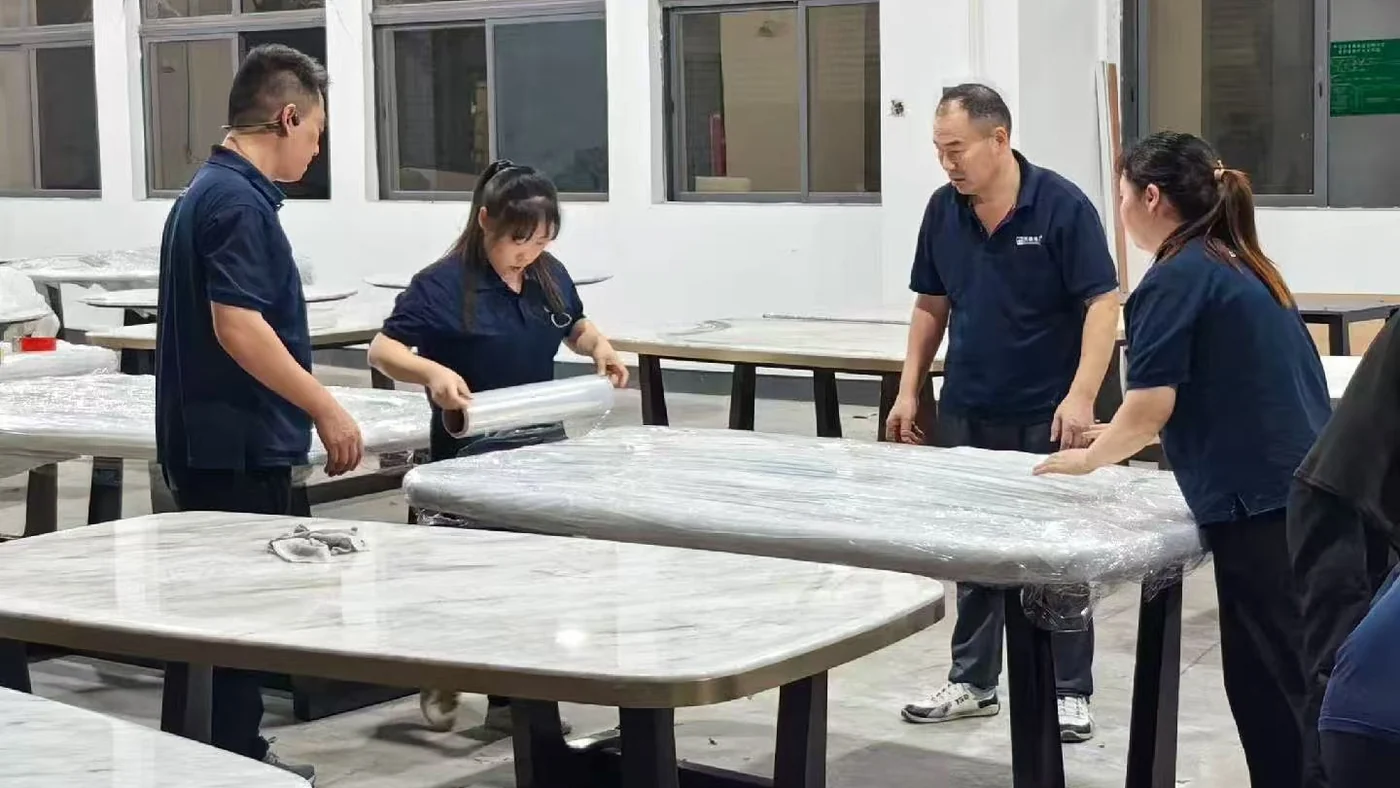
A logistics provider cannot preserve furniture identity if the origin team hands over only a carton count. The provider brief should state the data pack that must accompany each furniture batch:
- project, building, floor, room type or destination-zone code;
- furniture item code, current revision, quantity and package sequence;
- dimensions, mass and orientation information where required for handling and route planning;
- visible-surface risks, packaging method, lifting or stacking restrictions and loose accessories;
- release authority, open accepted conditions and the record that identifies the transferred batch;
- collection point, receiving point, contacts, required notices and evidence at the custody change.
Do not confuse “coordinating” the handoff with owning its contents. The manufacturer may define item identity and packaging information; the provider may verify that the agreed data has been received and remains searchable. The responsibility map should show who corrects a mismatch before the goods move.

Test the scope against the actual hotel destination
A quotation that ends at “delivery to hotel” is not yet specific enough. Test the proposed endpoint against the site. Is delivery to a vehicle-access point, a loading dock, a temporary warehouse, a floor staging area, the correct room or the installed position? Who unloads, opens packaging, records condition, moves items through lifts and corridors, assembles components and removes debris?
Furniture form matters. An upholstered lounge chair, long table, fragile mixed-material casegood and room package may require different handling, protection and destination coding. Ask the provider to explain the planned evidence and responsible party for the actual item mix without demanding an unsupported promise of zero damage or a universal transit time.

Room-package identity adds another test. If a guestroom shipment is split between vehicles, storage areas or delivery waves, can the provider still show where every required item is located and which revision it belongs to? The answer should be visible in a sample report, not only described in a sales presentation.

Keep the installation boundary separate. Gainwell’s hotel furniture installation guide treats site readiness, assembly, placement, inspection and handover as controlled work. Final-mile delivery does not automatically include those activities; the proposal must say where logistics ends and installation begins.
Request evidence before accepting a broad capability claim
Marketing language can identify a service category, but appointment needs current evidence matched to the proposed route and furniture scope. A practical request may include:
- a responsibility and contact chart naming the contracting provider and any partners;
- a redacted example of item-, package-, location- and exception-level reporting;
- the proposed origin, freight, customs-coordination, warehouse and final-mile operating model;
- receiving, condition-recording, storage-segregation and controlled-release methods;
- a furniture-specific handling brief showing how item form becomes protection, orientation and route instructions;
- the escalation route for a missing document, quantity mismatch, damaged package or unavailable site phase;
- current project-specific commercial evidence, insurance information, licences or registrations where required for the role and jurisdiction.
Evidence should answer a decision, not merely increase the document count. A network map is useful when it identifies who performs each leg. A dashboard is useful when its fields connect to furniture and destination codes. A case study is useful only after the team confirms that its route, service boundary and project conditions are relevant.

Normalize proposals on one evidence-backed scorecard
Gainwell’s hotel furniture procurement guide separates packaging, labeling, documentation, freight basis and installation-support inclusions so bidders can be compared on the same basis. Use the same principle for the provider appointment. First normalize scope; then evaluate price and value.
| Comparison line | Evidence to compare | Warning sign |
|---|---|---|
| Scope fit | Completed three-zone map with Own, Coordinate, Evidence and Excluded fields | “End to end” appears without named physical endpoints or excluded work |
| Furniture handling | Method for dimensions, surfaces, orientation, accessories, packaging and destination coding | Every item is treated as generic cargo |
| Control method | Milestones, notices, acceptance evidence, issue states and escalation authority | Reporting shows only a transport location or estimated arrival |
| Network accountability | Contracting entity, performing partners, contacts and responsibility at each leg | Subcontracted work is visible only after appointment |
| Commercial clarity | Common quantity and route basis, inclusions, exclusions, assumptions and change method | The lowest total depends on unstated site or third-party inputs |
| Project evidence | Relevant methods, redacted records and current project-specific documents | Experience claims replace route- and scope-specific evidence |
Do not hide a critical gap inside a weighted total. A high overall score cannot compensate for an unnamed importer, an uncovered final mile or an installation assumption that changes the physical endpoint. Keep mandatory conditions visible beside the score.
Run four scenarios before appointment
Ask each shortlisted provider to walk through the same four situations. The purpose is not to demand a perfect prediction. It is to see whether the proposed responsibility structure still produces a named decision and usable evidence.
- Origin release changes: one furniture code is held while the rest of the batch is ready. Who receives the status, changes the collection basis and protects the document trail?
- Trade document query: a required detail is challenged before clearance. Who owns the response, who supplies product information and how is the revised record controlled?
- Destination is not ready: the planned receiving phase cannot accept the furniture. Who can authorize a hold, diversion or new window, and which costs or risks require separate commercial approval?
- Room package is incomplete: receiving identifies a missing or visibly affected item. Who records it, preserves package identity, assigns the next action and updates the destination plan?
The appointed provider need not personally perform every action. It must make its own role, coordination duty, evidence and escalation boundary clear. After appointment, the active control method belongs in a shipment plan; Gainwell’s separate FF&E logistics guide covers that execution stage.
Keep Incoterms in their proper role
An Incoterms rule can be an important part of the commercial baseline. The International Chamber of Commerce explains that the rules allocate specified obligations, risks and costs between seller and buyer when incorporated with a named place and edition. ICC also states that they are not a substitute for the sale contract and do not govern every surrounding contract.
For provider comparison, that means a trade term cannot replace the three-zone map. It does not by itself name the warehouse operator, define hotel access, create item-level reporting, confirm installation, allocate every customs task or settle remedies. Record the applicable commercial term exactly where the responsible advisers and parties confirm it, then continue defining the operational interfaces separately.
Make the appointment decision against visible conditions
End the comparison with one of three decisions:
- APPOINT: required interfaces are covered, contracting and performing parties are known, evidence is adequate for the current stage, and exclusions have an accepted owner.
- APPOINT WITH CONDITIONS: the core role is suitable, but named documents, partners, route details or responsibility gaps must close by a defined date and authority before the affected work proceeds.
- DO NOT APPOINT YET: a critical interface has no owner, competing proposals remain incomparable, or the missing evidence could materially change scope, responsibility or the commercial basis.
This method does not select a carrier, broker, trade term or insurance arrangement for the project. Exact entities, routes, licences, customs requirements, rates, dates, liabilities and acceptance criteria depend on the contract and jurisdiction. To discuss the furniture-side inputs, share the current item schedule, origin and destination points, shipment phases, site constraints and proposed responsibility map through the Gainwell project enquiry.
Frequently Asked Questions
What does a hotel furniture logistics provider do?
The role can include some combination of origin collection, freight coordination, transport documents, customs coordination, receiving, storage, final-mile delivery, room distribution and installation support. The label alone does not define the scope. Confirm the physical start and end points, contracting entity, partners, evidence and exclusions for the live project.
Do you need one provider from the furniture factory to the hotel?
Not necessarily. A project can use several specialist providers if every interface has one owner and the information, custody and escalation routes connect. A lead coordinator may reduce communication paths, but the team must still distinguish work that is self-performed, subcontracted, coordinated or excluded.
What should be included in a hotel furniture logistics quote?
Use a common basis covering origin and destination points, furniture and package quantities, route assumptions, handling, labeling, documents, freight legs, customs-coordination scope, storage, final mile, installation boundary, reporting, exclusions, change method and the evidence required at each handoff. Separate allowances and unresolved inputs from fixed inclusions.
How do you compare international hotel furniture logistics providers?
Map the same three responsibility zones for every provider, require Own, Coordinate, Evidence and Excluded fields, then compare scope fit, furniture handling, control method, network accountability, reporting and commercial clarity. Test shortlisted providers against the same change, document, destination and room-package scenarios.
Who is responsible for customs, warehousing, final-mile delivery and installation?
There is no universal answer. The sale contract, provider contracts and project responsibility matrix must name the parties. A provider may coordinate an activity without contracting or performing it. Installation should also be separated from delivery unless assembly, placement, inspection, handover and related site work are expressly included.
Do Incoterms define the entire logistics-provider scope?
No. Incoterms rules address specified seller-and-buyer obligations, risks and costs when properly incorporated, but they do not replace the sale contract or every provider agreement. Hotel access, warehousing operations, item-level reporting, room distribution, installation and many acceptance or remedy questions still need explicit project provisions.