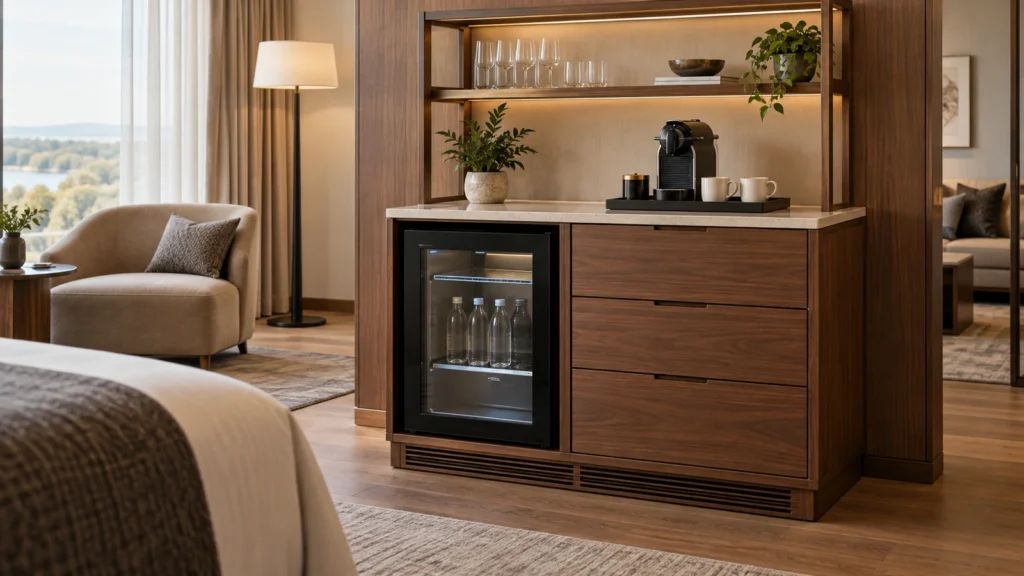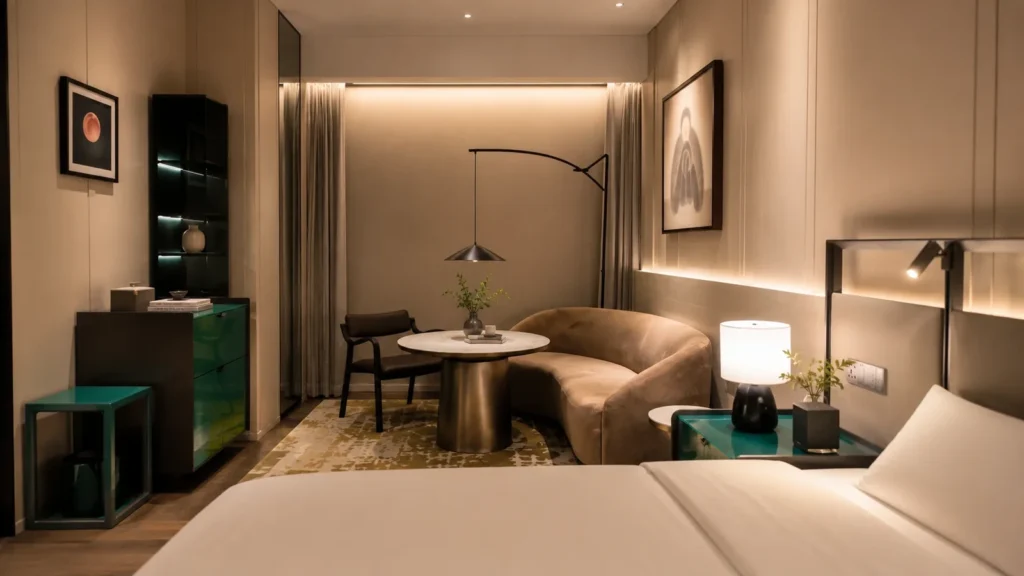

“Outdoor fabric” is not a complete hotel furniture specification. It may describe a removable cushion cover, fixed upholstery, a loose pillow, a liner, or a tensioned mesh panel that helps support the user. Those systems expose different components to water, sunlight, cleaning, movement and replacement. Treating them as one material label hides the interfaces where failures are most difficult to diagnose.
A project-ready brief should therefore control the complete outdoor soft-surface assembly. Classify the architecture, identify every component and revision, map exposure through seams and edges, verify product-specific evidence, inspect a representative sample in defined dry and wet states, and record how the operator will clean, remove, store and replace each unit. Keep the status at HOLD while any controlling input is missing or contradictory.
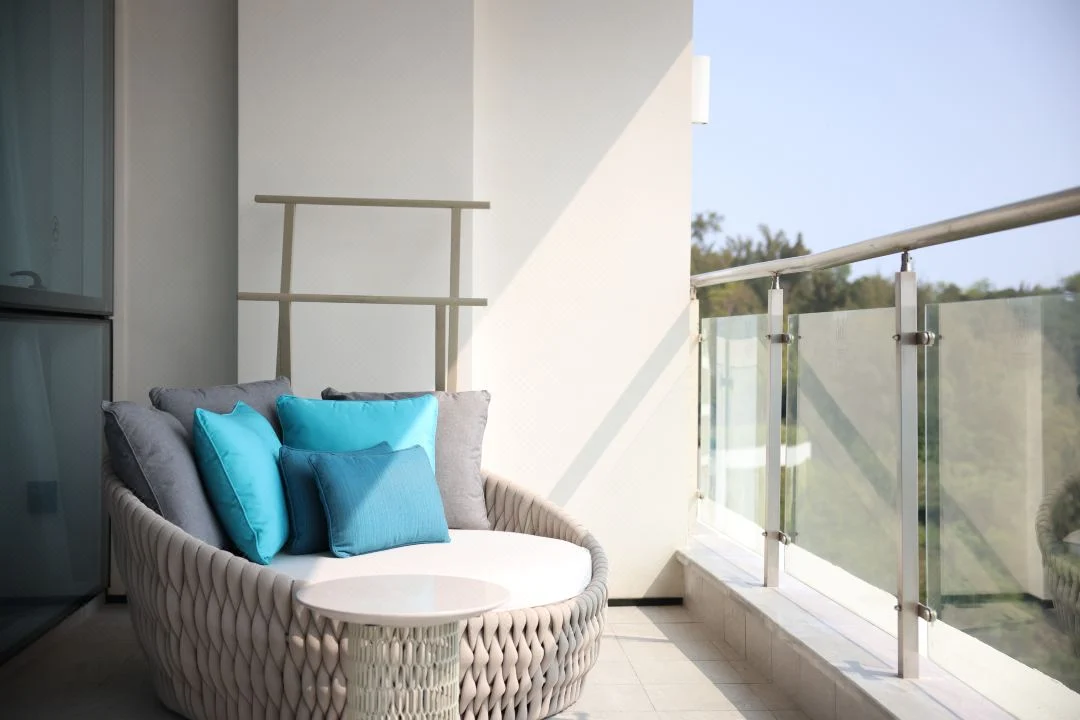
Classify the soft-surface architecture first
Begin with the furniture drawing, not a generic swatch. Mark which elements carry load, which add comfort, which keep their shape, and which can be removed without changing the frame. A textile selected for a loose cushion cover is not automatically appropriate as a tensioned seating panel. Likewise, a mesh offered for a specific sling construction should not be substituted into a different edge detail without coordinated evidence and a representative sample.
| Architecture | Components to identify | Prototype focus | Replacement unit |
|---|---|---|---|
| Removable cushion | Cover textile, thread, zipper, liner, insert, retention detail and furniture base | Fit, seam and zipper position, water path, comfort state, retention and removal | Cover, insert or complete cushion—state which |
| Fixed outdoor upholstery | Cover, sewing method, pad or foam, substrate, underside closure and fixings | Edge finish, trapped-water points, cleanability and authorized service access | Defined upholstered subassembly |
| Tensioned sling or mesh | Exact mesh, orientation, edge construction, spline or fastener, rail and frame | Installed tension state, perimeter capture, contact points and frame geometry | Panel plus required compatible edge parts |
| Loose decorative element | Cover, insert, trim, closure, tether if any and storage location | Appearance, removal, care, wind-management plan and reset responsibility | Complete identified loose element |
The list is a coordination framework, not a catalogue of approved constructions. The supplier and project team still need to name the exact proposed product, composition, finish, backing or coating, colour, lot or control sample, intended application and required evidence.
Map exposure and water through the assembly
Do not reduce exposure to a single indoor/outdoor checkbox. One hotel may have fully uncovered loungers, covered balconies, pool-splash zones, shaded dining, wind-driven rain at open pavilions, periodic washdown and seasonal storage. Record the conditions supplied by the project for each furniture family, together with who owns the assumption. Sun direction, rainfall, salt, chemicals, food and beverage, cleaning method and closure periods can change the review, but they should not be guessed from a photograph or city name.
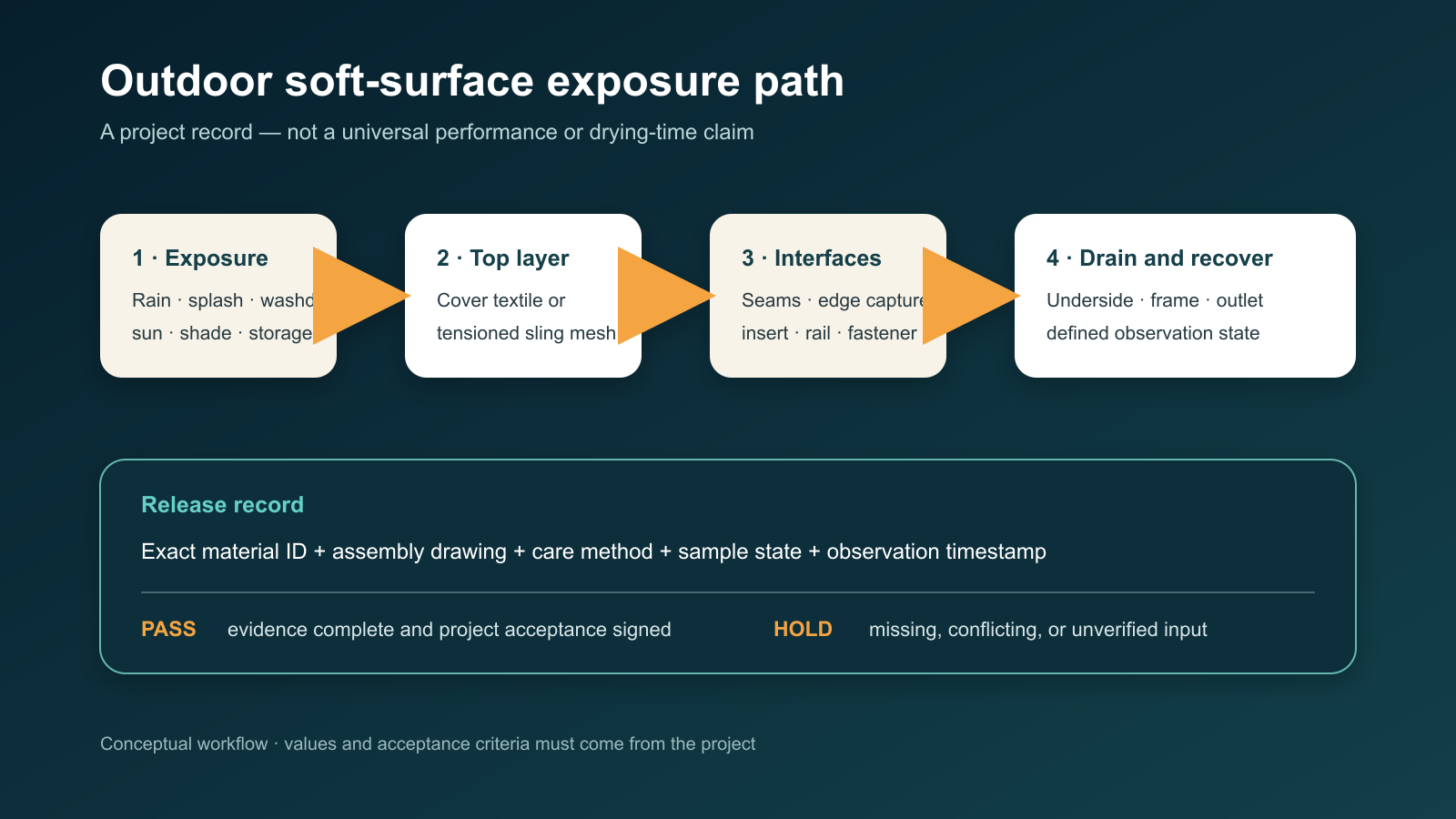
Then trace a water path: source of wetting → top textile or mesh → seams, perforations or openings → liner and insert → underside → furniture base or frame → drain and dry route. For a cushion, ask whether water can enter at seams or a zipper, whether the insert and liner are specified as one controlled set, and whether the base blocks the intended outlet. For a sling panel, inspect whether openings shed water yet retain soil at the edge, rail or fastener interface. “Water-resistant fabric” cannot answer those assembly questions by itself.
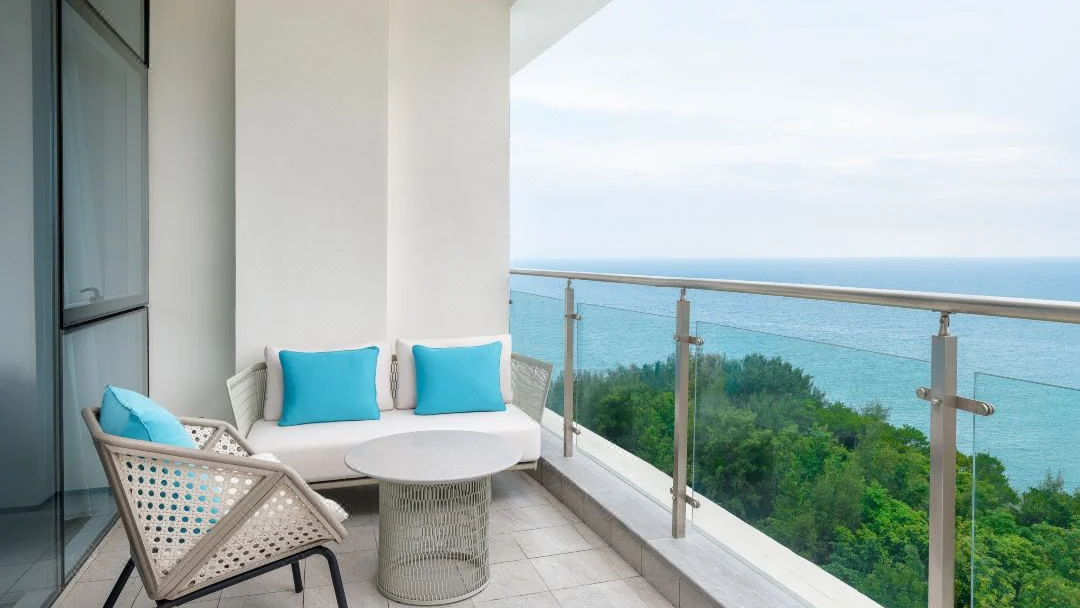
Match evidence to the exact construction and claim
The Association for Contract Textiles explains that construction—woven, coated or knit—must be considered with intended application and indoor or outdoor use when selecting an applicable voluntary guideline. It also notes that laboratory methods represent controlled conditions and minimum requirements, not every project law or use condition. That is a useful discipline for an outdoor furniture fabric schedule: record the product and construction that were actually tested, the method and edition, specimen description, test conditions, result, issuing party and date.
Keep each result inside its scope. ISO 105-B04:2024 describes an artificial-weathering method focused on colour response of textiles under xenon-arc exposure and can address sensitivity to combined light and water. It does not, by itself, prove the drainage of a cushion, the strength of an installed sling, a cleaning outcome or a service life. ASTM G154-23 governs operation of fluorescent ultraviolet and water apparatus; the standard states that the practice alone does not deliver a specific result and that the exposure and evaluation conditions must be defined. It also excludes some localized weather phenomena from its simulation.
Build a claim-to-evidence row for every statement that matters: claim, exact product and colour, assembly application, evidence document, test conditions, pass criterion supplied by the project, reviewer, date and decision. A marketing phrase such as “UV resistant,” “all weather,” “quick drying” or “commercial grade” remains orientation until the project receives evidence whose scope matches the proposed item and use.
Prototype cushion upholstery as a water-handling system
A cushion mock-up should use the proposed cover, thread, seams, zipper or closure, liner, insert, dimensions, base and retention detail. Review it in the actual orientation. A swatch cannot reveal how the cover fits after the insert is loaded, whether piping creates a low point, whether a zipper rests against the guest or weather side, or whether the furniture base obstructs the underside.
Define the cushion states before observation. “Dry” might mean the conditioned starting state recorded by the reviewer. “Wet” needs a named source and procedure supplied or approved for the project—not an improvised spray whose amount is unknown. Record surface, seams, closure, insert, underside, base and nearby frame at each checkpoint. If the project requires a measurable acceptance criterion, cite its source and method. Do not create a universal number for drying time or retained water.

Treat sling mesh as a load-path and edge-interface system
Outdoor furniture fabric for a sling chair is not simply upholstery stretched tighter. In a typical sling architecture, the textile or mesh participates in supporting the seated load and transfers forces through sewn or formed edges into rails, splines, fasteners and the frame. A current manufacturer example, Phifer’s outdoor sling range, identifies product-specific vinyl-coated polyester mesh constructions and emphasizes dimensional stability for the intended sling application. That description is evidence for those named products, not a universal composition or approval for another mesh.
The prototype review should name orientation, cut pattern, edge build-up, seam or pocket, spline or rod, rail geometry, fastener sequence, installed tension state and frame revision. Observe the perimeter at curves and transitions, contact between the panel and hard parts, surface appearance in the occupied and unloaded states, and whether removal can occur without damaging the frame. Structural adequacy, load tests and acceptance criteria belong to the responsible project professionals and cited requirements.
Use a wet-state recovery observation card
A short observation card makes sample comments reproducible. Start with the exact furniture item, material IDs, sample revision, location and conditioned starting state. Record the wetting source or approved procedure, start time and relevant conditions. At each project-defined checkpoint, note visible surface water, colour or appearance change, seam and edge condition, underside condition, insert or liner observations where inspection is authorized, frame contact points and whether the item is kept in use, moved, opened or stored.
End with evidence, not adjectives. Attach photographs from fixed viewpoints, identify who observed the item, and mark each requirement PASS, HOLD or NOT ASSESSED. A HOLD needs the missing fact, responsible owner and due date. If the assembly, material, construction or procedure changes, create a new card rather than editing the old observation into a different test state.
This card is not a laboratory report, accelerated-weathering result or prediction. It helps the project compare the exact sample against its own operational and approval criteria. Where a formal test is required, the evidence pack should reference the accredited or otherwise accepted report specified by the project.
Control cleaning, removal, storage and replacement
Operational ownership starts before handover. Link each material and assembly to the current supplier care instructions, approved cleaning agents and restrictions, spot-cleaning route, inspection frequency, closure or severe-weather plan, drying or storage procedure, and escalation contact. Confirm the instructions on the representative sample if the project requires it. Avoid combining methods from similar-looking fabrics: a cleaner, brush, pressure or temperature permitted for one construction may not be authorized for another.
Create a replacement-unit register alongside the item schedule. Give separate IDs to cover, insert, complete cushion, sling panel, spline or edge part, frame and fastener set. Record dimensions from controlled drawings, orientation, colour reference, compatible frame revision, spare quantity, storage location and supplier route. For striped or directional patterns, include alignment and left/right information. For a sling panel, replacement may require a compatible edge component or installation process; for a cushion, replacing only the cover may not resolve an insert or drainage issue.
Run the soft-surface release gate
Release one furniture family only when its item and frame revision, soft-surface architecture, exact material and colour, construction details, exposure assumptions, evidence scope, assembly drawing, representative sample, defined observations, care method, replacement units and authorized decisions all agree. If a report covers a different colour or construction, the water path is unresolved, the sling edge changed, or the operator has no approved care route, keep the affected item on HOLD.
Gainwell’s current Outdoor and Seating & Upholstery pages provide the product context, while its capabilities include technical development, samples, production control and delivery support. For a focused review, send the current area and furniture schedules, item drawings, quantities, destination and exposure brief, proposed material data, required tests, sample plan, cleaning expectations, spare strategy and approval matrix through the Gainwell project contact. Exact claims, methods, criteria, dates and responsibilities remain project-specific.
Frequently Asked Questions
What is sling mesh on outdoor furniture?
It is a textile or mesh panel installed under tension in a chair or lounger architecture. Depending on the design, it may form the visible seating surface or support another component. Specify the exact mesh, orientation, edge construction, rail or fastening method, frame revision and installed sample; do not approve it from the word “mesh” alone.
Does outdoor furniture fabric need to be waterproof?
That depends on the project’s exposure and assembly strategy. A surface claim alone does not show what happens at seams, closures, inserts, edges or the furniture base. Define whether the assembly should shed, pass, drain, resist or tolerate water, then request evidence and observations that match that function.
How is sling mesh different from cushion upholstery?
A cushion cover encloses or works with an insert and may be removable. Sling mesh is installed in tension and can participate in the seating support path through its edges and frame. They therefore need different drawings, sample checks, evidence fields and replacement routes.
How should a hotel replace outdoor cushions or sling panels?
Replace by controlled component ID and compatible revision. Keep dimensions, orientation, colour or control sample, construction, edge parts, insert, frame, care method and installation requirements in a replacement register. Verify a proposed substitute against the current assembly rather than matching appearance alone.
Which test documents should be requested for outdoor furniture fabric?
Start with the project requirement and exact intended claim. Request the named method and edition, specimen and product identification, construction and colour, exposure or test conditions, result, date and issuing party. Confirm that the scope applies to the proposed outdoor application; one abrasion or weathering result does not approve the entire furniture assembly.
What should a hotel send for an outdoor fabric and mesh review?
Send the area and furniture schedules, current item and frame drawings, quantities, destination, exposure and cleaning assumptions, material data, evidence requirements, sample and wet-state observation plan, care method, replacement and spare strategy, decision owners and open HOLD items. This lets the review connect the textile to the actual assembly and operation.