
Hotels buy furniture through layered sourcing routes, not one universal store. A route may combine a brand or owner approval lane, a procurement firm or other market-access channel, a contracting seller, a physical manufacturer and local receiving or installation parties. Sometimes one organization holds several layers; sometimes each layer belongs to a different company.
To understand how to buy hotel furniture for a live project, start with the furniture package and decide who should control each layer. A custom guestroom package, standard replacement chair and site-measured reception counter can require different routes even within the same hotel. Supplier discovery comes later. A name found online, at a trade show or on an approved list is not yet a complete purchasing route.
Start with four source layers, not a supplier list
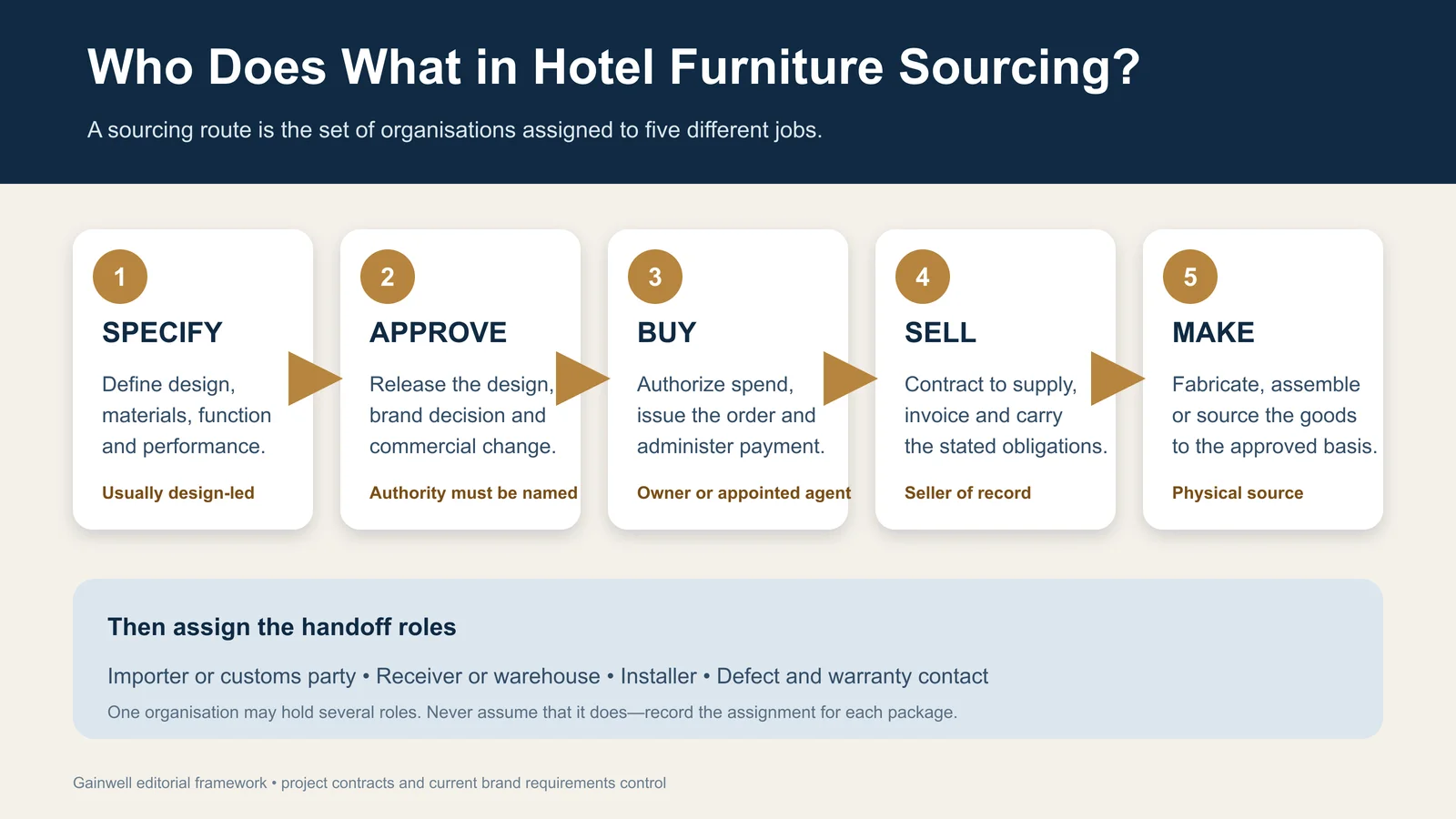
The word supplier can refer to a procurement company, dealer, seller, manufacturer or even a discovery platform. Separate four layers before collecting names.
| Source layer | Decision it answers | Typical organizations | Evidence to retain |
|---|---|---|---|
| Governance and approval | Who sets the permitted design, brand, product and exception path? | Owner, operator, brand or appointed designer | Current requirements, approval authority and exception route |
| Market access and coordination | Who takes the package to possible sources and coordinates the commercial response? | Owner team, procurement firm, GPO, dealer, design professional or direct manufacturer | Appointment, category scope, fees or commercial model, and named deliverables |
| Seller of record | Which entity offers and contracts to supply the furniture? | Manufacturer, dealer, distributor, reseller or another contracted seller | Legal entity, proposal, included services, exclusions and terms |
| Physical source | Who makes, assembles or supplies the actual item? | Factory, specialist workshop, brand-authorized maker or product manufacturer | Declared source, product identity and project-relevant production evidence |
Add the handoff parties after these layers: importer or customs party where applicable, freight coordinator, receiver, warehouse, installer and defect contact. The same organization may hold several roles, but do not infer that from a logo, website or channel label.
Choose how much coordination the owner will retain
The route should match the owner’s capacity to make decisions and manage interfaces. Use three control modes as a starting point.
| Control mode | Owner retains | Route holder coordinates | Main test |
|---|---|---|---|
| Owner-managed | Package strategy, market contact, contracts and cross-source coordination | A defined product, manufacture or supply scope | Can the owner team maintain common information, approvals and handoffs across several sellers? |
| Coordinator-managed | Approval, budget authority and key exceptions | Market enquiry, purchasing administration, reporting or multi-source consolidation under an appointment | Are authority, fees, seller identity, substitutions and excluded services transparent? |
| Governed network | Project-specific decisions allowed within the governing route | Access to a brand, owner or program network and its current process | Which requirements are mandatory, which sources are permitted and who approves an alternative? |
This is a control choice, not a quality ranking. More owner control creates more interfaces to manage. More coordination by one route holder can simplify communication but may reduce visibility if the seller, maker, fees or substitutions remain unclear.
Route each package using five decision signals
Do not choose one route for the entire hotel by habit. Score the package qualitatively against five signals:
- Customization: Does the package require drawing development, samples, mixed materials or a room prototype?
- Aggregation: Does the owner need one coordinator across many categories, sellers, payments or destination phases?
- Governance: Is there a current brand, owner or operator approval path that controls products or sources?
- Local service: Does the package depend on local stock, field measurement, repair, replacement or installation support?
- Continuity: Will operations need a documented path to reorder the same item, finish or controlled alternative?
A drawing-led guestroom casegoods package may point toward direct manufacturer engagement or a technically capable seller with a declared maker. Standard office furniture may point toward a contract dealer. A mixed public-area package may justify a procurement coordinator. A branded package may first need its current governed route confirmed. These are investigation priorities, not automatic awards.
Complete a package-route card before approaching names
The package-route card is the minimum record connecting project demand to a market structure. Use one card per coherent furniture package.
| Card field | What to record |
|---|---|
| Package identity | Room families, named areas or fixed locations included |
| Furniture character | Custom, standard, proprietary, replacement, loose, upholstered or fixed |
| Control mode | Owner-managed, coordinator-managed or governed network |
| Market-access holder | Organization appointed to contact or organize possible sources |
| Expected seller model | Direct manufacturer, dealer, distributor, reseller or another stated model |
| Maker visibility | Whether the physical source must be declared and at what stage |
| Approval boundary | Who accepts design, source, sample, substitution and commercial exceptions |
| Handoff boundary | Expected freight, receiving, storage, installation and closeout split |
| Continuity need | Replacement horizon, record required and acceptable alternative path |
| Open route decisions | Missing appointment, authorization, source evidence or local responsibility |
Do not copy a company name into every field. If one entity is expected to coordinate, sell and manufacture, state each role explicitly and ask it to confirm the boundaries in its proposal.
Match route examples to package conditions, not hotel prestige
Hotel class does not determine a single buying channel. The same luxury property may buy repeated custom casegoods directly, obtain standard task seating from an authorized dealer and route replacement items through a local commercial source.
- Direct manufacturer route: investigate for drawing-led, repeatable custom packages when the buyer can manage technical and commercial contact with the maker.
- Procurement firm or purchasing-agent route: investigate when several sellers or categories need one appointed coordination and reporting layer.
- Dealer or distributor route: investigate for standard or proprietary products, regional representation, local commercial support or authorized access.
- Designer-led purchasing route: investigate only when the professional’s purchasing role, authority, commercial position and liabilities are expressly appointed.
- Brand or owner network: investigate when current governance controls approved products, programs or source pathways.
Current search results often imply that direct buying is automatically less expensive or more controllable. The route name cannot prove that. Compare like-for-like scope, coordination effort, evidence, handoffs and current commercial terms after the route is defined.
Treat brand programs and GPOs as governed market access
A brand-linked network may combine design resources, sourcing support and supplier access. Hilton’s current Suppliers’ Connection is one public, brand-specific example. It does not establish a universal rule for other brands—or confirm that every package on a particular Hilton project follows the same route. Ask what is current for the property, region and package.
A group procurement organization is another market-access model. Avendra International, for example, describes itself as a GPO serving hospitality and other sectors. That establishes the type of organization, not whether a particular furniture package, seller, fee structure or project is covered.
For either route, record who grants access, who issues the order, who invoices, whether the physical source is visible, which alternatives are permitted and where project-specific approvals still sit.
Separate discovery evidence from permission to quote
Trade shows, directories, online search, social platforms, referrals and project photographs help discover names. Put every candidate on a five-state evidence ladder:
- Discovered: a name or product was found; identity and relevance are not yet confirmed.
- Route identified: the candidate’s likely role—market-access holder, seller, maker or more than one—is stated.
- Relationship evidenced: claimed authorization, representation or manufacturing relationship is supported where relevant.
- Package-relevant: the candidate can receive the actual furniture character, quantity, destination and evidence request.
- Enquiry-ready: the project knows which entity will respond, on what scope, through which commercial route and with which declared physical sources.
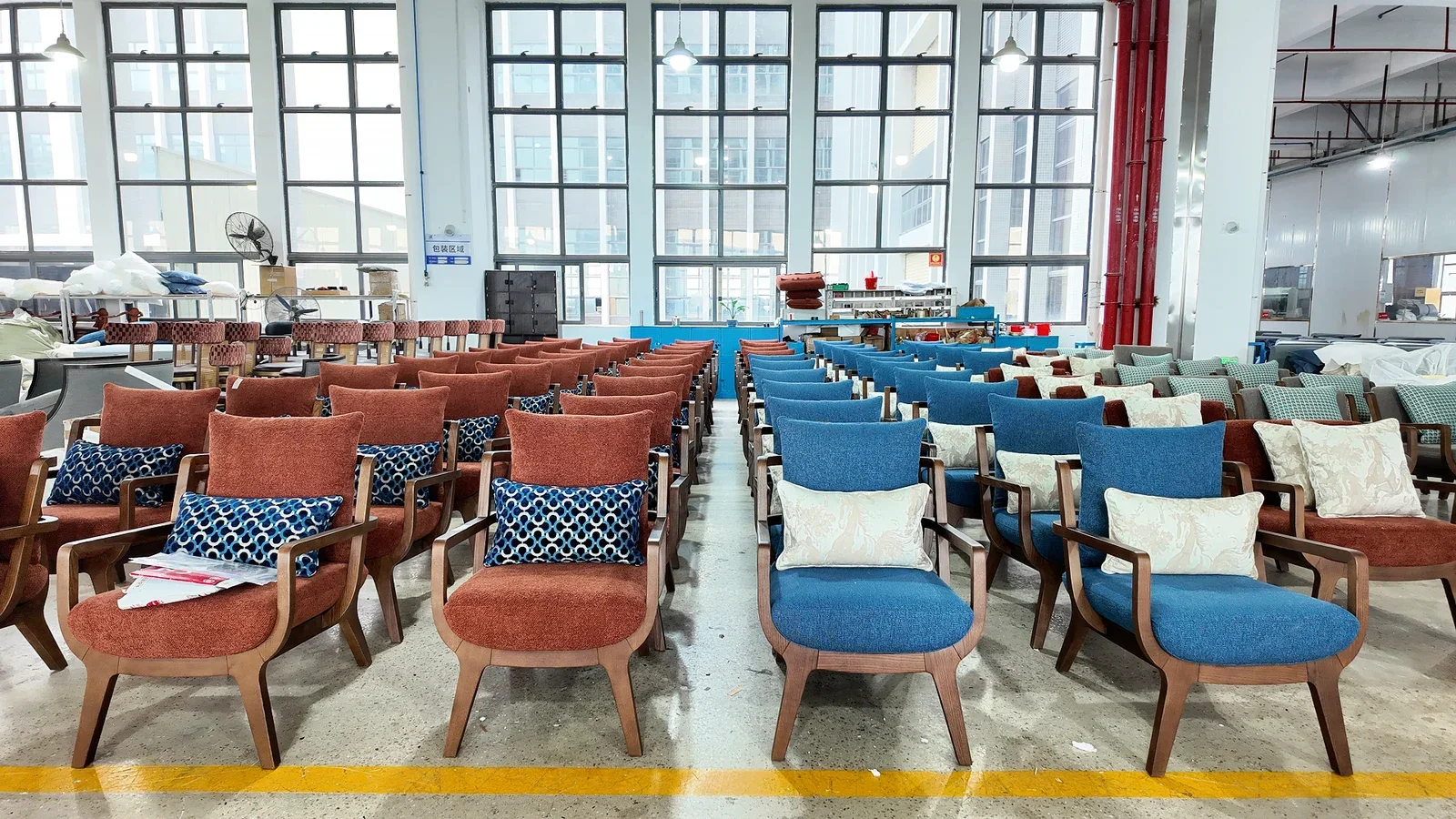
A catalogue screenshot remains discovery evidence. A brand-list entry may establish a governed relationship but not live capacity or package fit. A factory photograph may show a facility but not the seller or contract scope. Preserve the source of each claim and stop the candidate from advancing when the next state lacks evidence.
Run a representative sourceability probe
Before sending a broad request across the entire hotel, select one representative package and ask each proposed route to explain how it would handle it. A useful probe contains a controlled item or room set, indicative quantity, current drawing maturity, material direction, destination, sample need, approval authority and expected handoff point.
The response should identify:
- the organization receiving and coordinating the enquiry;
- the intended seller and physical maker, including unknowns;
- which technical inputs are sufficient and which are missing;
- what must be sampled, approved or clarified before a comparable proposal;
- which delivery, receiving or installation services are inside or outside the route; and
- how an authorized change would reach the seller and maker.
This probe does not approve a supplier or establish price, quality or programme. It tests whether the route can convert a real package into accountable questions without hiding interfaces.
Map the seams when one hotel uses several routes
A mixed route is normal; unmanaged seams are the risk. Connect packages that share a finish, dimension, site interface, installation sequence or replacement requirement. Then name one owner for each seam.
For example, a direct manufacturer may develop guestroom casegoods while an authorized dealer supplies a desk chair. If the chair must fit under the custom desk, somebody must control the dimensional interface. A procurement coordinator may buy lobby seating from several sellers, but the designer still needs one approval basis for related fabrics and finishes. A fixed reception counter may use a local measurement and installation route while sharing decorative metal or stone references with loose furniture.
Use a seam record with the two connected packages, shared requirement, controlling document or sample, decision owner, handoff date and consequence of late closure. Do not ask one route holder to resolve an interface that its appointment and information do not cover.
Make the seller-to-maker relationship visible
Knowing a factory address is not the same as knowing where the hotel buys. Conversely, contracting with a dealer or procurement firm does not make the physical source irrelevant. Decide what visibility the package needs.
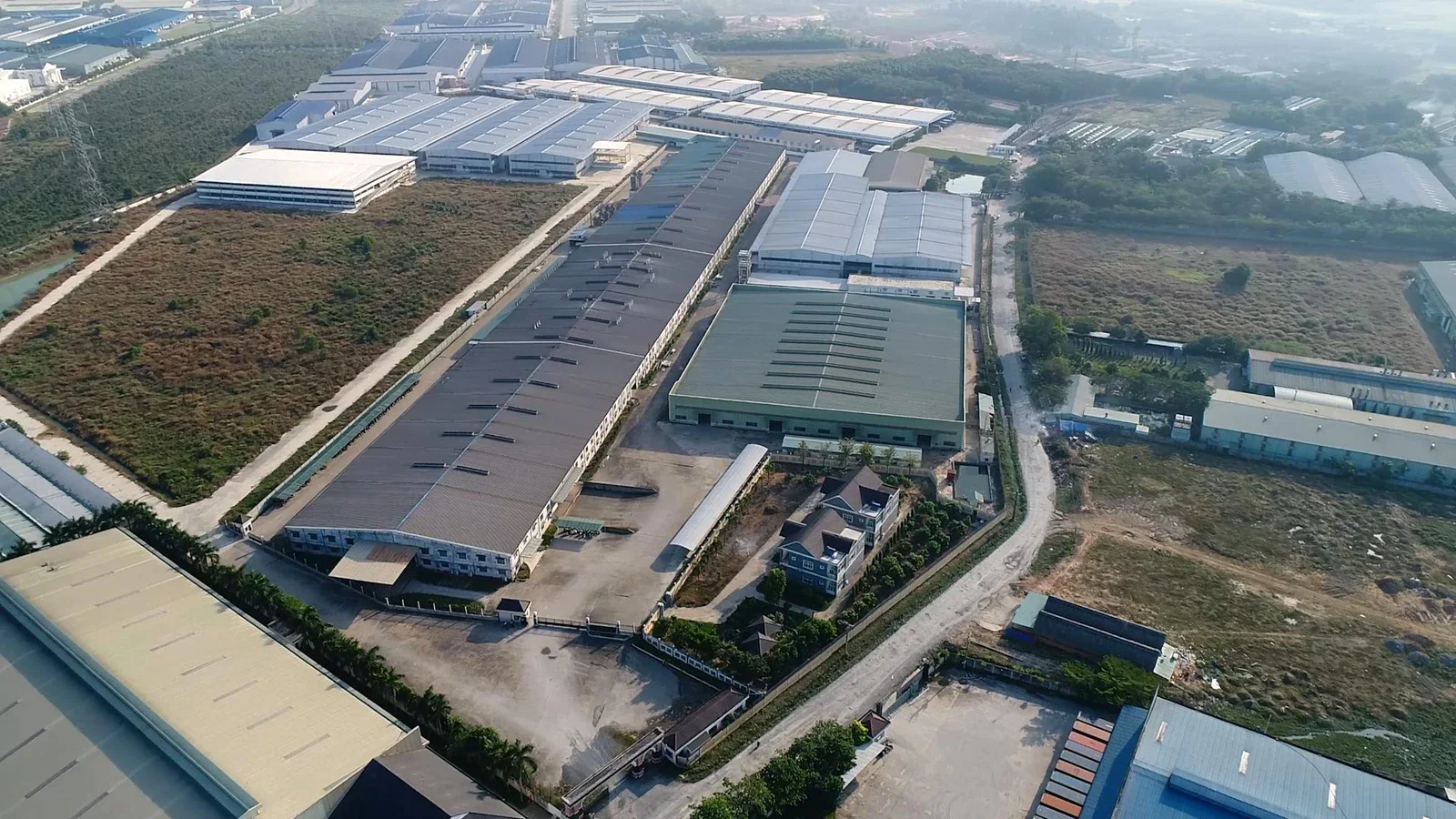
For custom or source-sensitive packages, ask the proposed seller to declare who develops the drawings, who makes each major component or assembled item, which activities are subcontracted, who controls revisions and samples, and who remains responsible under the proposal. For standard products, confirm the exact product identity and any authorization needed for the route.
Gainwell’s current capabilities page describes technical development, prototypes, manufacturing, quality control, packaging and delivery support. That is first-party discovery evidence. A live proposal must still confirm the applicable products, services, production location, records, timing and responsibilities.

Test replacement access before the first order
A route that can deliver the opening package may be weak for a single replacement later. Run a replacement-access test while records are current:
- Which item, configuration, finish and hardware records must the operator retain?
- Who will receive a future replacement enquiry: original seller, dealer, manufacturer or another appointed route?
- Does the route depend on a minimum quantity, authorization or product program that may change?
- If the original source is unavailable, who can approve a controlled alternative?
- Which installed condition or interface must be rechecked before remaking a fixed or handed item?
Do not promise future availability. The purpose is to preserve identities, decision authority and a fallback path. A replacement record without the seller-maker relationship may send operations back to a logo that no longer represents the same product source.
Worked example: route a mixed 120-key hotel
Consider an illustrative 120-key independent hotel. The example selects investigation routes only; it does not recommend an organization or determine an award.
| Furniture package | Dominant condition | Route to investigate first | Control retained | Open proof |
|---|---|---|---|---|
| Repeated guestroom casegoods and headboards | Custom drawings, room repetition and coordinated finishes | Direct hospitality manufacturer or technical seller with declared maker | Owner approves design, sample and seller; designer controls intent | Development scope, physical source, prototype route and delivery boundary |
| Standard guestroom task chair | Proprietary product and future replacement need | Authorized contract dealer or distributor | Owner controls exact model and acceptable alternative | Authorization, current product identity and replacement route |
| Lobby loose furniture from several sources | Mixed products and coordination across sellers | Appointed procurement coordinator with transparent sellers and makers | Owner and designer retain approval of substitutions and finishes | Fees, seller identities, approval handoffs and consolidation boundary |
| Site-measured reception counter | Fixed interfaces, field truth and local installation | Qualified millwork route aligned with site measurement and installer responsibility | Project team controls interface release and adjacent finishes | Measurement authority, maker, installer and site-condition hold points |
| Back-of-house replacement desks | Small quantities, standard function and local service | Verified local commercial furniture source | Operator controls function, dimensions and replacement record | Commercial suitability, current availability and installation need |
The resulting route ledger has five packages, not one hotel-wide answer. Its value is that every proposed name has a specific job and every shared interface has an owner.
Know when route selection ends and procurement begins
Route selection is complete when the package, control mode, market-access holder, expected seller model, maker-visibility rule, approvals, handoffs, evidence state and replacement path are documented. The next task is formal procurement: issuing common information, receiving comparable proposals, controlling samples, closing award exceptions and releasing the correct furniture basis.
Document the downstream package-control workflow separately from the route decision. If the chosen route includes a direct custom manufacturer, use Gainwell’s current guide to evaluate manufacturer evidence. Keeping the boundary clear prevents a route decision from masquerading as supplier approval.
Professional appointments also need their own confirmation. The AIA’s B254-2019 instructions provide one US-specific example of separately scoped architect purchasing-agent services. The BIID FF&E practice guidance distinguishes designer roles such as agent and principal. Neither should be applied as a universal appointment or legal rule; actual responsibilities depend on the signed documents, jurisdiction and qualified advice.
Prepare a route decision pack for project review
Compile the package-route cards, current furniture schedule, room or area quantities, design maturity, governance requirements, proposed control modes, candidate evidence states, seam records, handoff expectations and replacement-access notes. Mark every assumption and name the decision owner.
Gainwell’s current product directory can help identify whether the enquiry concerns guestroom, casegoods, seating, tables, outdoor, specialty or fixed furniture. If a direct or declared-manufacturer route may fit, use the project enquiry page to share the relevant package, destination, quantities, drawings, materials, approval route and programme. Gainwell can confirm which information it needs to consider a potential scope; no route, source, product, price, timing or responsibility is confirmed by this article.