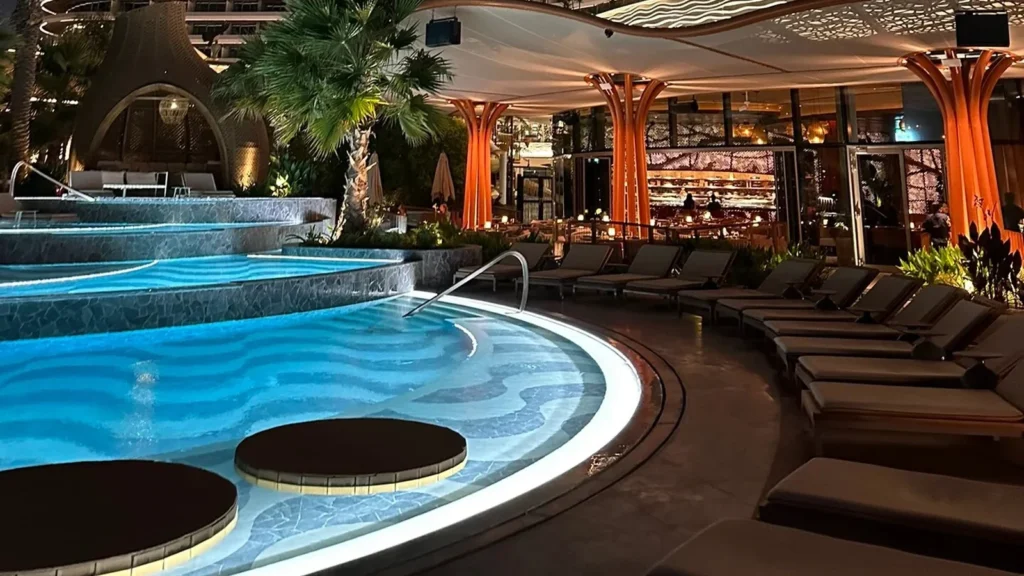

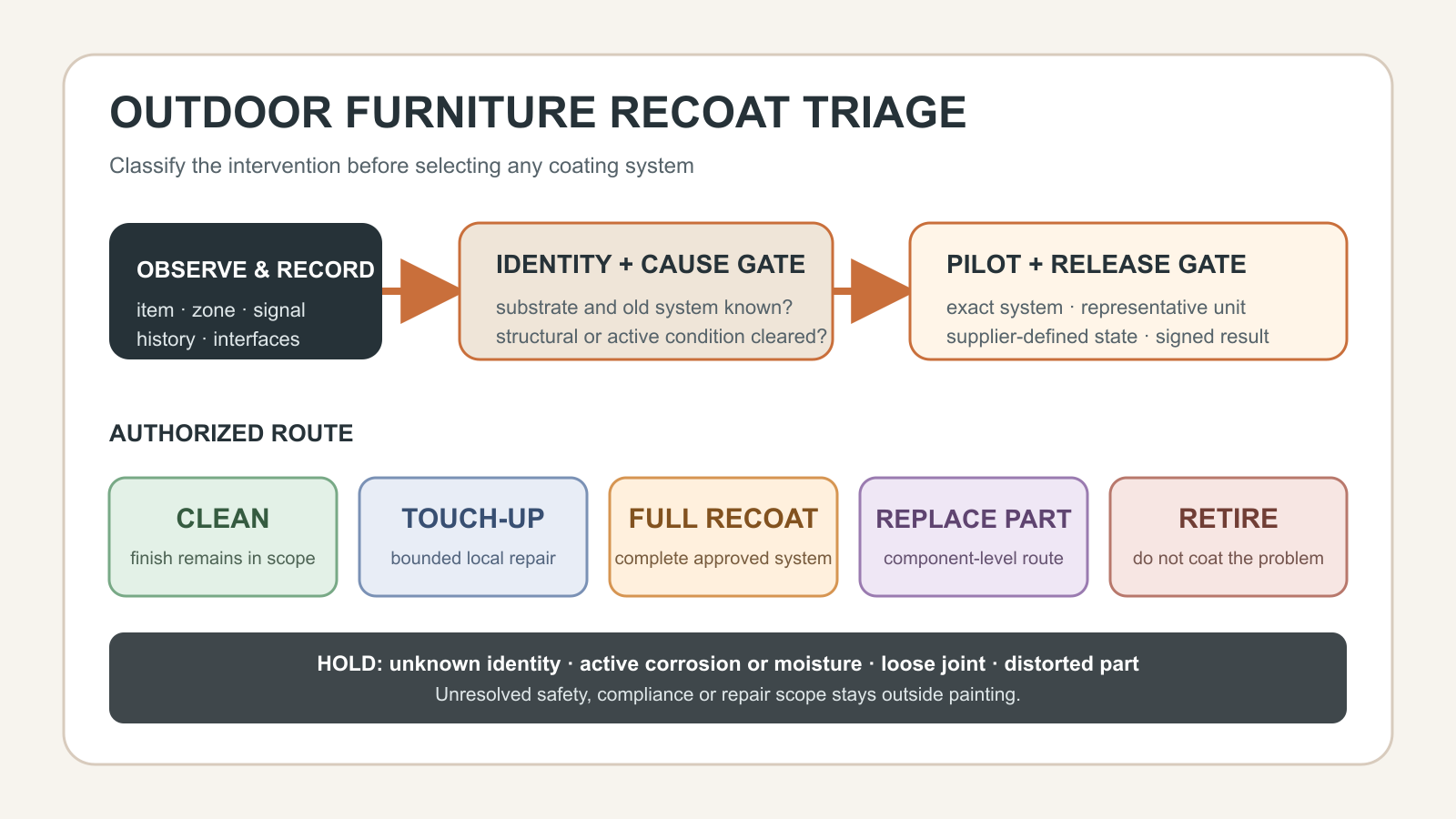
Should a hotel repaint outdoor furniture as soon as the finish looks tired? Not necessarily. First identify the exact item, substrate, existing coating and condition signal. Then choose one controlled route: clean, local touch-up, complete recoat, component replacement or retirement. Outdoor furniture paint should be selected only after that route is approved, not used to cover an unresolved structural, corrosion, moisture or compatibility problem.
The practical release sequence is simple to state but important to keep intact: record the condition, confirm what the item and old finish actually are, obtain the current coating documents, trial the complete proposed system on one representative unit, inspect at the supplier-defined release state, and extend the decision only to a matching batch. This protects guest-facing consistency while preventing a cosmetic project from silently becoming an uncontrolled repair.

Read the condition signal before choosing paint
Create an item-and-zone register before asking for a color or product. Record the furniture family, asset or room code, location, exposure, guest-contact surfaces, removable parts, previous repair marks and the observed signal. Useful condition words describe what can be seen—loss of color, chalky residue, isolated scratch, lifting edge, flaking area, stain, open joint, distortion or exposed base material—without declaring the cause.
Map how the signal is distributed. One scratch caused by handling is a different scope from similar lifting across many matching chairs. A sun-facing row may differ from a sheltered row. Furniture near irrigation, pools, food service or frequent stacking may have different contact histories. Distribution helps the team select a representative pilot and decide whether the problem belongs to cleaning, coating, component or broader asset review.

Choose one of five intervention routes
Do not combine every affected item into a single repaint order. Use the condition record to assign a provisional route, then keep the route on hold until identity and cause questions are closed.
| Route | Use when the controlled question is | Do not release when |
|---|---|---|
| Clean | Can approved routine care remove a surface deposit while the existing finish remains in scope? | The item shows lifting, exposed substrate, looseness, distortion or an unknown residue. |
| Local touch-up | Can a bounded defect be repaired without an unacceptable visible boundary or incompatible overlap? | The old finish is unidentified, the affected edge continues to move, or the repair will cross unlike materials. |
| Complete recoat | Can the exact furniture family receive a documented, compatible full system and consistent appearance? | The substrate, previous system, cause, preparation or return-to-service state is unresolved. |
| Replace component | Is a damaged or separately finished part replaceable under the approved drawing and spare rule? | The replacement changes fit, balance, movement, edges, interfaces or visible consistency without review. |
| Retire | Should the item leave service because repair is not technically, commercially or operationally acceptable? | A cosmetic coating is being proposed to conceal a structural or safety concern. |
Prove the substrate and existing coating
“Wood-look,” “metal,” “powder-coated” and “painted” are not complete records. Link each item to the approved schedule, drawing, finish sample, purchase record, maintenance history and any earlier repair document. Separate the base component from decorative skins, fillers, trims, feet, fasteners and adjacent textiles. If the original system is not known, state that directly and ask the qualified coating provider what investigation is required before proposing work.
Current manufacturer guidance itself branches by material and condition. It also points users to the exact product label or technical data sheet for recoat timing. That is the useful boundary for a hotel team: a generic article can define the evidence gate, but it cannot convert a visual guess into a substrate identity or turn one product’s instructions into a universal specification.

Map repair visibility and exposed interfaces
A touch-up is local in area, but its visual consequence may not be local. On the pilot, mark sightlines from the guest approach, seated position and service route. Record where color, gloss, texture or film build changes become visible. Extend the map around corners, welds or joints, underneath rails, at feet and along transitions to upholstery, rope, wicker-looking surfaces, stone-looking tops or plastic parts.
Set a visibility boundary before the work begins. The boundary may be one scratch, one rail, one leg, a whole frame or a complete item; it is a project decision, not a default rule. Protect or remove adjacent soft goods only under the approved work method. When the proposed repair crosses a junction or cannot be feathered within an acceptable visible field, move it from “touch-up” to a complete-system review.

Build an exact coating-system work card
The work card should identify the asset population, substrate evidence, old coating evidence, proposed complete system, color and sheen reference, permitted scope, provider, controlled work location, environmental limits, inspection points and waste or site-control responsibilities. Attach the current technical data sheet, safety data sheet and label for every proposed product. OSHA’s SDS brief explains that an SDS communicates hazards, protective measures and handling, storage and transport information; the qualified employer or contractor remains responsible for applying the current requirements.
Do not rewrite product instructions from memory. Preparation, mixing, application, interval and full-release requirements stay with the exact current manufacturer documents and qualified provider. The card should also say what is excluded: loose joints, distorted parts, active corrosion or moisture, unknown old coatings, contaminated surfaces, unapproved color changes and any item outside the defined furniture family.
Pilot one representative unit
Select the pilot from the condition map, not from the easiest item to access. It should represent the intended substrate and old system, the usual defect distribution, important edges and junctions, the operating exposure and the hardest normal guest viewpoint. If the batch contains meaningful variants, use separate pilots or keep those variants outside the decision.
Before work, photograph and code the unit, agree the observation fields, and retain the governing sample or color reference. After the qualified provider completes the approved system, record the actual product identities and batches, deviations, dates and conditions. A pilot is not merely a color sample. It tests whether the documented scope can be executed and inspected on the real geometry without creating a new interface or operations problem.
Inspect at the supplier-defined release state
“Dry to touch” is not a universal return-to-service rule. Use the exact product documentation and provider statement to define when the pilot may be handled, assembled, stacked, cleaned, exposed or returned to guests. These states may differ. Record the clock start, relevant conditions and person who releases each state rather than entering a guessed number into the programme.
At the agreed inspection state, compare the pilot with the accepted reference under named lighting and viewpoints. Check the visible field, edges, undersides, joints, feet, missed areas, overspray or transfer to adjacent materials, function of removable or moving parts, and any new defect. The project team decides PASS, PASS WITH RECORDED LIMIT, REWORK or HOLD. A later observation window may still be required before the batch is released.
Release only the matching batch
Translate the pilot decision into a batch rule. List the item codes, substrate and old-system identity, condition range, finish reference, approved work-card revision, provider, location and release observations that define “matching.” Every item that differs goes to an exception register; it does not inherit approval because it looks similar from a distance.
Use a first-off check at batch start and repeat the agreed observations at controlled intervals. Photograph exceptions, but let the signed item record—not a gallery—carry disposition. If a product, preparation route, color reference, old coating, work location or condition changes, stop the affected population and decide whether a new pilot is necessary.
Handover the repaint history for future care. Close the work with an asset-level repaint passport. Keep the original item and finish record, reason for intervention, diagnosis owner, approved route, complete product-system documents, samples, pilot and batch IDs, photographs, dates, observed limits, return-to-service release, cleaning boundary, retained materials and future inspection triggers. Mixed historic repairs become visible “repaint scope debt” when these fields are missing.
Link the passport to routine care rather than promising a fixed life. Housekeeping should know which products and methods are approved for the renewed surface, what contact should be avoided, and which signals trigger escalation. Engineering and FF&E teams should know which parts are replaceable and which changes reopen coating or sample approval. That record makes the next decision faster and keeps an isolated repair from becoming an unidentified layer.
Prepare the evidence packet for Gainwell
For a new programme or manufacturer-supported replacement scope, package the furniture schedule, zone and condition map, photographs, exact substrate and finish records, proposed intervention route, color and sheen reference, critical junctions, pilot population, acceptance fields, quantities, programme, spare rule and named decision owners. Gainwell’s Outdoor Furniture page defines the product-family channel, while its Materials and Capabilities pages show how finishes, samples, technical development and quality control enter a project workflow.
Share the completed brief through the Gainwell project contact. Final substrate identification, coating selection, preparation, application, safety, environmental, compliance, warranty and return-to-service decisions remain with the project’s qualified parties and the approved current documents.
Frequently Asked Questions
What is the best paint for outdoor furniture?
There is no universal best outdoor furniture paint. The acceptable system depends on the exact substrate, existing coating, condition cause, exposure, appearance target, preparation route, project rules and current manufacturer documents. Compare complete compatible systems on a representative pilot; do not select from color or generic material name alone.
Can painted outdoor furniture simply be painted again?
Sometimes, but only after the existing coating is identified and assessed. Stable, compatible layers may support a defined recoat route; lifting, unknown, contaminated or incompatible layers may require a different investigation and scope. Follow the qualified provider and exact current product documents rather than a general overpainting assumption.
Should a hotel use touch-up or repaint the whole item?
Use touch-up only when the defect is bounded, the existing system is known, the cause is closed and the repair boundary can meet the agreed appearance and compatibility criteria. If the repair crosses multiple visible faces, joints or unlike materials—or will remain conspicuous—review a complete recoat or component route.
Can metal and wood outdoor furniture use the same paint system?
Do not assume so. “Metal” and “wood” are broad categories, and each item may have primers, fillers, sealers, decorative layers or previous repairs. Require exact substrate and existing-system evidence, then obtain a documented proposal for that application. Similar color does not establish system compatibility.
How do you tell whether peeling paint is a cleaning issue or coating failure?
Do not diagnose from a photograph or appearance word alone. Record where and how the change appears, isolate the affected item if needed, review history and exposure, and have a qualified party determine the cause and permissible intervention. Cleaning should not be used to test an unstable or unknown surface informally.
When can repainted hotel furniture return to service?
Use the exact product label or technical data sheet, provider record and project release criteria. Handling, assembly, stacking, cleaning, weather exposure and guest use may have different release states. Record who confirmed each state and keep the unit unavailable until the required state is reached and inspected.