

FF&E procurement is broader than purchasing. It defines what a project will buy, organizes the supply market, compares proposals, controls approvals and changes, authorizes commercial commitments, and keeps each delivered asset traceable to the requirement the owner accepted.
Purchasing creates and administers orders inside that system. Sourcing identifies possible suppliers. A procurement company may perform both, but its name does not prove that it also owns design, manufacturing, freight, installation or final acceptance. The appointment and responsibility schedule must state those boundaries.
For a hotel owner or procurement lead, the practical goal is not simply to place orders. It is to make every commitment from enquiry to handover with the right information, authority and evidence.
Choose the procurement operating model before building a supplier list
The best operating model depends on the owner’s team, package diversity, design maturity, geography, reporting needs and appetite for direct contracts. Choose how the work will be governed before asking which company should do it.
| Operating model | Where it may fit | Boundary to make explicit |
|---|---|---|
| Owner-managed direct purchasing | The owner has experienced procurement resources and wants direct control of supplier contracts | Who prepares specifications, normalizes bids, expedites orders and coordinates delivery exceptions? |
| Independent procurement company | The owner wants one team to run tenders, purchasing, reporting and supplier coordination across categories | Is the company an adviser, purchasing agent, reseller or contracting principal, and how are fees or margins disclosed? |
| Designer-led procurement | Selection continuity and specification control are central, with commercial administration added to the design service | Separate design approval, buying authority, financial reporting and post-order management |
| Manufacturer-led package | A defined custom furniture package benefits from direct technical development, prototyping and production control | Do not assume that one manufacturer controls unrelated FF&E categories, owner-side tendering or site-wide logistics |
| Hybrid package model | Different categories need different routes—for example, direct custom furniture plus an agent for mixed standard products | Assign one owner for shared schedules, interfaces, consolidation and closeout records |
A hotel can use several models at once. What matters is that each item code has one buying route and that interfaces between routes remain visible.
Map decision rights, not just job titles
List the decisions that change scope, money, time or acceptance. Then name who prepares the recommendation, who reviews it, who can approve it and which record proves the decision. Typical rights include releasing an RFQ, approving an alternative, selecting a supplier, issuing a purchase order, approving a sample, accepting a price change, releasing production, authorizing shipment and accepting closeout.
Job titles are unreliable shortcuts. A designer may approve appearance without authority to change price. A procurement agent may issue an order only after owner approval. A manufacturer may propose a buildable alternative but cannot approve it for the project. An operator may review maintenance needs without owning the construction interface.
Current ISO/TC 176/SC 2 guidance for ISO 9001:2015 links to official papers on the process approach and documented information. Those principles are useful here, but they do not certify a procurement program or determine its commercial authority.
Create one baseline before asking the market to price
A procurement baseline is the controlled set of information against which proposals and later changes are measured. It should be complete enough to expose uncertainty, not pretend that every design decision is final.
- item codes, descriptions, room or area locations and quantity basis;
- current drawings, specifications, material and finish references;
- required samples, prototypes, mock-ups and approval authorities;
- performance, test or document requirements stated for the applicable market and product;
- packaging, coding, spares and delivery sequence;
- destination, named handover points and site constraints;
- responsibility for freight, receiving, storage, installation, connection and acceptance;
- pricing format, currency, validity, taxes or duties to identify, exclusions and alternates;
- target dates and dependencies, expressed as planning inputs rather than supplier guarantees.
Give the baseline a revision and issue date. Mark gaps as an assumption, allowance, option or hold point so every bidder treats them visibly.

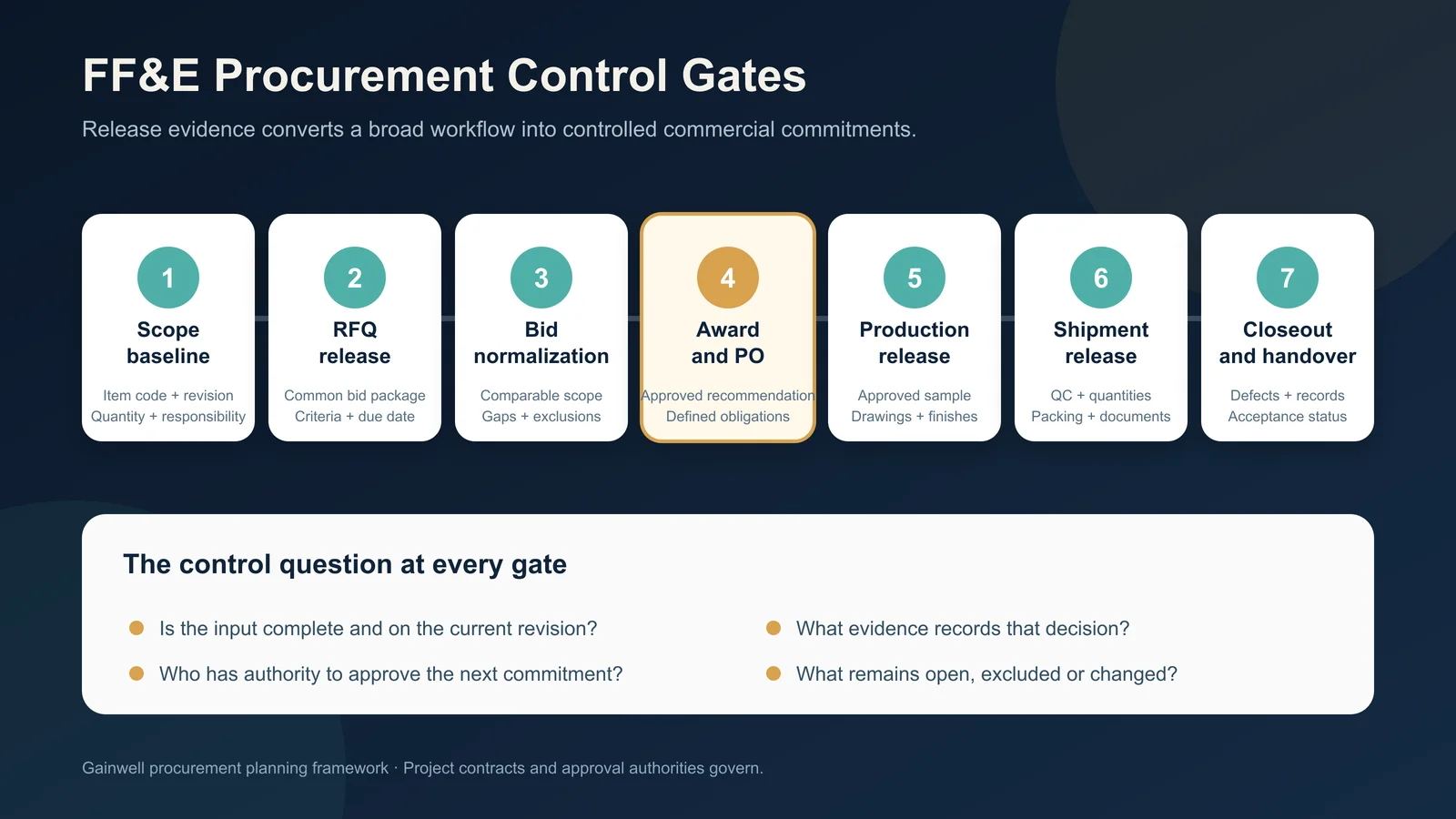
Use seven gates to control commercial commitment
- Scope baseline: authorize the coded items, quantities, current references and responsibility boundaries for market enquiry.
- RFQ release: confirm that invited parties receive the same issue set, response format, clarification route and due date.
- Bid normalization: reconcile qualifications, substitutions, omissions, delivery bases and commercial assumptions before scoring.
- Award and purchase order: record the accepted technical and commercial basis, required approvals and unresolved conditions.
- Production release: connect current drawings, quantities, samples, finishes and authorized changes to the work being made.
- Shipment release: reconcile inspection status, quantities, packing, labels, documents, delivery basis and destination readiness.
- Closeout and handover: reconcile received assets, exceptions, accepted records, spares, care information and contracted warranty data.
At every gate ask four questions: Is the input current? Who has authority? What evidence records the decision? What remains open, excluded or changed? A gate can hold one package without freezing unrelated packages.
Write an RFQ that makes uncertainty comparable
The RFQ should tell bidders how to respond when information is incomplete. Require a base response against the issued requirement, then separate any proposed alternative. Ask each bidder to identify exclusions, qualifications, assumed quantities, unpriced inputs, proposed production location, approval work, packaging, delivery basis and subcontracted services.
Use one clarification register. Distribute material answers to every affected bidder, version the response and state whether it changes the issued baseline. Private answers create different pricing assumptions even when the original RFQ was identical.
Do not use a verbal assurance to close a material gap. Convert it into a written clarification, revised schedule, proposal qualification or contract obligation before award.
Normalize proposals before evaluating the total
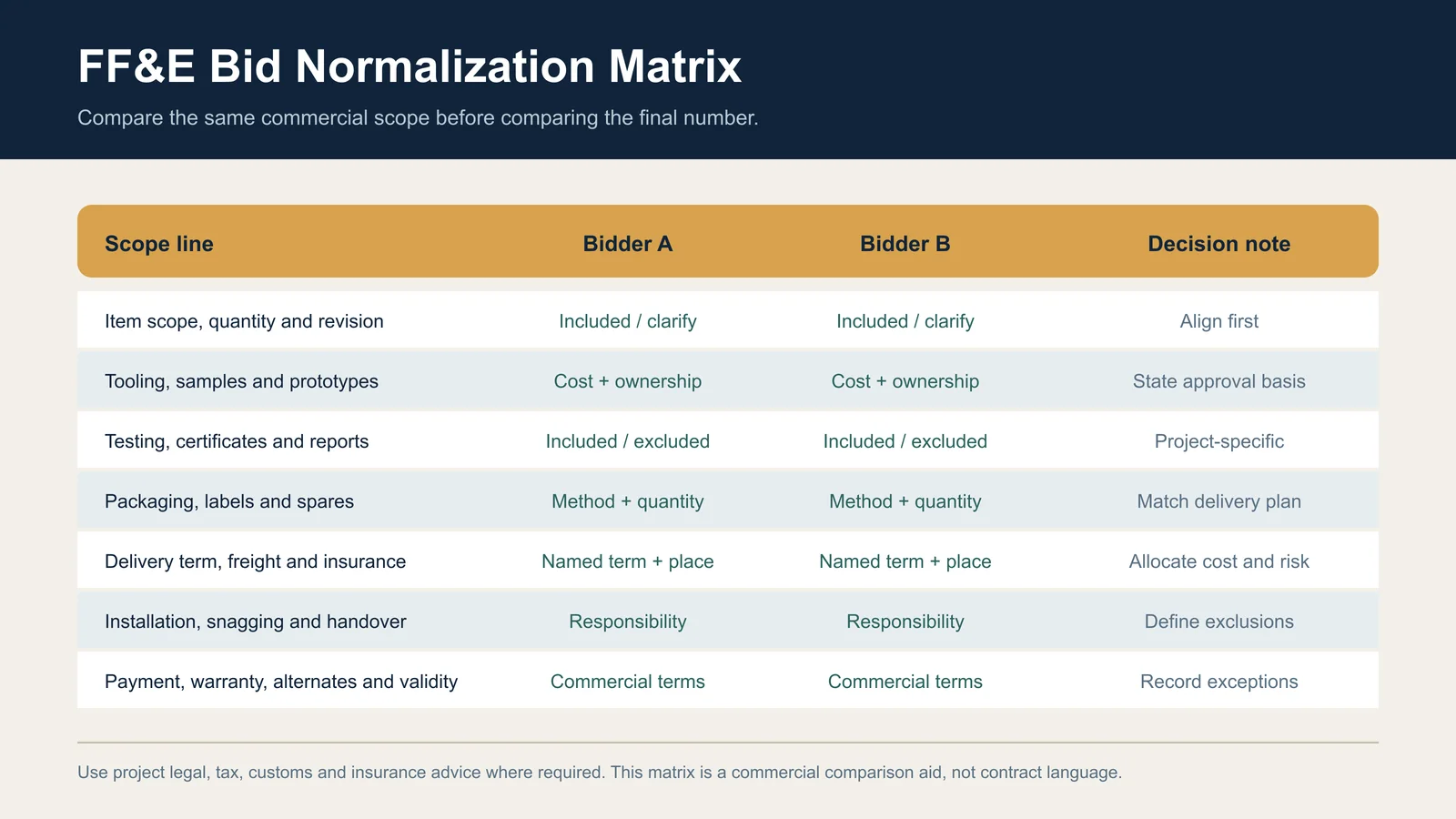
Keep the supplier’s submitted price intact, then add a separate comparison layer. This prevents the evaluation team from silently rewriting a bid while still allowing a like-for-like decision.
| Comparison layer | Normalize | Decision evidence |
|---|---|---|
| Scope | Item codes, quantities, configurations and locations | Included, excluded, duplicated or awaiting clarification |
| Technical basis | Materials, construction, hardware, interfaces and required evidence | Compliant basis or clearly described alternative |
| Approval work | Shop drawings, finish samples, prototypes, tests and resubmissions | Included effort, owner and approval consequence |
| Delivery | Packaging, labels, spares, freight, insurance and named handover point | Comparable responsibility and adjustment basis |
| Site and closeout | Receiving, storage, installation support, snagging and records | Included service, exclusion or separate allowance |
| Commercial | Currency, validity, payment milestones, taxes identified and warranty offered | Unadjusted offer plus transparent comparison adjustment |
Price is only one evaluation dimension. Assess whether the bidder can demonstrate the technical development, approval, production, reporting and delivery controls required by the actual package. Do not award points for evidence the project has not reviewed.

How should an owner evaluate FF&E procurement companies?
Evaluate the appointment model before the marketing claims. Ask whether the company acts as adviser, purchasing agent, reseller or contracting party; which entities will hold supplier contracts and funds; how fees, rebates or margins are disclosed; and which services are performed internally or subcontracted.
Request a proposed responsibility matrix and sample reporting set for a comparable type of project. Useful evidence may include an anonymized procurement schedule, bid comparison, change log, expediting report, payment recommendation, delivery tracker and closeout index. Review how the company handles conflicts of interest, design changes, supplier failure, damaged goods and records after handover.
A company list cannot determine fit without the live scope. The project should compare candidates against the same required services, authority, systems, market coverage and reporting outputs. This article therefore does not rank providers or recommend one universal model.
Turn the award recommendation into managed obligations
The award record should identify the selected baseline, accepted alternatives, quantities, price basis, approval stages, programme dependencies, production and inspection inputs, packaging, delivery point, site services, closeout deliverables and every surviving qualification. Transfer those decisions into the executed order or contract rather than leaving them only in an evaluation spreadsheet.
Where an Incoterms rule applies, the International Chamber of Commerce describes Incoterms 2020 as allocating specified buyer and seller costs, risks and obligations. Use the correct rule, named place and edition with qualified advice. Do not let a trade term stand in for product scope, payment, acceptance, installation or remedies.
Assign an owner for prerequisites the supplier cannot control, such as final dimensions, approved finishes, access to nominated components or site handover dates. A committed order does not make an open input disappear.

Control approvals and changes as commercial events
Separate approval types. A finish sample may approve color and sheen without approving dimensions, construction, comfort or price. A prototype may confirm representative form and interfaces while some tests or production documents remain open. Each approval record should state what was reviewed, what was not reviewed, which item and revision it affects, and whether it releases further work.
For every proposed change, record the initiator, reason, affected items and quantities, revised documents, technical consequence, price effect, programme effect, approval authority and implementation status. Update both the procurement baseline and the supplier obligation after authorization.
Gainwell’s current capabilities workflow connects technical development, prototypes, manufacturing, quality control, project coding and delivery support. This can support a custom furniture package within a wider FF&E program; a live proposal must confirm the exact product and service scope. Gainwell’s product overview shows the current furniture categories to use when defining that package boundary.
Define the procurement-to-delivery handover
Production release and shipment release are different decisions. Production release confirms what may be made. Shipment release confirms what inspected and documented goods may leave for an agreed destination phase. Delivery acceptance confirms what custody and condition reached the named handover point. Installation and operational acceptance may occur later and under different authority.
At closeout, reconcile the as-delivered item schedule, accepted drawings and finishes, location records, exceptions, care information, spare or replacement details, supplier contacts and contracted warranty documents. The operator should be able to identify an asset without searching through procurement email.
What proves the FF&E procurement process is controlled?
A controlled process has one current baseline; named decision rights; comparable proposal records; an award basis transferred into obligations; approvals and changes tied to item codes and revisions; production, shipment and delivery released separately; and closeout records that match delivered assets.
No checklist guarantees supplier performance, cost or opening dates. The value of the control system is that assumptions, decisions and exceptions remain visible early enough for the authorized project team to act.
If Gainwell’s custom loose or fixed furniture falls within your FF&E package, prepare the coded item schedule, current drawings, quantity basis, approval route, destination and requested delivery responsibilities. Share the controlled furniture scope with Gainwell so the team can confirm technical and commercial fit for the live project.