


A headboard can usually be attached to a platform bed in one of three ways: directly to compatible mounting points on the bed frame, through an adapter or mounting bracket, or independently to the wall. The correct method depends on the exact bed frame, headboard construction, mounting-point position and surrounding wall condition.
Not every platform bed is designed to accept a headboard. Before buying hardware or drilling new holes, check how the frame is constructed and whether the manufacturer provides a defined attachment point or approved accessory.
For a single bed, the immediate goal may simply be a secure and aligned installation. In a hotel project, the same decision also affects repeated room installation, mattress position, bedside furniture, wall finishes, lighting and service access. The mounting method therefore needs to work as part of the complete room rather than only as a connection between two pieces of furniture.
Check the Platform Bed Before Choosing an Installation Method
Start with the existing bed rather than the headboard hardware.
Look behind the head end of the platform frame for mounting holes, plates, brackets or other connection points. On upholstered frames, some of these details may be concealed beneath fabric or removable panels, so use the product drawing or installation instructions where available instead of assuming that a flat-looking surface can be drilled.
The basic checks are:
| Check | What to confirm |
|---|---|
| Bed frame construction | Wood, metal, upholstered frame or another system |
| Existing mounting points | Holes, plates or brackets intended for a headboard |
| Hole position | Whether it aligns with the headboard mounting points |
| Headboard type | Bed-mounted, freestanding or wall-mounted |
| Hardware | What bolts, brackets or fasteners the product requires |
| Wall condition | Whether an independent wall-mounted solution is possible |
| Final bed position | Whether the headboard changes the relationship with the wall and bedside furniture |
Also measure the actual bed frame rather than relying only on the nominal mattress size. A queen mattress, for example, does not tell you the outer width of an upholstered platform base or the location of its mounting holes.
If the existing holes do not match the headboard, do not immediately solve the problem by adding new holes. First determine whether the frame was designed to carry a headboard and whether an adapter or independent mounting method is more appropriate.
Method 1: Attach the Headboard Directly to the Bed Frame
Direct frame mounting is the simplest option when the platform bed already has compatible headboard mounting points.
The headboard normally connects through its legs, mounting plates or another designed interface using the hardware specified for the bed and headboard. Before tightening everything fully, position the headboard, check its height and centerline, and make sure both sides sit evenly.
A practical sequence is:
- Identify the intended mounting points on the bed frame.
- Position the headboard against the frame and check whether the holes align.
- Install the specified hardware loosely enough to allow minor alignment.
- Center and level the headboard relative to the bed.
- Tighten the connections according to the product requirements.
- Check for movement after the bed is returned to its final position.

The important point is that direct attachment works only when the two products are actually compatible. A hole that is close to the correct position is not necessarily suitable, and a bolt that physically fits does not prove that the frame was designed for that load.
After installation, check the bed under normal movement. If the headboard shifts, twists or develops a gap at one side, reassess the mounting surfaces and connection rather than repeatedly tightening the hardware without identifying the cause.
Method 2: Use a Headboard Adapter or Mounting Bracket
An adapter or mounting bracket can help when the platform bed has a usable mounting structure but its hole pattern does not line up directly with the headboard.
The bracket acts as an intermediate connection between the two sets of mounting points. This can provide more adjustment in width or height, but it does not make every bed and headboard automatically compatible.
Before using one, confirm:
- The bracket is suitable for the bed-frame construction.
- Its mounting range covers both the frame and headboard positions.
- The specified hardware can be used at both interfaces.
- The added bracket thickness does not push the bed too far away from the wall.
- The complete connection remains stable once the headboard is installed.
Projection matters more than it may appear. A bracket added behind the frame can change the final bed position, which may then affect the gap to the wall, nightstand alignment or the relationship between the mattress and headboard.
An adapter is therefore useful when the problem is a controlled mounting-position mismatch. It should not be used simply to compensate for a frame that has no suitable structural attachment point.
Method 3: Mount the Headboard Independently to the Wall
When the platform bed has no appropriate headboard connection—or when the design intentionally separates the bed from the headboard—the headboard can be mounted independently to the wall.
This approach is common for larger upholstered headboards, feature panels and hotel bedroom systems because the bed and headboard can be positioned from the same room datum without depending on one another structurally.
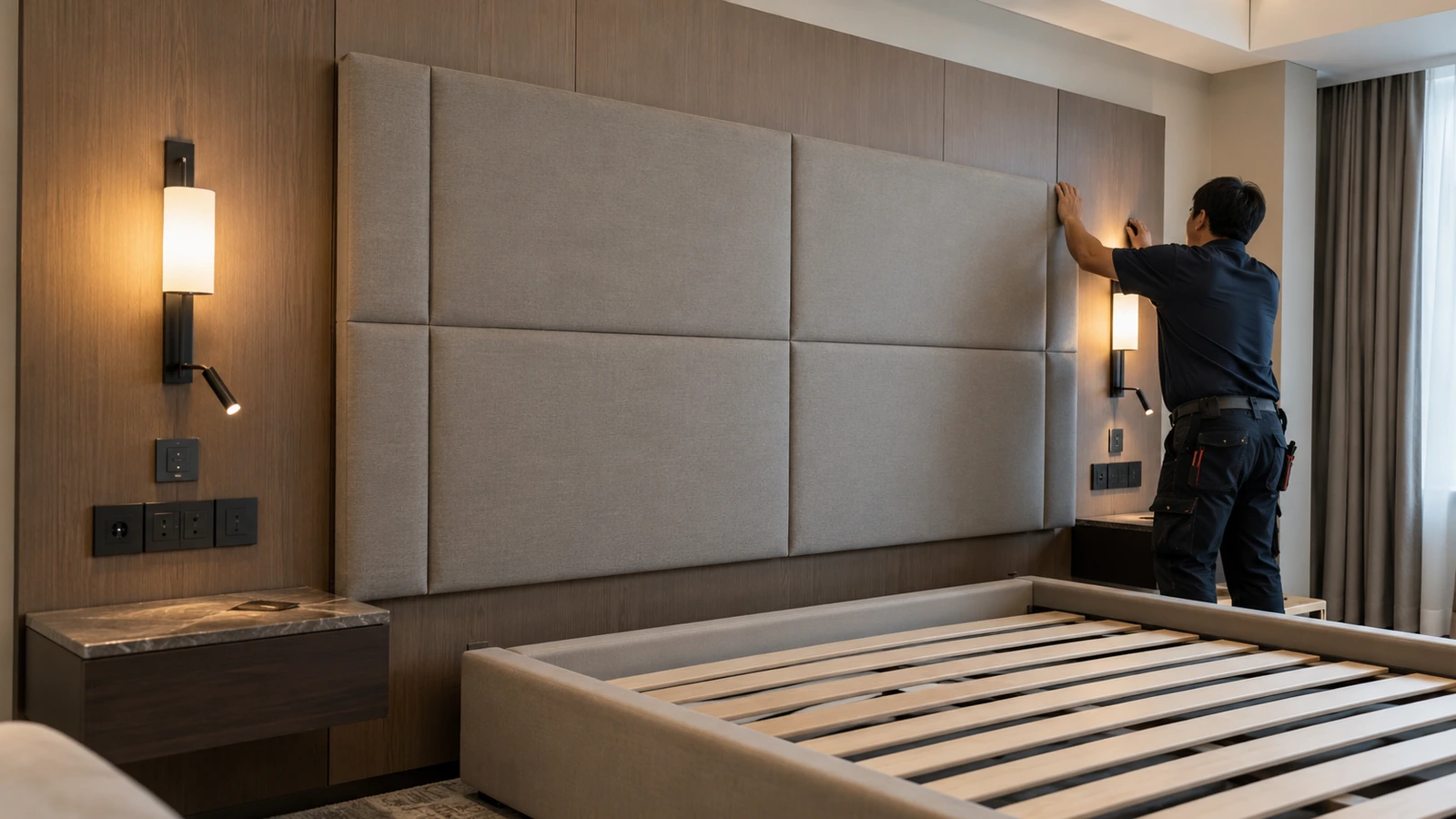
Wall mounting changes the planning questions. Instead of matching holes on the bed frame, the installation needs to coordinate:
- Wall substrate and any required backing
- Approved fixing locations
- Bed centerline
- Finished floor level
- Mattress and base height
- Headboard width and visible height
- Nightstand positions
- Bedside lighting
- Switches and power outlets
- Future removal or maintenance access
The fixing system should follow the headboard design, wall construction and approved project requirements. There is no universal wall anchor or fastener that is appropriate for every headboard and substrate.
The final bed position should also be confirmed before the wall mounting height is released. If the mattress or platform base changes later, the headboard may remain securely fixed but sit at the wrong visual height.
Choose the Right Method and Check the Final Fit
The three methods can be reduced to one practical decision:
| Existing condition | Likely approach | Main check |
|---|---|---|
| Bed and headboard mounting points align | Direct frame mounting | Hardware and stability |
| Bed has mounting points but positions differ | Adapter or bracket | Bracket compatibility and projection |
| Bed has no suitable mounting interface | Wall mounting | Wall condition and positioning |
| Large integrated hotel headboard | Independent fixed system may be appropriate | Room interfaces and installation design |
Once the headboard is attached, do not stop at “it feels secure.” Check how it fits the complete sleeping area.
The headboard should relate correctly to the mattress and bed centerline. If it extends beyond the bed, confirm that the left and right exposure matches the intended design. Check the relationship with nightstands, lamps, controls and wall outlets.
The beds and headboards package should be reviewed as a complete room relationship rather than as two independent product dimensions.

Common problems can often be traced to this final-fit stage.
The headboard moves when the bed moves. Check whether movement comes from the frame-to-headboard connection, the bracket interface or the bed itself. More tightening is not always the answer.
The headboard is level but looks off-center. Compare the headboard and mattress centerlines. A centered mounting bracket does not guarantee that the visible bed system is centered if the frame or mattress is positioned differently.
There is a large gap between the mattress and headboard. Check the platform-frame projection, headboard legs, bracket thickness and final bed position before altering the headboard.
The bed no longer aligns with the nightstands. The mounting method may have shifted the entire bed forward or sideways. Recheck the complete furniture layout instead of adjusting the nightstands independently.
Noise appears after use. Inspect the mounting interfaces and hardware for movement or contact rather than treating the sound as a cosmetic problem.
A headboard can therefore be securely attached and still be incorrectly positioned. Installation is complete only when both the connection and the room relationship work.
Coordinate and Verify the Installation Before Repeat Production
For a hotel project, the challenge is not attaching one headboard successfully. It is making sure the same result can be reproduced across every applicable room.
Treat the bed, headboard and adjacent room elements as one interface. The controlled information should identify:
- Bed-frame or platform reference
- Headboard reference
- Mattress and base specification
- Bed centerline
- Finished floor datum
- Headboard mounting method
- Wall or backing condition
- Nightstand position
- Bedside lighting and services
- Approved dimensions and tolerances
- Room-type variations
This matters because a small change in one item can affect several others. A thicker mattress can alter the visible headboard height. A revised platform base can move the bed away from the wall. A deeper nightstand can reduce access beside the bed. A late outlet change can place the service behind the headboard or outside the intended bedside zone.
Before repeating the installation through multiple guestrooms, verify one complete representative setting.
Install the approved bed or base, mattress, headboard, bedside furniture and representative bedside services. Then check:
- Headboard and bed centerlines
- Visible headboard height
- Left and right alignment
- Gap between bed and wall
- Fixing access
- Nightstand relationship
- Lighting and outlet positions
- Installation sequence
- Removal or maintenance access
Record the approved arrangement against the current drawing and item revisions. If the bed base, mattress depth, headboard construction, wall build-up or mounting hardware changes afterward, reopen the affected checks instead of assuming the original approval still applies.
For projects moving from design into repeat production, technical development and production coordination can help carry the approved dimensions, materials, interfaces and sample decisions into the production package.
Headboard installation is also closely tied to overall dimension planning. The guide to hotel headboard sizes explains how mattress, base, headboard span and bedside relationships should be coordinated before a room type is released.
Platform Beds and Headboards for Hotel Projects
For hotel projects, the platform bed and headboard should be developed around the room layout, mattress specification, wall condition, bedside furniture and intended fixing method. Resolving these relationships before production reduces alignment changes and inconsistent installation across repeated guestrooms.
Gainwell develops custom beds and headboards for hospitality guestrooms, including platform beds, upholstered headboards and integrated bedroom systems. Project development can include drawing coordination, material and finish review, prototypes, production control and installation coordination.
To review a project-specific configuration, share the room drawings, bed specification, headboard design, quantities and installation conditions through platform bed and headboard.
Frequently Asked Questions
Why is there a gap between the headboard and mattress?
The gap may come from the platform-frame projection, headboard legs, bracket thickness, mattress position or the intended design. Check the final bed position and product drawings before moving the headboard forward, because reducing the gap may affect the wall or bedside layout.
Can a wall-mounted headboard be removed without moving the bed?
It depends on the mounting system and available access. Some systems can be released from above or from concealed attachment points, while others require more working space. For hotel projects, the removal route should be considered during the mock-up if future access or replacement is expected.
Should the headboard be installed before or after the platform bed is positioned?
It depends on the mounting method. A bed-mounted headboard normally needs to be coordinated directly with the frame, while a wall-mounted headboard is positioned from room datums and the intended bed centerline. For repeated guestrooms, confirm the preferred installation sequence in the representative room before applying it across the project.