

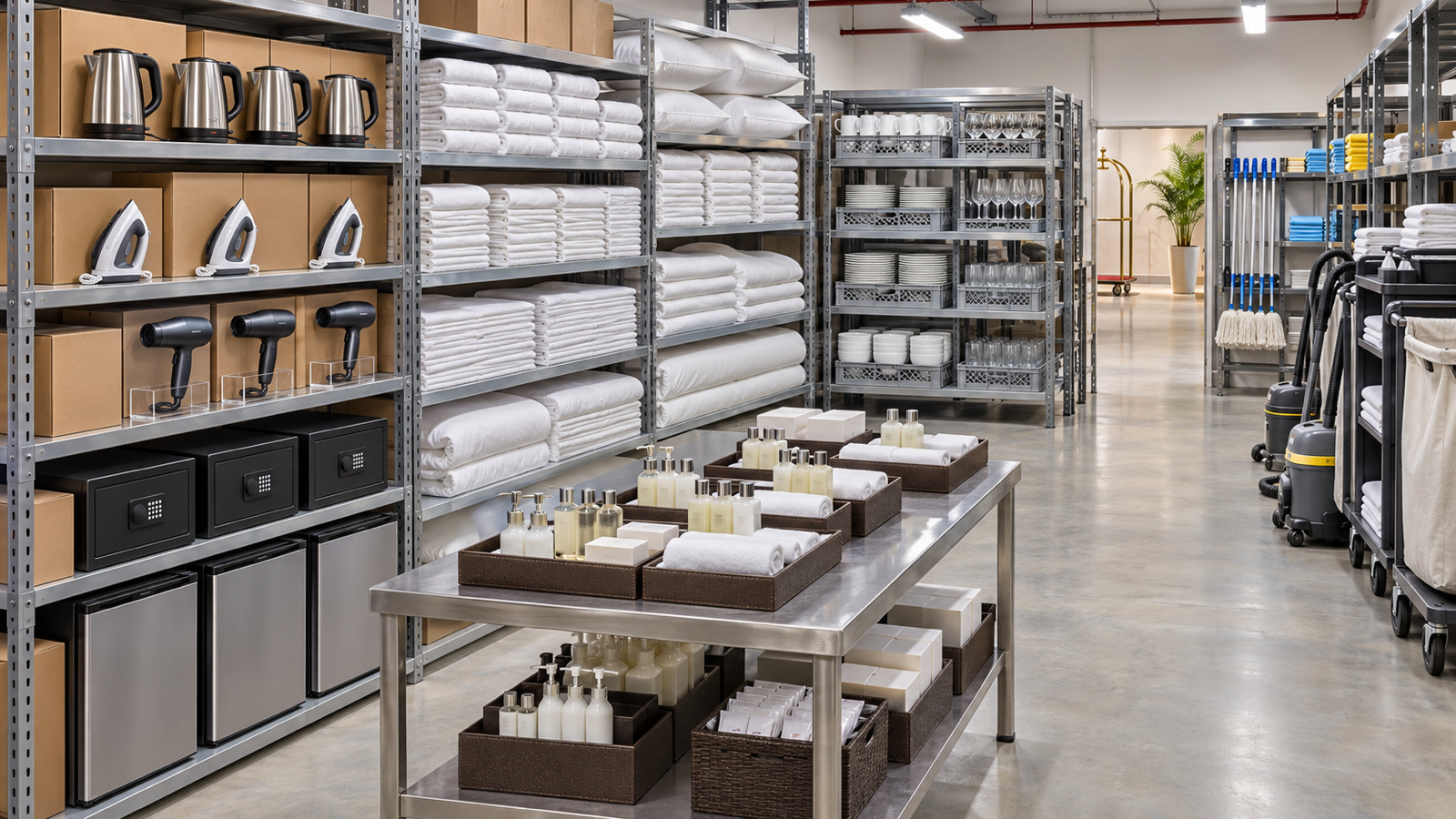
Hotel OS&E procurement works best as a department-owned register that connects each operating item to a quantity calculation, approval status, replenishment plan and delivery destination. The process is different from buying a single furniture package because many OS&E items are small, numerous, consumable, equipment-dependent or required only shortly before opening. A list of product names is therefore insufficient; the hotel needs a controlled route from operating standards to room- or department-ready inventory.
This article focuses specifically on procuring OS&E, not on re-explaining the general boundary between FF&E and OS&E. It shows how to structure categories, assign owners, calculate quantities, compare offers, coordinate interfaces and release deliveries so operating teams receive usable stock rather than an accumulation of cartons.
Begin With the Operating Model, Not a Supplier Catalogue
OS&E exists to run the hotel. The first inputs are therefore the operating concept, room count and room-type mix, food-and-beverage outlets, service model, staffing assumptions, brand or operator requirements and opening sequence. These inputs determine whether the hotel needs full in-room dining equipment, extensive banquet inventory, a limited minibar setup, spa operating items or a larger housekeeping reserve.
Supplier catalogues show choices; the hotel’s operating standard determines which choices belong on the list. Two properties with the same number of keys may need very different quantities because one includes several restaurants and event venues while the other offers a focused-service model. Procurement should start with approved operating requirements, then translate them into item families and count rules that can be checked.
Divide OS&E Into Department-Owned Categories
Department ownership makes the list usable: the people who approve, receive, use and replenish an item are all identified. The exact category names can vary by operator, but the structure should prevent items from disappearing between broad labels.
| Department or function | Typical OS&E families | Key quantity driver | Primary approval concern |
|---|---|---|---|
| Guestrooms | Linen, hangers, trays, bins, small appliances and accessories | Keys, room types and par level | Guest standard and equipment compatibility |
| Housekeeping | Carts, cleaning tools, room supplies and back-of-house equipment | Floors, work shifts and service model | Workflow, storage and replenishment |
| Food and beverage | Tableware, glassware, cutlery, service ware and small equipment | Seats, covers, turns and menu | Service sequence and replacement stock |
| Banqueting | Event tableware, mobile service equipment and accessories | Maximum event layout and concurrent use | Changeover and storage capacity |
| Kitchen and stewarding | Smallwares, utensils, racks and movable equipment | Menu, stations and production volume | Equipment interface and sanitation process |
| Front office and public areas | Luggage, queue, desk and guest-service items | Arrival volume and service standard | Accessibility, storage and appearance |
| Spa, pool and recreation | Treatment, towel, beverage and operating accessories | Treatment rooms, loungers and peak use | Wet-area suitability and hygiene process |
| Engineering and security | Portable tools, testing devices and operating equipment | Maintenance plan and asset base | Technical compatibility and control |
The category owner should define the operating need, but procurement still requires one coordinated master register. Without that common record, the same item may be purchased by two departments or omitted because each expects another package to provide it.
Give Every Item a Count Rule
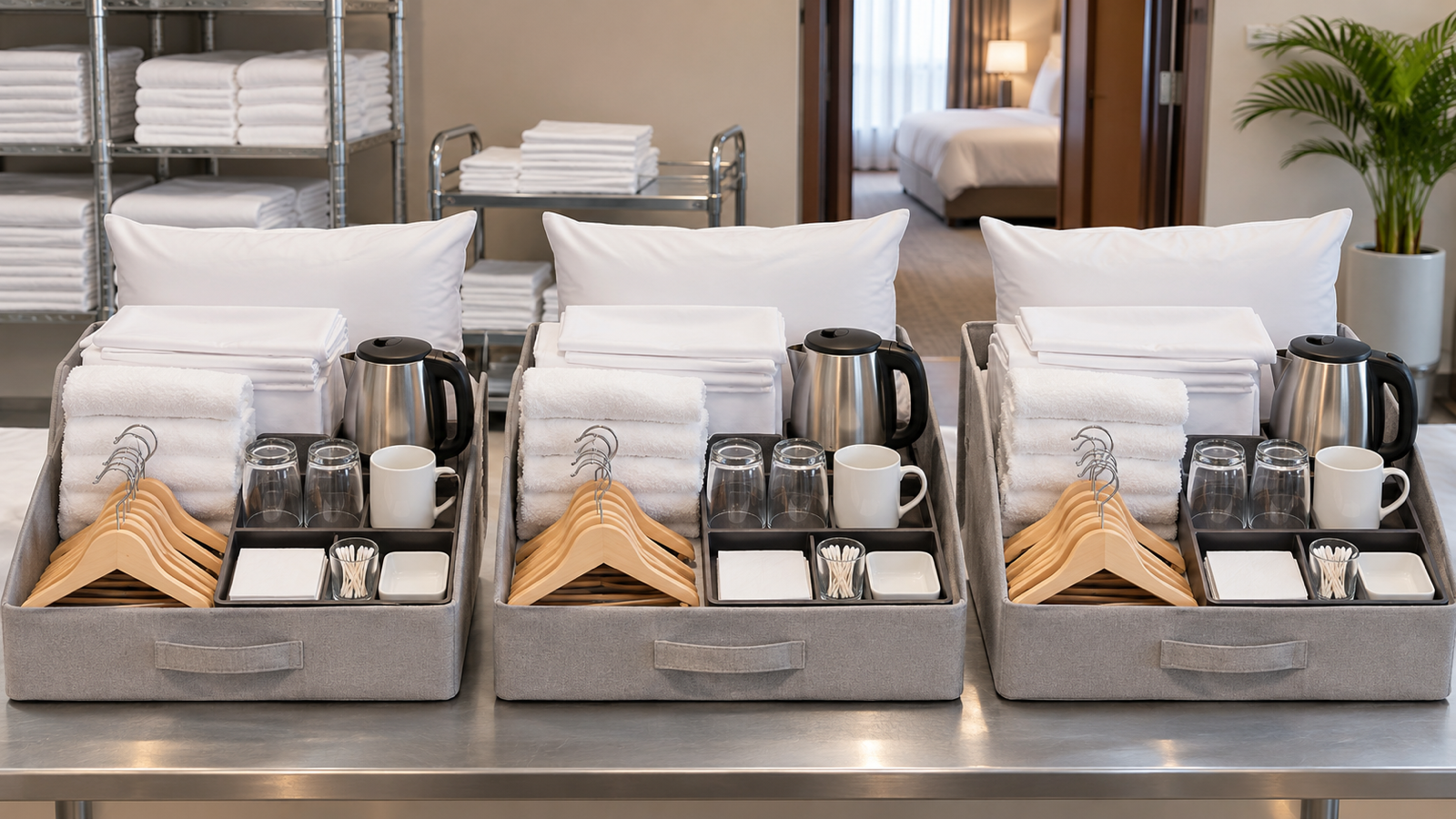
Choose the counting driver before setting a purchase quantity. Guestroom accessories may be counted per key; glassware may be driven by rooms, restaurant seats or service turns; housekeeping tools by floors, carts and shifts. Every register line needs the base population, units per location and any reserve or par assumption.
Take a hypothetical 120-room hotel that provides two reusable glasses per room. If the operator decides to plan on three sets in circulation to cover use, cleaning and storage, the initial working quantity is:
120 rooms × 2 glasses × 3 sets = 720 glasses
Here, three sets is an example assumption, not an industry-wide par level. The actual multiplier must reflect washing arrangements, breakage, replenishment, room occupancy and the operator’s policy. If the supplier packs twelve glasses per carton, 720 pieces equal 60 full cartons before any separate contingency or replacement allowance. Recording those steps makes the quantity auditable.
Separate opening stock from consumables and later replacement orders. An item that stays in service for months cannot be budgeted in the same way as an item used up in a week. Keep any provisional multiplier marked as provisional until the operating team approves it.
Define Each OS&E Line Beyond Its Product Name
“Kettle,” “wine glass” or “housekeeping cart” is not a complete procurement description. The line should include the application, size or capacity, material, finish or colour, required components, compatibility, packaging unit, cleaning or care condition and any approved sample or reference. Electrical items need the applicable voltage, plug, frequency, market requirements and interface with the room or equipment package.
For branded or guest-facing items, artwork, logos, colours and presentation may require additional approvals. Food-contact or hygiene-related items may need defined material or documentation requirements for the target market. The procurement team should request the evidence appropriate to the item and jurisdiction without treating a general supplier statement as proof for every product in the offer.
Substitution rules also belong in the line record. If an exact model is unavailable, the supplier should identify the proposed change against the controlled attributes rather than offer an unmarked equivalent. A replacement may preserve appearance while changing capacity, dimensions, electrical characteristics, cleaning method or compatibility with racks and storage.
Separate Three Kinds of OS&E Interface
Many operating items depend on something outside the OS&E package. Recognizing those dependencies early prevents an item from arriving that cannot be stored, connected or used.
First, physical interfaces concern size and fit. A minibar tray must fit its cabinet; a waste bin must clear a desk or vanity; a glass rack must match the selected glassware and warewashing system. Second, service interfaces concern power, water, drainage, charging or data. Small equipment may be movable but still rely on an outlet or utility provided under another package. Third, operating interfaces concern cleaning, refilling, transport and storage. A housekeeping cart may fit the corridor but not the service lift or back-of-house store.
Each critical interface should identify the related drawing, equipment model or operating rule and the person responsible for confirmation. This allows an OS&E purchase to be released on evidence rather than on the assumption that “small equipment” will work anywhere.
Build a Master OS&E Register That Teams Can Update
A practical register combines the specification with the decision trail. Start with these fields: item code, department, intended location, item specification, quantity formula, approved quantity, supplier, pack size, sample status, required delivery date, receiving owner and receipt status. Where a product fits furniture or equipment, add the drawing or model reference.
A shortened example shows how quantity basis and status appear in the same row:
| Code | Department / item | Quantity basis | Working quantity | Interface or purchase unit | Status |
|---|---|---|---|---|---|
| OS-001 | Guestrooms / reusable glasses | 120 rooms × 2 × 3 sets | 720 pcs | 12 pcs/carton; cabinet shelf to be checked | Pending sample |
| OS-002 | Guestrooms / minibar tray | 120 rooms × 1 | 120 pcs | Tray dimensions against minibar drawing | Fit check open |
| OS-003 | Housekeeping / service carts | Approved carts per shift | TBD | Store and service-lift dimensions | Quantity pending |
*Illustrative entries only; neither quantities nor statuses describe an actual hotel project.*
The master total should reconcile with the room-type and outlet matrices. Procurement can filter the record by supplier, while housekeeping or F&B can filter by destination, without creating competing lists. The existing guide to FF&E and OS&E boundaries helps classify ambiguous items before the purchasing workflow begins.
Normalize Supplier Offers Before Comparing Price

Quoted pack prices can look attractive but obscure the real unit cost and ordering constraint. Compare offers against the same approved quantity, product specification and delivery basis before choosing a supplier.
Suppose the hotel needs the 720 glasses in the preceding example:
| Illustrative offer | Quoted price | Converted unit price | Price for 720 pieces |
|---|---|---|---|
| Supplier A | US$48 per carton of 12 | US$4.00 each | US$2,880 for 60 cartons |
| Supplier B | US$3.80 per piece | US$3.80 each | US$2,736 before any excluded charges |
These prices are fictional and only demonstrate the arithmetic. Supplier B's apparent US$144 advantage may disappear if freight, breakage replacements, minimum orders or required documentation are excluded. Supplier A may be unsuitable if its carton contents, rim profile or cleaning compatibility fail the approved specification, regardless of price.
A proper bid comparison also records offered model, material, capacity, finish, packaging, minimum order quantity, sample status, production time, delivery terms and deviations. For reusable hotel-specific pieces, check whether a matching item will be available for reorders. That is part of operational cost, not merely a purchasing convenience.
Use Samples According to the Risk of the Item
Not every low-value item requires a full formal prototype process, but guest-facing, fit-critical, branded, electrical or high-quantity items deserve an appropriate sample or evidence review. The review should test the aspect that matters: a tableware setting can be assessed for scale, stackability and service; a guestroom appliance can be checked for controls, plug, noise and storage; a bin or tray can be placed in the actual furniture location.
Sample approval should record the supplier, model, material or finish, date, reviewer and any limitations. If an item is approved only for appearance, technical or market evidence remains a separate decision. A reference sample should be protected and identified where production colour, finish or form must be compared later.
The sampling plan can group related items into operating scenes. Reviewing a complete guestroom accessory set or restaurant place setting often reveals proportion and compatibility issues that item-by-item approvals miss. The scene does not replace line-level records; it makes the relationships visible before quantities are committed.
Sequence Purchasing Around Opening Readiness
OS&E should not all arrive at the same time. Long-lead customized items may require early commitment, while consumables and easily damaged guest supplies may be better delivered closer to opening. The delivery plan should consider warehouse availability, fit-out completion, staff training, venue commissioning and the sequence in which rooms or departments are handed over.
A practical wave plan may separate early technical equipment, training and setup items, room- or venue-ready packages, opening stock and final top-up quantities. Each wave needs a receiving location and owner. Delivering a container of mixed cartons to an unfinished site transfers sorting and loss risk to the project; packing and labels should support the way the hotel intends to distribute the goods.
Room kits, outlet kits or department kits can reduce site handling when the item mix and counts are stable. However, kit contents should reconcile to the master register, and exceptions must remain visible. A missing component inside a sealed kit can affect hundreds of rooms if the discrepancy is discovered only during distribution.
Receive, Count and Commission the Inventory
Receiving should verify item identity, quantity, condition and documents against the purchase and packing records. Count methods can vary by risk and packaging: high-value or fit-critical items may require direct inspection, while repetitive sealed packs may use an agreed sampling and reconciliation method. Damaged, short or mismatched items need a location, evidence record and resolution owner so they do not disappear into a general snag list.
Electrical or operating equipment may require commissioning, setup or staff familiarization before it is considered ready. Guestroom appliances should be placed and checked in the intended room setup; restaurant and housekeeping items should be tested through representative service motions. The handover is complete when the relevant department accepts usable inventory and receives the information needed for care, replacement and future ordering.
Keep OS&E and Furniture Connected Where They Meet
OS&E procurement remains separate from furniture manufacturing, but the two scopes meet at guestrooms, minibars, wardrobes, vanities, restaurants and service areas. Furniture openings, shelves, power access and equipment clearances should reflect the approved operating items. Conversely, OS&E buyers need the current furniture information before committing to trays, bins, appliances or organizers that must fit within it.
For example, the casegoods and storage category includes wardrobes, minibars and cabinetry that may receive operating accessories or equipment. The furniture item and the OS&E item should retain separate codes and owners while sharing a controlled interface. A change to either side should trigger a review of fit, access, ventilation or service where relevant.
Close Procurement With an Operating Record
Receiving records should reconcile the approved register to ordered, delivered, distributed and accepted quantities. Store spare stock and reorder details separately from the opening-room allocation. Department sign-off means the items are usable in the intended location, not just that cartons reached the building.
OS&E buying is normally a separate scope from custom furniture manufacturing. The critical overlap occurs where a tray, appliance, safe or accessory must fit a minibar, wardrobe, vanity or other casegood. Gainwell coordinates hospitality furniture with these equipment interfaces; for a hotel furniture interface review, provide the approved accessory and equipment list, the furniture drawings, room quantities and programme.
Frequently Asked Questions
Should consumables be included in an opening OS&E budget?
They can be, if the scope defines them clearly. Separate the initial consumable purchase from reusable equipment and reserve stock. Record the coverage period and quantity basis so operating expenditure is not confused with a one-time opening requirement.
How should minimum order quantities affect the OS&E list?
Compare each supplier minimum with the calculated operating need, storage capacity and likely reordering cycle. Excess inventory may be justified for a hard-to-match item; for a standard item, changing the supplier or pack format may be better than buying unnecessary stock.
When does an OS&E substitute need new approval?
Review a substitution when dimensions, capacity, materials, electrical characteristics, cleaning method, appearance or equipment compatibility change. Record the proposed model and affected locations before purchasing, rather than treating the replacement as an undocumented equivalent.
What happens if an OS&E item does not fit the furniture?
Check the approved equipment or accessory model against the furniture drawing and its revision. Determine whether the error came from a changed product, incorrect dimension, unapproved substitution or furniture opening. Resolve it before repeating the same mismatch across guestrooms; keep the corrected interface in both records.