

A finished hotel suite contains two different control systems. The sofa, lounge chair, tables and cabinetry shape the physical space. The cups, tray, linen, guest supplies and service tools help the operating team run it. If both groups remain in one undifferentiated shopping list, quantities, approvals, storage and handover can break in different ways.
In practical hotel project terms, FF&E primarily equips the space; OS&E primarily equips the operation. FF&E means furniture, fixtures and equipment. OS&E means operating supplies and equipment. Durability and replenishment frequency are useful clues, but neither is a universal rule. The project’s operator standards, contracts, accounting policy and responsibility schedule must confirm the final boundary.

FF&E vs OS&E: the short project answer
| Control question | FF&E track | OS&E track |
|---|---|---|
| Primary job | Equip and define the guest, staff or public space | Enable the team to operate, clean, serve, replenish or support that space |
| Typical quantity starting point | Room type, area, layout, item code and configuration | Department, service method, operating capacity, turnover, cleaning cycle, storage and reserve policy |
| Approval focus | Dimensions, construction, finish, coordination, representative sample or prototype | Function, capacity, compatibility, handling, cleaning, storage and operational acceptance |
| Delivery question | Where will the coded asset be installed, placed or connected? | Where will stock be received, counted, stored and issued? |
| Handover question | Is the location complete and is the asset identifiable? | Is the opening quantity received, usable and under departmental control? |
| After opening | Asset care, repair, replacement and contracted records | Consumption, laundering, breakage, rotation, replenishment and inventory control |
The table is a coordination aid, not an accounting test. An item can be durable and still belong to an operating package. Another can be movable but remain part of the project’s furniture scope. Classification has value only when it tells the project which schedule, buyer, approval route, receiving path and owner will control the item.
Walk one hotel suite through both schedules
Start with the intended room outcome, then split the assets and operating contents. A suite may need a bed or sofa, bedside units, a desk, chair, luggage bench, tables, decorative lighting, window treatment and a minibar cabinet. Those elements are commonly coordinated through the FF&E or related fixed-furniture schedules because their dimensions, finish, location and interfaces shape the space.
The same suite may need sheets, towels, hangers, glasses, cups, a tray, waste-bin liners, cleaning tools, guest amenities and replacement consumables. Those items usually follow the OS&E or departmental opening schedule because the operator must define how many are in use, in cleaning, in storage or held as reserve.
Do not split the schedules and walk away. Reconcile them around functional assemblies. A minibar station can contain a furniture cabinet, an appliance, glassware, tray items and consumable stock. Each component needs one control route, while the complete station still needs one owner to confirm fit, power, ventilation if applicable, placement, stocking and readiness.
Compare the quantity logic before arguing about the acronym
A product name does not expose its quantity risk. Quantity logic often does.
For FF&E, the team may begin with the room matrix and ask how many instances of each room type exist, which layouts differ, which items are mirrored or handed, and whether an approved spare basis applies. The code should connect each quantity to an area and configuration.
For OS&E, the team may need to model operational use: service capacity, occupancy or covers, the number of shifts, items temporarily in cleaning or laundry, breakage exposure, storeroom capacity and the approved reserve or replenishment policy. A single room count may therefore be the wrong multiplier.
Record the formula, inputs, owner and date beside the quantity. Avoid copying a generic percentage or “par” number from another hotel without checking the operating model. The useful question is not only “How many?” but “What conditions make this quantity sufficient?”
Use five controls to classify an ambiguous item
- Purpose: Does the item primarily complete the physical space, or enable a department to operate and serve?
- Quantity basis: Is it counted by room and layout, or by service activity, rotation, cleaning and replenishment?
- Physical interface: Does it need dimensions, fixing, power, plumbing, ventilation, protection or coordination with another trade or furniture assembly?
- Handover state: Is success an installed and identified asset, or counted stock that a department can receive and issue?
- Replenishment owner: After opening, who maintains, replaces, launders, consumes or restocks it?
If the answers point in different directions, do not force the whole assembly into one acronym. Break it into components, appoint an interface owner and record the decision. If a contract, brand standard or accounting policy uses another classification, retain that rule and make the operational handoffs explicit.
Resolve boundary items by complete assembly
The examples below show questions to resolve, not universal classifications.
| Boundary assembly | Possible FF&E-controlled component | Possible OS&E-controlled component | Interface decision |
|---|---|---|---|
| Minibar station | Cabinet, counter, integrated panels and coordinated appliance opening | Glassware, tray, opener, stock and replenishment materials | Appliance model, ventilation, power, shelves, loading sequence and stocking owner |
| Coffee or tea station | Console, cabinet, shelf and coordinated power access | Kettle or brewer if operator-supplied, cups, spoons, tray and consumables | Equipment dimensions, heat and cleaning clearance, cable route and restocking layout |
| Guestroom television | Mounting panel, credenza or joinery interface | Operational accessories or department-controlled devices where the project assigns them | Screen model, bracket, power/data point, ventilation, controls and commissioning owner |
| Window treatment | Track, motor, valance or coordinated decorative treatment where included | Operating or replacement accessories if separately assigned | Opening direction, controls, power, maintenance access and final dressing |
| Banquet service station | Mobile or fixed cabinet and protected work surface | Service tools, trays, linen and inventory loaded into the station | Capacity, movement route, storage location, protection and departmental ownership |
| Decorative light | Fixture, shade and furniture or wall interface where assigned to FF&E | Portable accessories or replacement stock if separately controlled | Electrical responsibility, mounting, lamp specification, access and acceptance |
For every assembly, identify the component breakdown and the final integration check. This prevents the cabinet supplier, electrical team and operating buyer from each assuming that someone else owns the missing adapter, bracket, shelf, tray or consumable.
Turn classification into a responsibility record
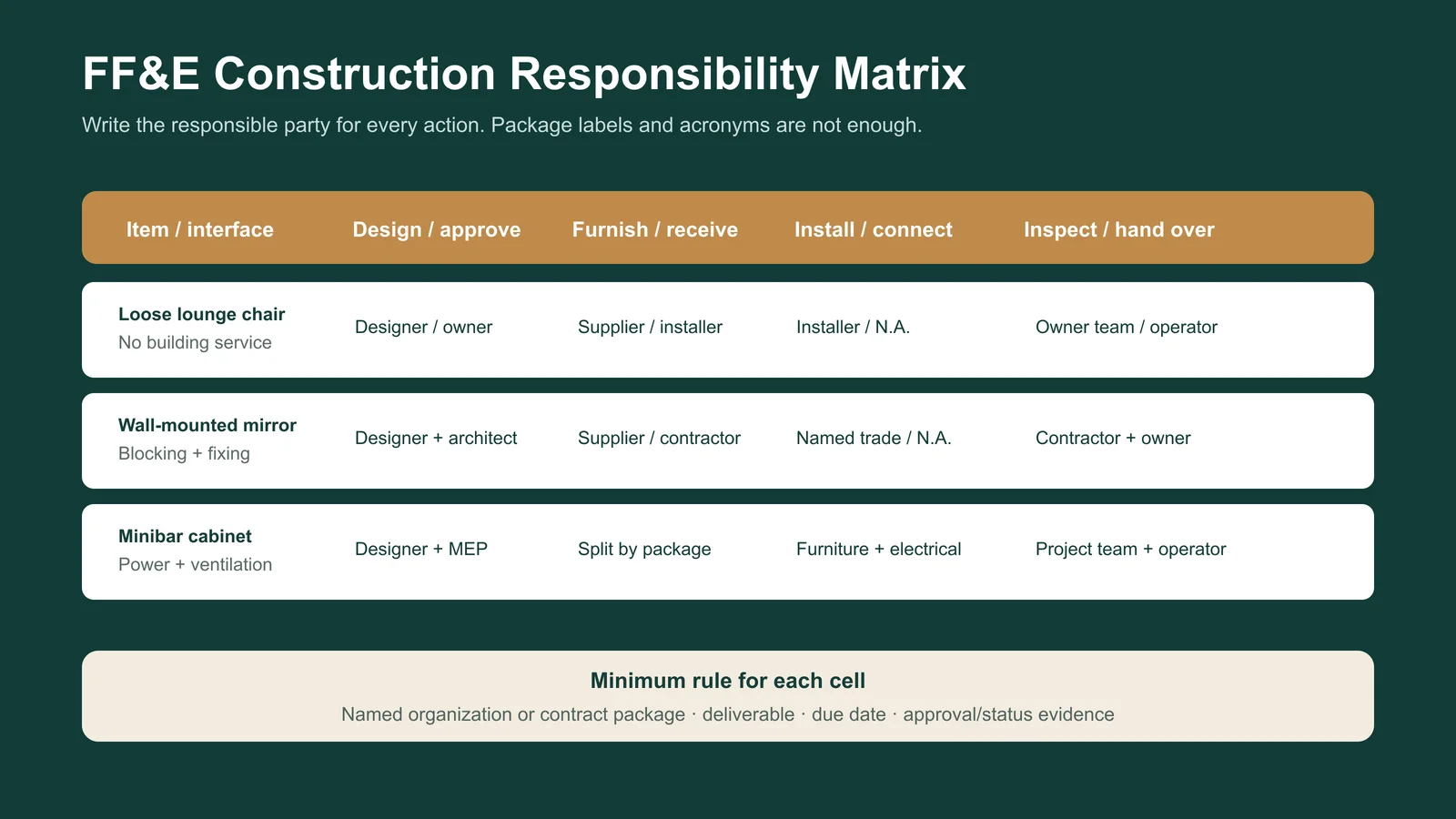
Give each item or component one source schedule. Then record who specifies or approves it, who buys it, who receives it, who installs or connects it where required, who inspects it and who accepts it for operation. A category label by itself does none of that work.
Use role names rather than assumptions about company types. A furniture manufacturer can own a cabinet but not the appliance inside it. An OS&E buyer can supply a device but not the power point. An operator can accept a stocked room without approving the furniture finish. The live appointment must decide each responsibility.
Give each track the right approval evidence
FF&E approval commonly needs coded drawings, dimensions, material and finish references, hardware, interfaces, samples or prototypes, packaging rules and an authorized release status. The objective is to prove that the asset being produced matches the coordinated requirement.
OS&E approval often needs a different evidence set: intended operating use, capacity, dimensions where storage or equipment fit matters, compatibility, cleaning or care method, handling, sample acceptance, packaging units and the department authorized to accept it. A visual sample may not prove operational suitability.
Keep the evidence proportional to the item and project. Do not copy test, compliance or certification requirements without confirming the product, market and reviewing authority. When an OS&E component touches a furniture assembly, share the approved physical data early enough to coordinate the interface.
Run separate purchasing tracks with shared interface gates
FF&E and OS&E may need different suppliers, approval calendars, consolidation routes, storage conditions and receiving teams. Keeping them separate can make control clearer. Separating them completely can make the room fail.
Create shared gates only where the tracks meet. Before releasing a minibar cabinet, confirm the selected appliance and operating contents. Before finalizing a service station, confirm tray or equipment dimensions and loaded weight assumptions provided by the responsible reviewer. Before delivery, confirm whether the destination is an installation area, consolidation warehouse, OS&E storeroom or department issue point.
This page does not repeat the full commercial tender and award workflow covered by Gainwell’s separate FF&E procurement guide. The key rule here is simpler: every boundary interface must be resolved before either track makes an irreversible commitment.
Prevent double-buy and silent omission
Reconcile both schedules by item code, plain-language name, room or department, component assembly and responsible buyer. Search for synonyms—such as kettle versus beverage appliance, waste bin versus litter receptacle, or service cart versus trolley—because duplicate names can hide the same intended function.
Apply a one-source rule: one component has one controlling schedule and one approved quantity. The other schedule may reference it as an interface, but should not create a second order. If neither schedule owns it, place it in an open-decision log with an owner and due date rather than hiding it in meeting notes.
A useful reconciliation review asks:
- Does every guest and staff function have the physical asset and operating contents it needs?
- Is any item purchased twice under different names or package codes?
- Do quantities use a visible and approved basis?
- Are appliance, furniture and building-service interfaces coordinated?
- Is the receiving location appropriate for installation or inventory?
- Can the final operating owner identify what it must inspect, store and replace?
Handover the space and the operating inventory separately
Installed-area readiness asks whether the coded assets are in the correct location, coordinated, protected, inspected and recorded, with exceptions assigned. Operating-inventory readiness asks whether approved opening quantities have been received, counted, stored, issued and accepted by the responsible department.
The two states can be linked without being confused. A guestroom may have a complete minibar cabinet but no approved glassware or opening stock. A storeroom may contain operating supplies while guestroom furniture remains inaccessible or incomplete. Report each state honestly, then define the joint room or area release that the operator requires.
Build a dual-track FF&E–OS&E register
One combined oversight register can point to the detailed schedules without merging their different quantity and operating logic. Include at least:
- component code, name and parent assembly;
- room, area or operating department;
- controlling track: FF&E, OS&E or another named package;
- quantity, unit and documented quantity basis;
- specification and approval reference;
- buyer or contracting party;
- physical interface and interface owner;
- receiving point, storage or installation route;
- handover evidence and acceptance owner;
- post-opening maintenance, replacement or replenishment owner;
- current status, open decision and due date;
- revision and change record.
This is the bridge between design completion and operational readiness. It lets the team preserve different specialist schedules while exposing the exact points where one depends on the other.
Where does Gainwell’s scope fit?
Gainwell’s current hospitality furniture product scope centers on loose, fixed, upholstered, outdoor and specialty furniture. Its luxury-hotel solution covers furniture requirements across guest rooms, suites and public areas. That can form a defined FF&E or furniture package within a wider project, but it does not establish that Gainwell supplies every OS&E item visible in the same room.
A live enquiry should identify the furniture item codes, drawings, quantities, finishes, appliance or operating-item interfaces, required approvals, destination and requested services. Gainwell can then confirm what is included, what information is needed from adjacent packages and what remains with the owner, operator or another supplier.
What proves the boundary is controlled?
The job is complete when every component has one source schedule, an approved quantity basis, a named buyer, resolved physical interfaces, a receiving route, defined handover evidence and a post-opening owner. The two schedules should reconcile without duplicate orders, unowned gaps or assumptions hidden inside package names.
No FF&E–OS&E chart can decide accounting, tax or contractual treatment for every hotel. Use this lifecycle method to expose the operational decision, then obtain the required project-specific approvals.
If Gainwell furniture sits inside a minibar, coffee station, guestroom, suite or public-area package, share the coded scope and interface schedule with Gainwell. The team can review the furniture boundary before technical development or commercial release begins.