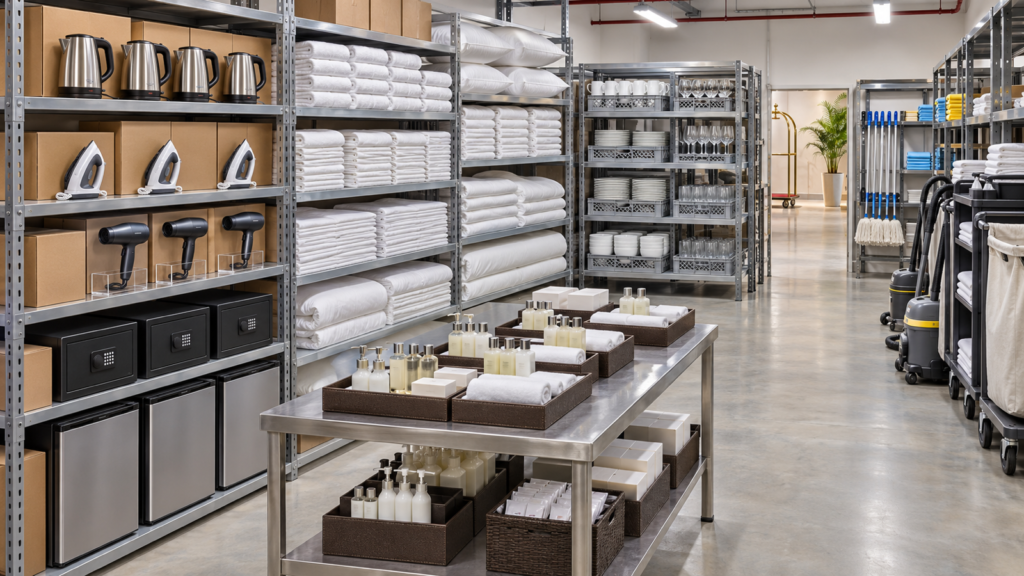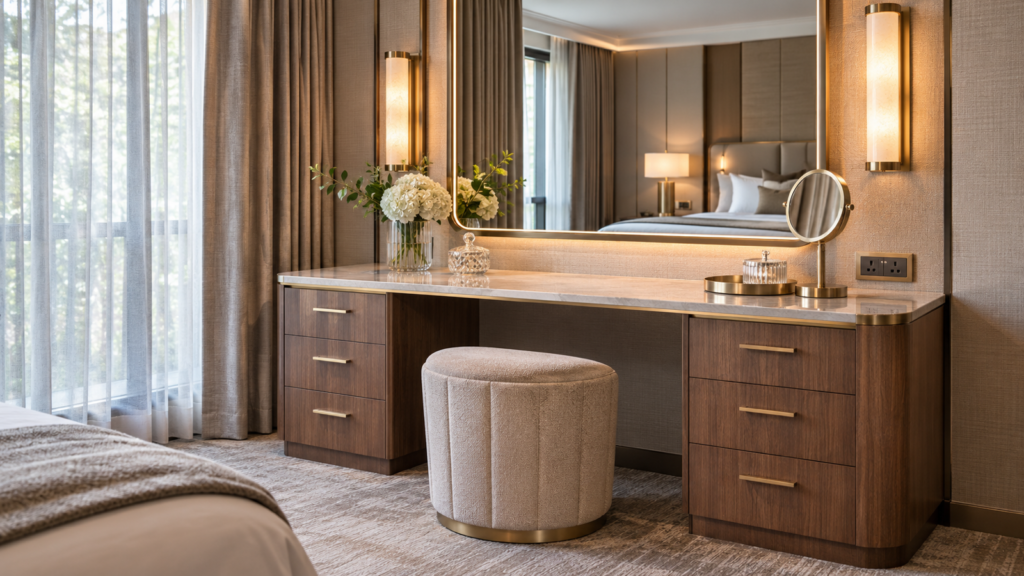

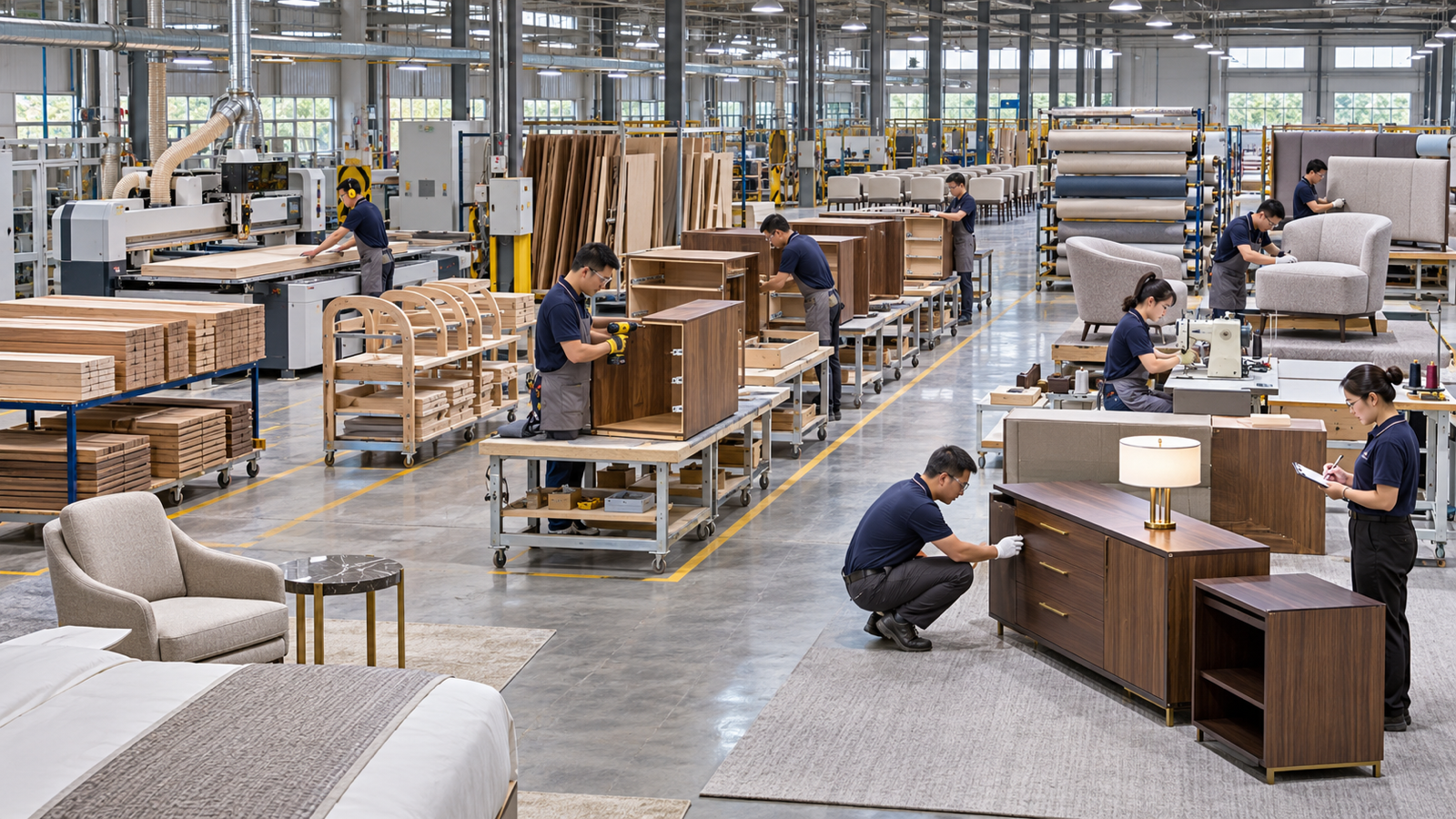
Inside a hotel furniture factory, a custom order moves from approved drawings and a physical sample into material preparation, specialist production, finishing, assembly, inspection and project-coded packing. A hotel minibar cabinet does not follow the same path as an upholstered lounge chair: one depends heavily on accurate panel machining, hardware and equipment openings; the other adds frame strength, suspension, foam and fabric tailoring. Both must arrive as the version the project approved.
For a buyer, the important questions are practical. What actually happens at each stage? What can go wrong before the furniture looks finished? How can the factory show that the approved sample matches the batch being packed? The following walkthrough uses two typical furniture routes to make those checks visible. Specific machines, subcontracted operations and inspection plans vary by factory and contract; the examples are process illustrations, not a claim that every order follows an identical line.
The Production Route, from Drawing to Carton
A single item code connects work that may take place in several workshops. The critical stages and evidence are:
| Stage | What happens to the furniture | What a buyer can verify |
|---|---|---|
| Technical preparation | Renderings become buildable details and component lists | Current shop drawing, hardware, finishes and service interfaces |
| Prototype and approval | A representative unit or mock-up is made and adjusted | Signed sample, approved materials and recorded changes |
| Material preparation | Timber, boards, veneer, fabric, metal or stone are checked and allocated | Material identity, finish reference and any required reports |
| Component production | Panels or frames are cut, joined, shaped and prepared | First-piece checks and dimensions before defects repeat |
| Finishing and upholstery | Surfaces are finished; seating receives foam and covers | Comparison with the approved appearance and comfort reference |
| Final assembly and inspection | Doors, drawers, cushions, hardware and joined materials are checked | Functional results, issues closed and correct item quantity |
| Packing and release | Goods are protected, labelled and matched to shipment documents | Carton IDs, item codes, destination and accepted release status |
Not every item passes through every stage. A stone-topped console may involve separate stone and metal fabrication; a fixed headboard wall needs verified installation interfaces. Those routes converge before the completed item is accepted and packed.
Before Cutting: Resolve the Drawing and Prove the Sample
The factory first needs more than a perspective rendering. An item schedule identifies what is being made, how many units are needed and where each belongs. Shop drawings define finished dimensions, sections, joinery, hardware positions, material build-ups and assembly details. A bill of materials links those drawings to the actual components. If the order includes different room types, handed units or finishes, those variants need separate, traceable identities.
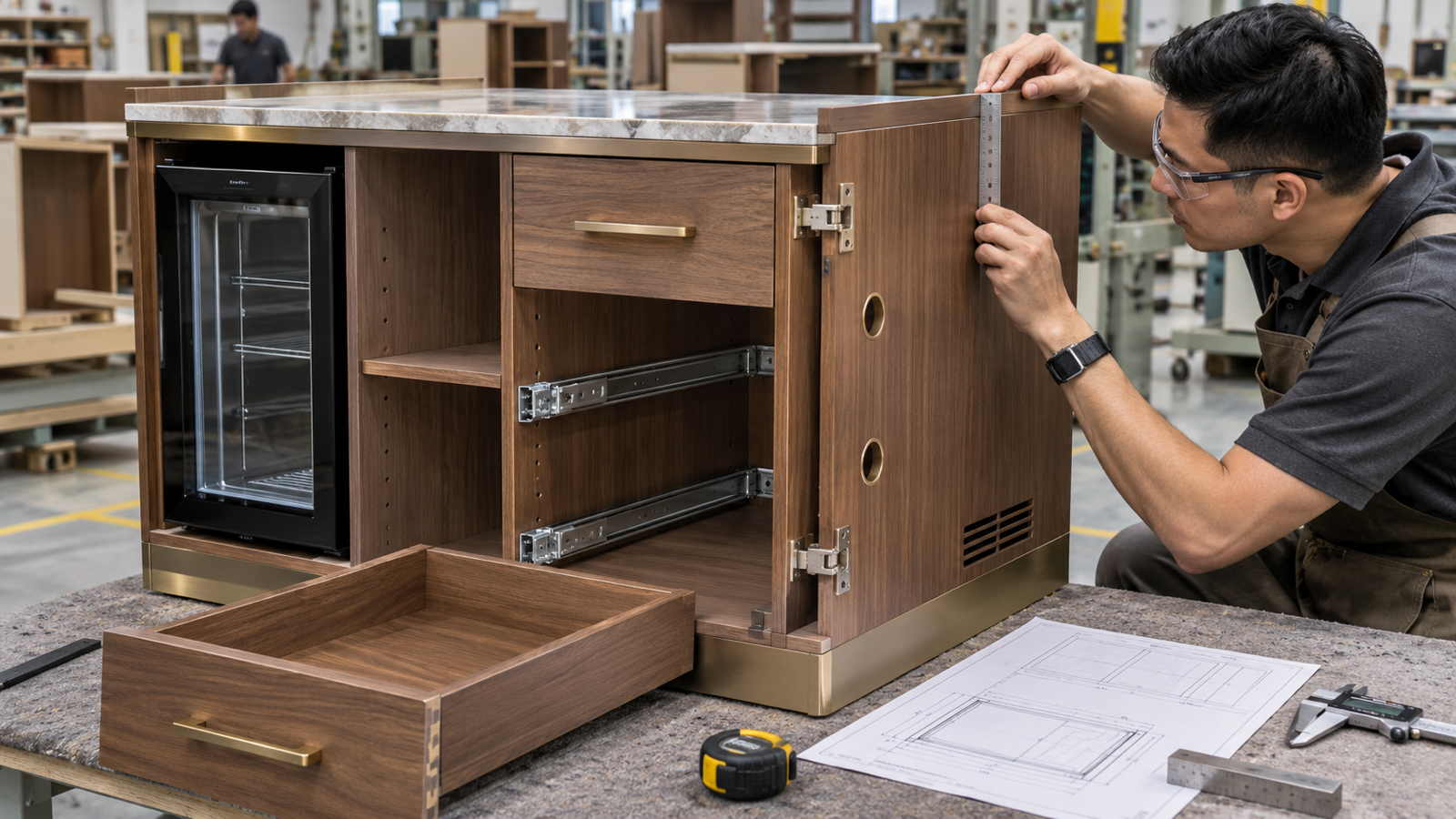
Consider a custom minibar cabinet. The elevation may show doors and shelving, but the production drawing also needs the approved refrigerator model, the opening around it, hinge swing, cable route, ventilation requirement and a way to replace the appliance later. If the refrigerator model is still undecided, cutting the cabinet openings to a guessed size risks producing an entire batch that must be modified.
A prototype brings those decisions into physical form. The project team can open a cabinet door, inspect the edging, confirm drawer movement and compare the finish with the intended room palette. For seating, reviewers also sit in the chair and check comfort, posture and arm height. A sample approved only for appearance is not automatically approved for construction or performance. The hotel furniture prototype review guide covers that decision in more detail.
Once changes are agreed, the drawings and sample references have to match. A photograph of a corrected prototype does little good if the workshop is still working from the previous drawer detail. The production handover should make the approved version unambiguous.
Material Receiving and Production Routing
After approval, the factory prepares and checks the materials required for that order. Panel substrates, timber and veneer are checked against the item specification; upholstery rolls are checked for the intended colourway, pattern and usable quantity; hardware is matched to the approved part. Stone, metal and glass components may be fabricated separately and introduced later during assembly.
Material variation needs a plan rather than a promise of perfect uniformity. Natural veneer may differ from sheet to sheet, while fabric or coated components can vary by lot. For a run of guestroom nightstands, the buyer may expect a reasonably consistent appearance across many rooms; for a lobby feature console, a specific matching arrangement may be required. Approved physical references and allocation rules help the factory manage those two situations differently.
The order is then split into suitable production routes. The table below follows two common examples; each is intentionally simplified so the stages can be understood without pretending every workshop uses the same equipment.
| Custom minibar cabinet | Upholstered lounge chair |
|---|---|
| Prepare panels and veneer or laminate | Cut and join structural frame members |
| Machine openings, hardware holes and edges | Check frame geometry and reinforced connections |
| Dry-fit or assemble the carcass | Install suspension and build the foam profile |
| Apply specified surface finish where required | Cut, sew and fit the approved upholstery |
| Fit doors, drawers and hardware | Check tailoring, comfort and stability |
| Check appliance clearance and access | Inspect fabric alignment and exposed edges |
The point is not that one route is automatically better. It is that the right checks happen before an error becomes hidden or multiplied across a batch.
Casegoods: What Happens Between Panel Cutting and a Working Cabinet?
A typical casegood route starts with prepared boards or solid components. Panels are cut to the current dimensions; edges are treated; holes and grooves are made for connectors, hinges, shelves and drawer runners. At this stage, a misplaced fixing hole can affect every door gap downstream. Checking a first completed set of panels helps catch that problem before many units are assembled.
The cabinet body is joined and checked for square, level and correct dimensions. Doors and drawers are then fitted and adjusted. On a minibar or wardrobe, the test is not simply whether a door opens: it is whether it clears adjacent furniture, whether shelves are usable, and whether the selected equipment can be inserted, ventilated and serviced. Hidden cable passages and reinforcements are easier to inspect before the back or top is permanently closed.
Finishing may happen to individual components or a larger assembly, depending on the material system. Veneered doors, exposed edges and the cabinet body need to read as one product. For a repeated hotel package, even a small mismatch in sheen or edge detail can become noticeable across dozens of rooms.
Imagine the refrigerator supplier changes its appliance depth after the first cabinet sample is approved. The factory must check the new model against the opening depth, door movement, airflow and service access before releasing the remaining run. Reworking one trial cabinet is possible; discovering the mismatch after 120 cabinets are packed is a much larger problem. The casegoods and storage collection shows furniture families where these interfaces regularly matter.
Upholstered Seating: The Work Hidden Beneath the Cover
An upholstered chair begins with a stable, dimensionally correct frame. Joints and reinforcements deserve attention at the back and arms, where repeated use can concentrate force. Before the cover goes on, the workshop can inspect the support arrangement, suspension and foam build-up. Once the chair is upholstered, many of those details are difficult to assess without dismantling it.
Foam shapes the seated feel as much as the visible silhouette. Changing density, layer thickness or edge profile may alter comfort even when the chair looks almost identical to the approved prototype. Suspension and webbing also influence how the cushion behaves under load. For that reason, the sample review should record the construction basis behind a comfort approval rather than relying only on a photograph of the finished seat.
Fabric cutting and sewing bring their own controls. Directional patterns, seams, piping and shade matching must be planned across chairs produced in quantity. A striped fabric can make alignment differences obvious; a plain fabric may reveal unwanted tension or puckering around an arm. A first finished chair is useful for checking tailoring before the remaining covers are cut or fitted.
At final assembly, the chair needs a functional and visual review: does it sit level, feel stable, match the intended seat height, and show the specified stitch and finish details? Material abrasion data helps with fabric selection, but it does not prove the strength or comfort of the whole chair. Those issues require their own relevant tests and sample checks.
Finishing and Inspection: Catch Problems Before They Are Hidden
Surface finishing is not one final cosmetic spray. Preparation, sanding, coating, drying or curing, and handling between stages influence the result. A painted cabinet door may need a different process from a stained veneer panel or powder-coated metal base. The approved colour, grain direction and sheen remain the comparison points, but the factory also checks the condition of corners, edges, joints and high-contact surfaces.
Inspection has the most value at the stage where a defect is still visible. A completed chair can be inspected for overall appearance, but not every concealed frame joint. A finished wardrobe can be tested for door operation, but a hidden fixing detail may already be inaccessible. A useful in-process check plan ties each risk to the point where it can be seen:
| Inspection moment | Example check | Risk if postponed |
|---|---|---|
| First machined cabinet parts | Dimensions, hole positions, edge quality | Same mismatch repeated across all parts |
| Cabinet before closing | Internal supports, cable route, appliance opening | Hidden rework after finishing |
| Chair frame before covering | Joints, suspension and foam build-up | Defect concealed beneath upholstery |
| First finished piece | Finish reference, seams, hardware fit and function | Large batch finished to wrong standard |
| Final assembly | Stability, gaps, moving parts, quantity and accessories | Costly repairs after packing or delivery |
The checks above are examples, not an inspection protocol for a specific project. Contractual testing, sampling, fire-safety or other market requirements still need their own defined evidence. A nonconformance record should connect the issue to the item or batch, state the fix and show that the corrected work was rechecked.
Packing, Site Delivery and Shipment Release
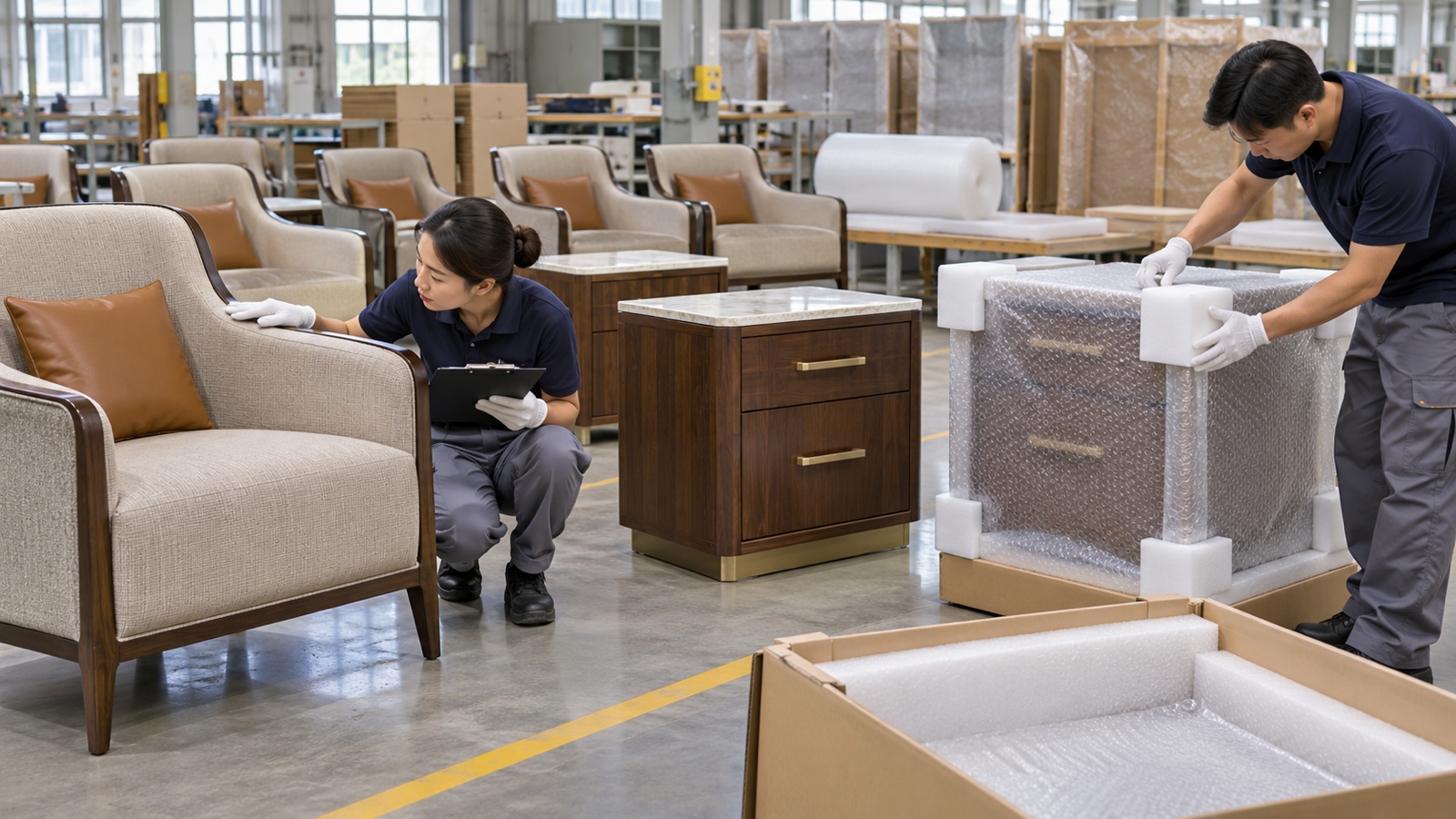
A chair, a glass-topped table and a tall wardrobe do not need identical packaging. Exposed legs, glass, finished corners and soft upholstery are vulnerable to different handling risks. The factory selects protection and packing form with the product and delivery route in mind; large furniture may be shipped fully assembled, in modules or knocked down depending on access and installation needs.
The packing label should make the carton identifiable without opening it. A useful label ties together the project, item code, room type or destination, finish variant, component count and carton sequence. Hardware packed separately needs an obvious link back to the unit it belongs to. At the loading stage, those records should reconcile with the purchase and delivery schedule.
“Manufactured” is not the same as “released for shipment.” Before dispatch, the project and factory need accepted inspection status, a clear record of any exceptions, correct quantities, protective packaging and required documents. A shipment can be physically complete yet still be held because a finish exception has not been approved or the site cannot receive the goods safely.
For a phased hotel opening, batches may be grouped by building, floor or room type. That changes labels and load planning, not just transport dates. An item delivered to the wrong floor creates rehandling risk even if the furniture itself is perfect.
What to Ask During a Factory Visit or Video Review
An impressive machine or tidy showroom can be useful context, but a stronger review follows one item from its approved drawing to the carton. Ask to see how the same item code appears on the shop drawing, work instructions, material reference, first-piece check, final inspection and packing list. If a design detail changed last week, ask how the factory prevented the old version from continuing down the line.
For a real-world illustration of the stages, the manufacturing video library includes factory tours and demonstrations of table-making, woodworking, upholstery, sanding and hand-painting. Published footage can help a buyer visualize operations that text describes. It is not a substitute for inspecting the equipment, workforce, relevant order records or current production location for a specific contract.
A short review can focus on four questions: What was approved? Where is the first-piece reference? What is checked before the work is covered or finished? How does the packed item retain its destination identity? Clear, project-specific answers are more informative than a general claim of “strict quality control.”
From Factory Process to a Reliable Hotel Furniture Order
The value of a controlled production route is visible in the finished room. Cabinet drawers work, seating feels consistent, finishes match the approved palette, and the correctly labelled pieces arrive where installation teams need them. Those outcomes depend on decisions made long before the shipping container is loaded.
Gainwell describes a Guangdong manufacturing base focused on technical development, mock-ups, bespoke mixed-material furniture and fixed-furniture coordination, alongside a Vietnam production base with scalable wood-furniture and painted-finish capacity. Its published capabilities and manufacturing overview explain the wider project workflow. A specific order's factory allocation, sequence, tests and deliverables still need confirmation in the project brief. For a custom hotel furniture enquiry, send drawings, quantities, material direction, project location and required completion dates.
Frequently Asked Questions
What happens after hotel furniture shop drawings are approved?
The factory aligns the current drawing revision with its material list and approved samples, then releases the relevant materials and work instructions. A representative first piece can be checked before repeating the work. Any later change must be identified against work already started.
Why inspect an upholstered chair before the fabric is fitted?
A cover hides structural joints, suspension and much of the foam build-up. Checking these features while exposed makes defects easier to correct and helps maintain consistent comfort through repeated production. A final visual inspection cannot replace those checks.
Can a hotel furniture order be made in more than one factory?
It can, where the supplier has the relevant capacity and the contract allows it. The order still needs common drawings, approved material and finish references, defined inspection standards and clear item tracking across production locations. Factory selection should be confirmed for the actual order rather than assumed from a company profile.
What does shipment release confirm?
It confirms that the agreed items and quantities have passed the applicable acceptance checks, outstanding issues are resolved or explicitly authorized, packaging and labels are correct, and the shipping documents match the intended destination. Production completion alone does not establish shipment readiness.