

How should a hotel clean teak outdoor furniture? First confirm the exact item, its documented material or species claim, and the finish currently on the surface. Isolate any loose, cracked, splintered or otherwise unstable item. Classify what you see, choose only a method supported by the product and project records, and test it on a small inconspicuous area. If the test causes no adverse change, clean the approved scope, allow it to dry, inspect it in consistent light and record the outcome before returning it to service.
There is no responsible universal recipe for cleaner, dilution, dwell time, water pressure, oiling or care frequency. Those choices depend on the item, finish, exposure, soil, product instructions, safety controls and the hotel’s acceptance criteria. Sanding, bleaching, acid treatment, pressure washing, oiling and recoating are hold points unless the exact procedure is authorized.

Confirm that the item is teak—and identify its current finish
Start with the asset register, approved submittal, purchase record, shop drawing, material schedule, finish sample, maintenance manual and supplier instructions. Record the hotel, zone, item code, furniture family, drawing revision, asset or batch reference, component being treated, stated material, current finish and the document that supports each entry. “Looks like teak” is not an identity record.
USDA Forest Service species information identifies teak botanically as Tectona grandis. That reference does not prove that every visible board, veneer, repair, plug or replacement component in a furniture item is that species. If the project record says “teak finish,” “teak color,” “teak-look” or simply “wood,” preserve that exact language and seek clarification rather than upgrading it to a species claim.
The current surface system matters as much as the stated wood. A film-forming coating, penetrating treatment, weathered unfinished surface and undocumented field repair may react differently to the same action. The USDA Forest Products Laboratory’s wood-finishing chapter discusses finish choice in relation to appearance, protection, cleanability, wood–finish interaction and exposure. Use it as general wood-science context, not as the item’s maintenance manual.
Make the furniture safe to inspect
Remove the item from guest use or secure the work zone. Photograph all sides before moving loose cushions or accessories. Check for unstable joints, sharp edges, splinters, cracks, loose hardware, rocking, trapped water and damaged glides. A structural or safety concern goes directly to repair review; cleaning must not hide or delay it.
Protect adjacent stone, metal, glass, textile, planting and drainage surfaces. Confirm ventilation, runoff control and personal protective equipment from the site’s risk assessment and the cleaner manufacturer’s current label and safety data. Do not mix products. If the chemical identity, instructions or site permission is missing, stop before wet work.

Classify the finding before choosing a method
Do not call every visible change a stain. Record the observation without diagnosing beyond the evidence, and separate mixed findings:
| Finding class | Record | Initial route |
|---|---|---|
| Loose soil | Location, coverage and whether particles are abrasive or embedded | Documented dry-removal method, then reassess |
| Recent spill or contact mark | Known or unknown substance, time observed and affected interfaces | Product/site method plus bounded test |
| Surface color or sheen change | Pattern, exposure side, wet/dry appearance and comparison area | Hold diagnosis; cleaning may not be the remedy |
| Finish distress | Peeling, flaking, whitening, tackiness, cracking or patchiness | Finish review |
| Material or structural distress | Splits, raised fibers, decay-like softness, loose joints or deformation | Repair review and isolation |
Use “unknown” where needed. Color alone does not establish dirt, species, finish failure or a need for oil. A before photograph should include the item ID, orientation and a neutral size reference without obscuring the defect.
Use the condition-to-action gate
The gate below keeps a routine task from drifting into restoration. Identify the asset and finish; classify the finding; run a bounded test; choose the authorized action; and release only after a dry inspection. The available outcomes are clean, hold, finish review and repair review.
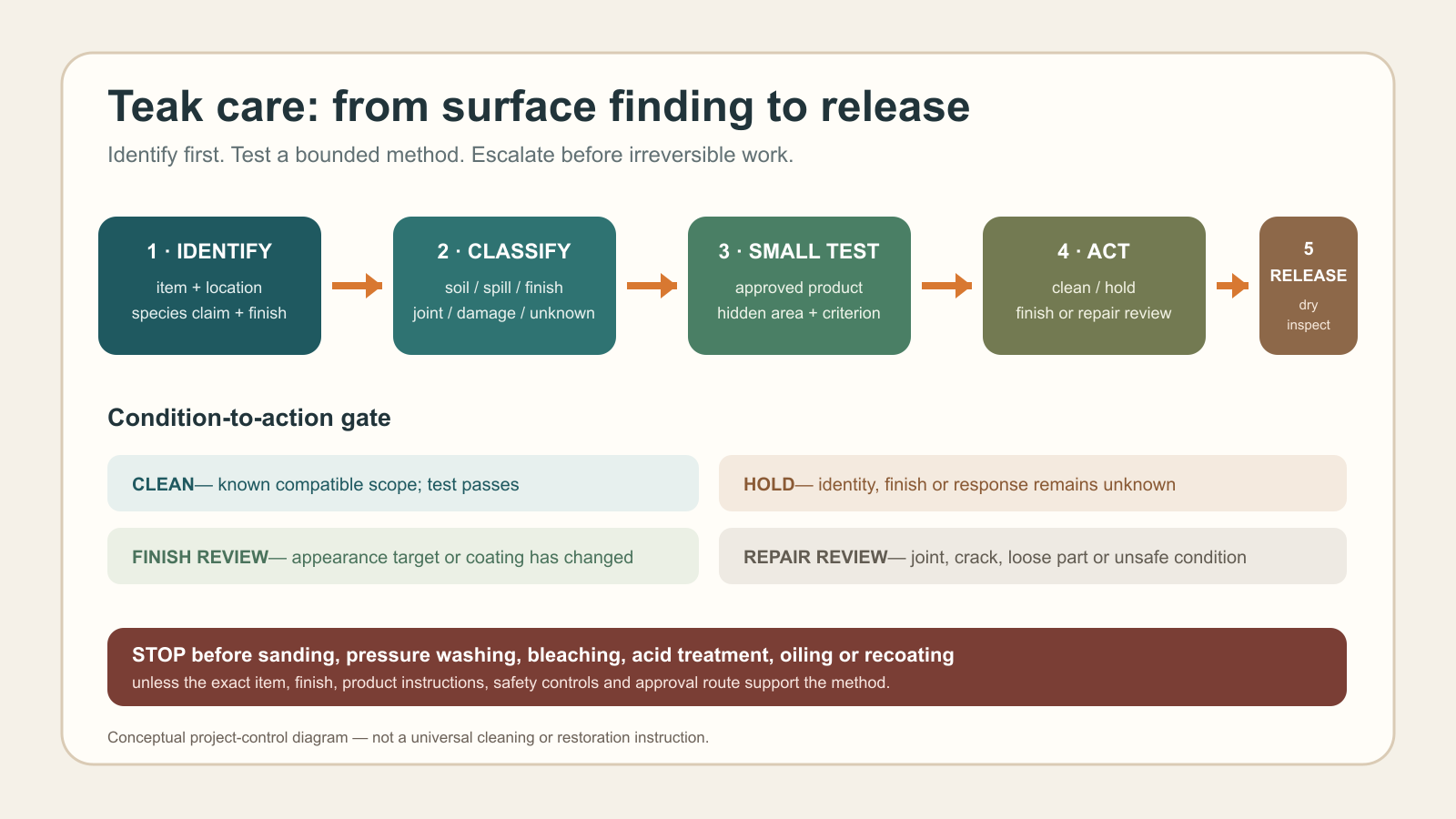
Stop before sanding, pressure washing, bleaching, acid treatment, oiling or recoating unless the exact item and finish are confirmed, the current instructions and safety controls support the action, and the authorized project party approves it. A stop does not mean the item cannot be restored; it means restoration is a separate scoped decision.
Run a bounded small-area test
Choose an inconspicuous area on the same component and finish, not a hidden part with a different exposure history. Record the test location, cleaner or tool identification, batch where relevant, dilution and application method from the approved instructions, contact time, rinse or removal method, ambient conditions, start time and operator. Take a close before photograph.
Apply the least extensive approved test needed to answer the decision. Keep the surrounding area untreated as a comparison. The National Park Service recommends testing a cleaning approach on a small inconspicuous area and stopping if damage or appearance change occurs. That guidance concerns museum exhibits, not teak hotel furniture; here it supports only the precautionary test logic.
Classify the dry result in one of three states:
- No observable adverse change: no new color shift, gloss difference, raised fiber, softening, tackiness, transfer, coating loss or boundary line under the agreed inspection conditions. Proceed only within the tested scope.
- Localized adverse change: stop, photograph, protect the area and route it to finish or repair review.
- Inconclusive: hold. Do not enlarge the test to create an answer; request technical review or a better comparison area.
Clean only the approved scope
Once the test is accepted, work in controlled sections:
- Record the starting condition and protect adjacent materials.
- Remove loose particles with the documented tool and direction; do not grind debris into the surface.
- Prepare and identify only the approved product according to its current instructions.
- Apply the tested method consistently without extending it to joints, end grain, hardware, textiles or finishes that were not in the test.
- Remove or rinse residues exactly as the instructions require and prevent pooled liquid.
- Allow the item to dry under the project’s defined conditions, then inspect before use.

The Canadian Conservation Institute cautions that aggressive cleaning can wear or alter vulnerable unfinished wood and exaggerate its grain. Its guidance is for conservation contexts, not hotel maintenance, but the warning supports a firm escalation rule: when the surface is degraded, friable or undocumented, do not make the cleaning more forceful.
Complete a dry inspection and care release card
Wet wood can mask residue, color differences and boundary marks. Inspect the item after the agreed dry interval in consistent light and from the agreed viewing distance. Compare the test, cleaned area and untreated reference. Confirm that the surface is dry, no transferable residue remains, no new damage is visible, hardware and glides are secure, accessories are correctly refitted, and the item is stable in its service position.
The teak care release card should contain:
- property, zone, item ID, furniture family, component and quantity;
- documented material claim, current finish, record source and revision;
- finding class, safety isolation and surrounding-material controls;
- product/tool ID, approved instruction, test location and operator;
- before, test and dry-after photographs with timestamps;
- test result, cleaned scope, exceptions and observable completion criteria;
- outcome: released, held, finish review or repair review;
- reviewer, authority, date and next permitted action.
Release applies only to the recorded item or authorized family, zone and method. A successful test on one finish, batch or exposure condition does not automatically approve every timber-toned item on the property.
Escalate sanding, oiling and refinishing
Sanding changes the surface; oiling or coating changes the finish system. Either can affect color, sheen, texture, future cleaning, surrounding materials and the match across a furniture family. Treat them as a finish project with its own scope, sample, method statement, safety review, edge and joint treatment, curing conditions, acceptance criteria and authorized sign-off.

Do not infer that oil is required because a surface looks pale, or that gray color alone is a defect. Do not promise that restoration will extend service life. If identity, finish compatibility, joint condition or previous treatment remains unresolved, preserve the evidence and request a technical decision before work continues.
Send a reviewable care brief
For cross-material routine cleaning, use Gainwell’s live outdoor furniture cleaning guide. The Outdoor Material Guide helps frame material questions, while Gainwell’s Capabilities page shows its technical-development, sampling and production-control context.
For a project review, send the item schedule, drawings, material and finish records, zone exposure, existing care instructions, finding register, photographs, proposed product and method, small-test record, safety constraints, acceptance criteria and decision owners through the Gainwell project contact. The property and authorized project parties retain responsibility for site safety, chemical approval, access, acceptance and return to service.
Frequently Asked Questions
How do you clean teak outdoor furniture in a hotel?
Confirm the item, documented teak claim and current finish; isolate unsafe furniture; classify the finding; use a compatible documented method; test a small inconspicuous area; clean only the approved scope; allow it to dry; then inspect and record release or escalation.
Can a hotel pressure wash teak outdoor furniture?
Do not treat pressure washing as a default. Hold it unless the exact item and finish are known, current instructions explicitly support the pressure, distance, nozzle and method, adjacent materials are protected, site safety is approved, and a bounded test passes. Otherwise use a less aggressive authorized route.
Should hotel teak furniture be oiled after cleaning?
Not automatically. Oiling is a finish decision, not the final step of every cleaning task. Confirm the existing finish, desired appearance, compatibility, sample, application and curing requirements before authorization. If those inputs are missing, record a finish-review hold.
How should a hotel respond to stains on teak outdoor furniture?
Record the location, extent, known or unknown substance and surrounding finish condition. Follow the approved product and project instructions, test the proposed method in an inconspicuous area, and stop if it causes color, gloss, fiber or coating change. Unknown deep or finish-related marks need technical review.
Does a color change mean hotel teak furniture needs refinishing?
No. Color change alone does not diagnose dirt, species, finish failure or loss of performance. Compare the documented finish reference, exposure pattern, dry surface and physical condition. Refinish only when an authorized assessment and sample define the required outcome.
When should hotel teak furniture be repaired or refinished?
Route loose joints, cracks, splinters, deformation, soft areas or other safety concerns to repair review. Route peeling, flaking, tackiness, whitening, coating loss or an incompatible cleaning response to finish review. Keep the item out of service until the responsible party records the next permitted action.