

How should a hotel clean plastic outdoor furniture? Start with one verified furniture family, not a universal plastic-cleaner recipe. Confirm the item, documented material and surface, zone, condition and current care instruction. Isolate cracked, loose, tacky or visibly changed pieces. Map the dry faces, texture, seams, underside, feet and cavities; test the approved method on one representative item; clean from open faces into reachable details; complete the specified rinse or removal path; and let the item dry fully. Release the family only when the representative item is residue-free, stable and dry—including hidden paths that could transfer water when stacked.
“Plastic,” “resin,” “poly,” “composite” and “wicker” are not interchangeable treatment specifications. A woven appearance does not show whether a strand is synthetic, natural, coated, wrapped or combined with another material. A white or faded-looking surface also does not prove that a removable stain is present. Hotel care should preserve an identified surface and produce an observable service decision, not promise that every mark will disappear.

Define one furniture-family cleaning cell
Build the working unit before tools reach the terrace. A cleaning cell contains one exact item family, the documented hard-surface material and finish, one exposure zone, one comparable condition band and one current instruction. Record the property, location, item code, drawing or purchase reference, manufacturer or supplier reference where available, color, quantity and known repair history. Separate cushions, slings, metal frames, timber inserts, tabletops, glides and fasteners unless the instruction explicitly includes them.
Identification matters because plastics can be difficult to distinguish. National Park Service plastics-care guidance recommends looking for original marks, trade names, packaging or other records when identifying a plastic object. Its context is museum collections, not commercial furniture, but the boundary is useful: do not infer a polymer or safe treatment from appearance. If the installed asset record is incomplete, photograph any molded mark or label without presenting it as a complete specification, then ask the responsible supplier or technical party to resolve the missing identity.
Map the face, texture, seam and cavity while dry
Remove loose cushions only when the site procedure permits, then observe the hard furniture body before adding water. Divide it into broad open faces; patterned, embossed or woven-looking surfaces; edges and seams; cushion wells and undersides; feet and glides; fastener interfaces; tube ends; and cavities where liquid can collect or drain. Mark the soil or unknown condition on that geometry.

| Dry observation | Record | First route |
|---|---|---|
| Loose dust, sand, pollen or leaves | Coverage and collection points | Approved dry removal, then reassess |
| Food, drink or sunscreen event | Known substance, time, spread and contacted materials | Current instruction and representative patch |
| Unknown dark, pale or colored mark | Edge, texture, transfer and whether it changes when dry | Do not name it; test or hold |
| Tackiness, bloom, chalk-like transfer or distortion | Location, extent and handling response | Material review |
| Crack, loose strand, sharp edge or unstable joint | Movement and guest-contact risk | Isolate for repair review |
A dry map preserves evidence that a wet, glossy surface can conceal. It also establishes the return inspection: the team can revisit the same face, intersection and drain point instead of judging the item from a few steps away.
Stop routine cleaning at damage or uncertain material
The Canadian Conservation Institute explains that some plastics can be dissolved by cleaning solvents or lose additives through direct exposure to solvents or surfactants. The same government guidance notes that wet plastics may have unexpectedly soft surfaces. Its advice concerns collections and includes older or degraded plastics; it is not a detergent rule for a modern hotel chair. The operational lesson is narrower: an unidentified or visibly changed plastic-like surface should not receive an improvised chemical escalation.
Keep an item out of the routine cell when it is cracked, embrittled-looking, distorted, sticky, flaking, abraded, deeply scratched, discolored with an uncertain cause, loose at a strand or joint, or unstable in use. Preserve photographs and labels. Do not bleach, dissolve, sand, heat, polish, coat or pressure-test the condition in order to make it look clean. Material assessment and structural repair are separate scopes with different evidence and approval.
Approve one method and test one representative item
The work card should reproduce the exact current instruction: approved product, preparation or concentration if specified, tool, contact time, working temperature or shade requirement, rinse or removal step, personal and site controls, runoff route, drying condition and excluded components. Do not carry a product approval from another polymer, color, supplier, repair history or exposure zone.
Choose one representative item from the family and a small inconspicuous area on the same surface system. Record the patch location, starting condition, solution or product identifier, tool, time, operator and dry-after comparison. Stop if the area softens, becomes tacky, changes gloss or color, transfers surface material, scratches, lifts, retains a film or produces an unexpected edge. An inconclusive patch is a hold—not permission to add pressure, abrasion, stronger concentration or longer dwell.
Clean open faces before reachable details
Remove loose dry debris with the approved low-contact method. Protect excluded materials and nearby food-service or guest-contact surfaces. On the tested hard surface, work in small sections from accessible open faces toward texture, intersections and edges. Use the approved tool without sawing across loose strands or forcing liquid into unverified joints. Keep the team on the mapped soil boundary; a stubborn unknown mark does not authorize a new chemical step.

Complex or suspended forms need a separate access and stability plan before cleaning. A visible lattice can have concealed anchors, wraps and contact points. Remove the item from service and follow the responsible party’s handling instructions rather than leaning, pulling or rotating an installed assembly for access. Cushions and other soft components follow their own care records.
Complete the surface-to-cavity rinse path
“Rinse” means the instruction-defined removal step, not automatically flooding the furniture. Follow the permitted direction and volume so loosened soil and cleaner move away from completed faces and do not pool in cushion wells, weave intersections, hollow members, feet or hardware. If the method calls for wiping rather than water rinsing, use the specified sequence and fresh surfaces so residue is removed rather than redistributed.
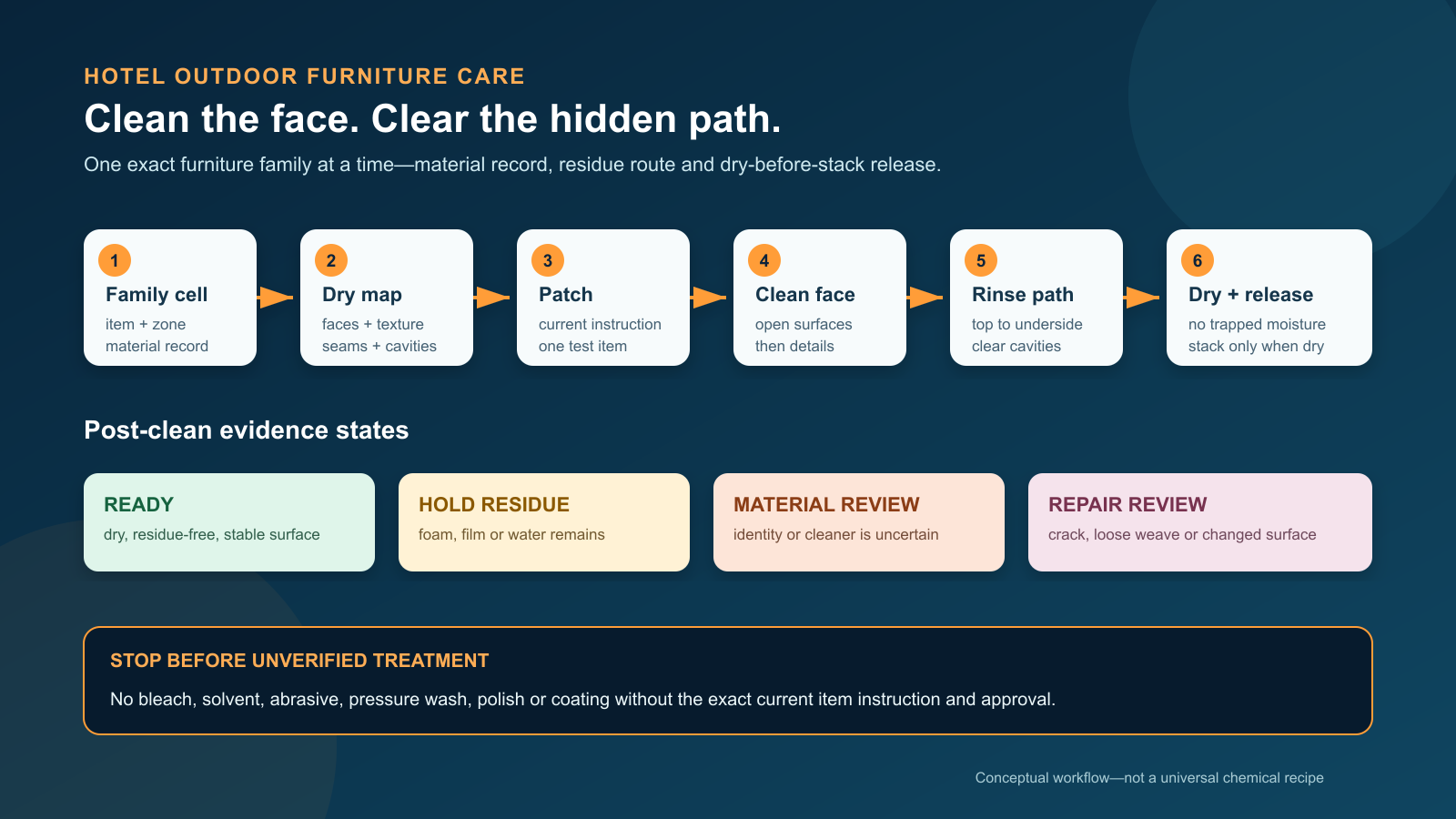
The diagram creates a visible stop line. Bleach, vinegar, solvents, abrasives, pressure washing, polish and coating are not default follow-on steps. Use any such treatment only if the exact current item instruction, site controls and approval route authorize it and the bounded test passes. Otherwise retain the item as a residue or material-review exception.
Inspect dry and classify the appearance outcome
Do not release the item while wet. Under the agreed lighting, revisit the dry map and classify each original observation. Removed soil means the approved target is gone with no film, transfer or new change. Residual unknown means a mark remains but has not been identified as soil or damage. Surface changed means gloss, color, texture, hardness, shape, strand position or coating differs from the baseline. Only the first state can support routine release; the other two require a recorded hold or review.

Check open faces, patterned intersections, seams, underside, feet, glides, fasteners, drain points and contact surfaces. The item must be stable, residue-free and dry before cushions return or pieces are nested, covered or stacked. Trapped water can transfer to another surface and also hides whether the removal path was completed. “Looks dry on top” is not a dry-before-stack criterion.
Roll out by family and quarantine exceptions
Once the representative item passes, authorize the method only for the recorded family and condition band. Brief the team with one approved example and one exception example. Use a unit count: attempted, passed, residue hold, material review and repair review. Give each exception an item ID and physical hold location so it cannot be returned to the terrace by appearance alone.

Do not silently extend the pass from one chair to a table, another color, a repaired batch, a natural-fibre weave, a metal frame or a different zone. Record unexpected trends—such as the same residue at one intersection or the same change on one batch—and pause that family for review. This is faster to investigate than mixing every terrace piece into one undifferentiated cleaning result.
Send a reviewable furniture-family care brief
The brief should include property and zone; item, batch and quantity; material and finish claims with source documents; separated components; dry map; condition exclusions; current instruction and revision; representative patch evidence; face-to-cavity sequence; runoff and drying controls; dry-after photographs; appearance classification; family counts; exception IDs; reviewers; and the next permitted action.
Use Gainwell’s live outdoor furniture cleaning guide for the wider cross-material route and the Outdoor Material Guide when a project is still defining material questions. The Capabilities page shows where technical development, sampling, production controls and inspection enter Gainwell’s project process. Send the asset record, photographs, care instruction, test, exceptions and acceptance criteria through the Gainwell project contact when a product or project review is needed. The property and authorized parties retain responsibility for chemical approval, site safety, access, repair and return to service.
Frequently Asked Questions
What is the best way to clean plastic outdoor furniture at a hotel?
Verify one item family and its material and care record; isolate damaged pieces; dry-map faces and hidden paths; test the approved method on one representative item; clean open faces before reachable details; complete the specified removal or rinse; dry fully; then release or hold the family on recorded evidence.
Should hotel staff try to make white plastic furniture look new again?
No restoration result should be assumed. First separate removable soil from an unknown mark or a changed surface. Use only the exact approved care method. If color, gloss or texture remains different, record the condition for material review rather than escalating to bleach, abrasion, solvent, polish or coating.
Can hotel plastic outdoor furniture be pressure washed?
Do not make pressure washing the default. Use it only when the exact item’s current instructions authorize the equipment, pressure, nozzle, distance, direction and excluded interfaces; the site controls safety and runoff; and a representative test passes. Otherwise use the approved lower-contact method.
Can woven-looking outdoor furniture be treated as plastic wicker?
Not from appearance. Confirm whether the documented component is a synthetic strand, natural fibre, coated material, wrapped element or another construction. Also identify the frame, fasteners and cushions separately. An uncertain or damaged weave remains on hold until its care boundary is resolved.
When can hotel outdoor furniture be stacked after cleaning?
Only after the full mapped item is dry: open faces, seams, underside, feet, intersections and cavities. It must also be residue-free and stable. Follow any item-specific stacking limit or handling instruction; a dry surface does not prove that a furniture design is stackable.
What should the hotel do if a mark remains after the approved cleaning method?
Stop and classify it as a residual unknown or changed surface. Record the location, dry appearance, patch and completed method. Do not increase chemical strength or abrasion. Keep the item or family on hold until the responsible material or repair reviewer defines the next permitted action.