

Sustainable outdoor furniture is not established by a recycled-plastic label alone. For a hotel, the decision starts with the service the current fleet must provide and continues through maintenance, repair, component replacement, logistics and a real end-of-use route. Record those stages against an exact item family, zone and date. If a claim, spare part or destination cannot be verified, hold that field instead of turning an assumption into a purchasing conclusion.
Start with the existing outdoor furniture fleet
A replacement brief often starts with a desired material: recycled plastic, certified timber, powder-coated metal or another preferred option. Reverse the sequence. First list what the property already owns and what each zone needs. Create one baseline row for item family, quantity, location, exposure, operational role, current condition, recurring maintenance, known damage, available parts and the decision date. Add photographs and item references, but do not convert appearance into a condition grade.
This baseline separates different problems. A chair that is cosmetically tired but structurally serviceable is not the same decision as a frame with an unresolved safety concern. A missing glide is not the same as a failed joint. Poolside loungers, rooftop dining chairs and sheltered balcony tables may share a visual language yet have different handling, cleaning, wind, moisture and storage conditions. The responsible project party should define the assessment method and acceptance criteria.

Use an intervention route before disposal
The US EPA describes sustainable materials management through the full lifecycle: material acquisition, manufacture, production, use, reuse, maintenance and waste management. Its lifecycle perspective is useful here because it prevents the purchase stage from becoming the whole story. The EPA’s non-hazardous materials hierarchy emphasizes source reduction and reuse before recycling, while also saying that no single approach suits every material or circumstance.
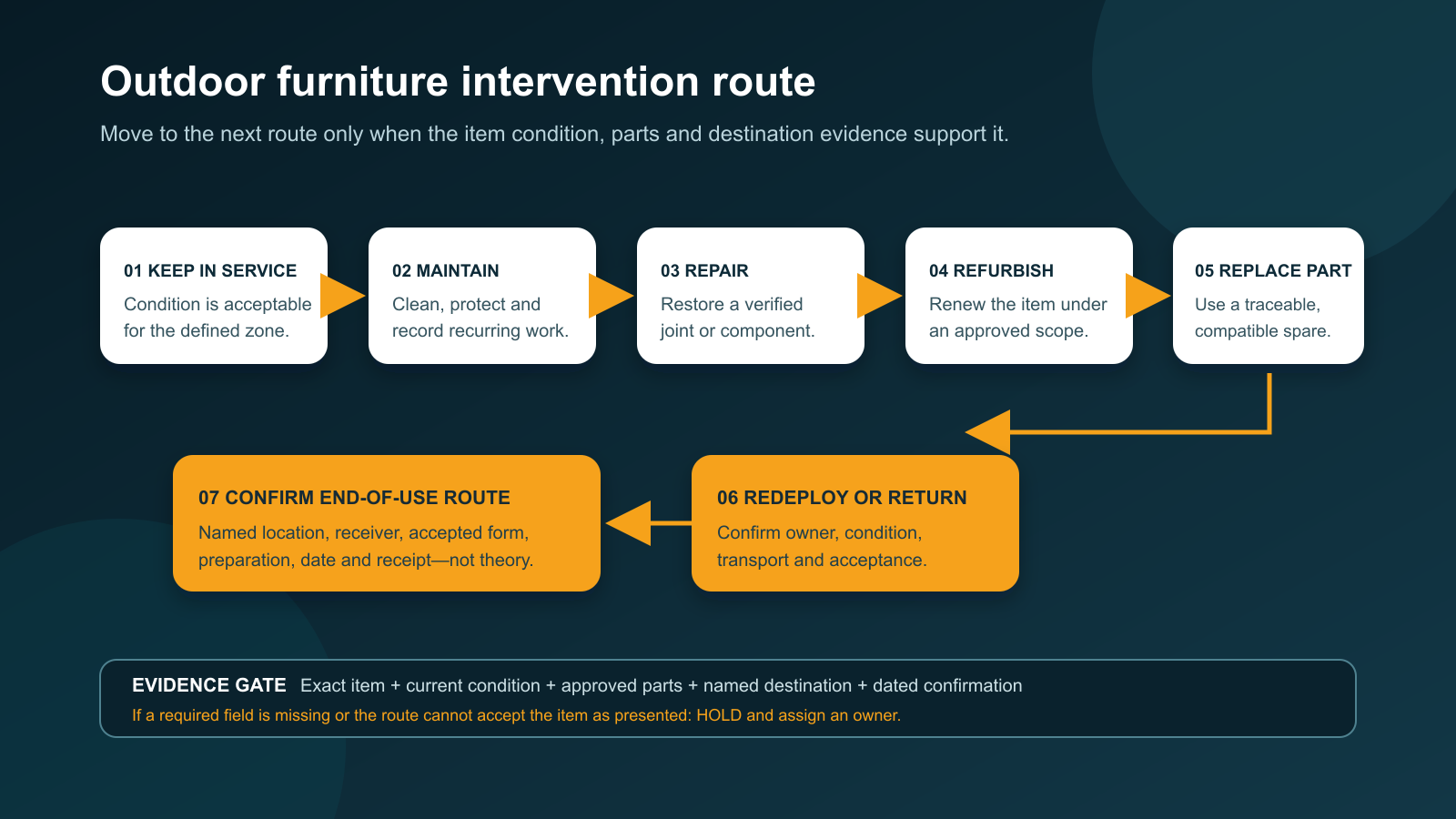
Translate that principle into a project route: keep an acceptable item in service; maintain it; repair a defined defect; refurbish an approved scope; replace a compatible component; redeploy or return the item; then confirm an end-of-use route. This is a decision sequence, not a universal promise that every item can or should pass through every stage. Safety, hygiene, guest experience, accessibility, warranty, local requirements and technical feasibility still govern the result.
Map components, separation and spare parts
An outdoor furniture item is usually a system, not one material. Map the frame, seat or sling, cushions, tabletop, fasteners, glides, covers, finish and accessories. For each component, record the declared material, attachment method, non-destructive removal route, required tool, replacement reference and evidence owner. Note when removal damages the component or contaminates another stream. A theoretical material label is not a disassembly instruction.
Ask whether spare parts are named at quotation, whether drawings and sample approvals preserve the interface, who may perform the work, and how long the supplier commits to retaining the reference. Do not invent a universal spare-parts period. Record the offered period, territory, lead time, minimum order, finish-match limitations and compatible revisions. If a later substitution changes fit, finish, material or claim scope, reopen approval before using it across the fleet.
Turn the offer into a maintainable furniture family
Procurement can reduce avoidable variation by grouping items into controlled families. One family should share a defined construction, component map, finish system, spare-part logic and maintenance route. Preserve the item code, drawing revision, approved sample, component references and supplier declarations through production and receiving. The aim is not to make every hotel zone identical; it is to keep each approved family understandable after handover.
Attach an operations sheet to each family: cleaning document, inspection frequency set by the project, common fault codes, safe isolation rule, approved repair owner, spare list, finish-touch-up boundary, storage requirement and escalation contact. Link routine procedures to the exact approved materials. This article does not replace the current outdoor furniture cleaning guide or a project-specific maintenance plan.
Separate material attributes from whole-product claims
For US marketing, the FTC’s Green Guides are intended to help marketers avoid misleading environmental claims. The agency’s summary warns against broad, unqualified claims such as “green” or “eco-friendly” and calls for clear, specific qualifications. This is general US marketing guidance, not legal advice; the responsible team must check the current rules for the actual market.
Keep five fields separate: which component the claim covers, the declared material identity, the recycled-content percentage and basis, the document holder and validity, and the environmental statement the team proposes to use. “Contains recycled material” does not establish repairability, longevity, lower lifecycle impact or local recyclability. A material that can technically be reprocessed also does not prove that a receiver will accept the assembled item at the hotel’s destination.
Control packaging, transport and return loops
Package design and transport belong in the same record because they affect handling and the feasibility of a return route. For each furniture family, list protective materials by type and quantity basis, where they are removed, who owns them after unpacking, whether they are reusable, and the named local collection or return option. Record pallet, crate and cover returns separately. Avoid claiming that packaging is recyclable until the destination route accepts the exact material in the form presented.
If the supplier offers returnable packaging or product take-back, capture territory, minimum quantity, preparation, consolidation point, transport responsibility, charges, exclusions, request lead time and evidence of acceptance. A policy statement is not the same as a booked route. Reconfirm the arrangement near shipment and again before the property releases material.
Confirm a destination-specific end-of-use route
End-of-use confirmation should name the hotel location, item or component, material declaration, condition, contamination limits, disassembly requirement, receiver, accepted form, collection method, date and expected receipt. The FTC guidance on recyclable claims makes facility availability material to how a claim is qualified. For a hotel team, that means a generic resin symbol or supplier sentence cannot replace a current local acceptance check.
Ask the receiver what it accepts now, not what a material might become in theory. Does the facility accept a complete chair, a separated frame, clean production scrap or only a particular polymer grade? Are coatings, fabric, foam, metal inserts or mixed fasteners excluded? Who performs separation and bears transport? What receipt or weight record will close the route? If these fields are unresolved, mark the outcome “route unconfirmed” rather than “recyclable.”
Compare sustainable outdoor furniture offers on one worksheet
A like-for-like worksheet makes trade-offs visible without inventing a single green score.
| Decision field | Evidence to request | HOLD trigger |
|---|---|---|
| Service need and baseline | Zone, item family, quantity, exposure, current condition and required function | Replacement is proposed before the existing population is assessed |
| Material and claim scope | Exact component, declaration, percentage/basis, holder, date and proposed wording | Whole-product benefit is inferred from one attribute |
| Intervention route | Retain, maintain, repair, refurbish, replace part, redeploy or retire decision with owner | No feasibility or acceptance record |
| Components and spares | Attachment map, removal method, compatible spare, availability and approval reference | Destructive separation or undefined replacement interface |
| Packaging and logistics | Material list, reuse/return owner, collection territory and confirmation date | Generic return policy with no project route |
| End-of-use destination | Named receiver, accepted material and form, preparation, transport and receipt | Theoretical recyclability only |
| Continuity | Approved sample, drawing, production revision, handover sheet and change log | Material, component or route changes without reapproval |
Do not collapse these rows into an unsupported point total. A recycled-content offer can have strong documentation yet a weak local end-of-use route. Another offer may support repair and part replacement but lack a substantiated marketing claim. Record observations separately from inferences, identify the decision each document can support, and leave gaps visible for the authorized team.
Carry the plan from production into operations
At sample approval, link the exact furniture family to its component map, maintenance route, spare list, packaging plan and claim record. At production release, verify that the controlling materials, interfaces and documents have not changed. At shipment, confirm packaging and return responsibilities. At receiving, preserve item and batch references. At handover, give operations the inspection, repair, isolation, spare-order and end-of-use contacts in a usable register.
Open a change request when material identity, recycled-content scope, component construction, fastener, finish, spare source, packaging, production site, receiver or local acceptance condition changes. State the old and new field, affected items, evidence, reviewer and effective date. A change may be acceptable, but it should not inherit the previous sustainability statement automatically.
Send a reviewable project brief
Gainwell’s Outdoor Material Guide and Materials pages provide product and material context. The Capabilities page can be used to place technical development, sampling, factory controls, inspection, packing and delivery into the project handoff.
For an outdoor fleet review, send the zone and item schedule, quantities, destination, current condition survey, service and exposure brief, offered component declarations, claim documents, sample references, maintenance and spare requirements, packaging plan, local receiver confirmations, acceptance owners and change rules through the Gainwell project contact. Final interventions, claims, legal requirements and end-of-use routes remain project-specific.
Frequently Asked Questions
What makes outdoor furniture sustainable for a hotel?
No single material label answers that question. A hotel should define the service need, assess the current fleet, compare exact material and component evidence, plan maintenance and parts, control logistics, and confirm a real end-of-use route. Any environmental statement should be specific to the attribute and evidence it actually covers.
Is recycled plastic outdoor furniture automatically sustainable?
No. Recycled content is one product attribute. Verify the percentage, basis and component scope, then separately review fitness for the service need, construction, repair route, spares, maintenance, packaging and destination-specific end-of-use option. Do not infer an overall lifecycle benefit without comparable product-specific analysis.
What is the difference between recycled content and recyclable?
Recycled content describes material recovered or diverted before it entered the current product, within the stated component and percentage scope. Recyclable concerns whether the product or component can enter an available recycling route. One does not establish the other, and neither alone proves an overall environmental benefit.
How should hotels compare sustainable outdoor furniture offers?
Use the same worksheet for every offer: service baseline, exact component/material declarations, scoped claims, intervention route, separability, compatible spares, packaging, return options, named end-of-use destination and change controls. Keep unsupported fields blank or on HOLD instead of awarding points for marketing language.
Can outdoor furniture be repaired or refurbished instead of replaced?
Sometimes, but the answer depends on condition, safety, construction, parts, skills, acceptance criteria and project requirements. Identify the defect and affected component, obtain an approved method and compatible part, record the work and verify return to service. Do not assume every item is repairable from appearance alone.
What should a hotel verify before claiming outdoor furniture can be recycled?
Confirm the exact item or component, material declaration, required disassembly, coatings or contamination limits, named receiver, accepted form, location, transport arrangement, confirmation date and evidence of receipt. If a suitable route is not currently available at the destination, qualify or withhold the claim under the applicable market rules.