
There is no responsible universal answer to how long outdoor furniture lasts. For a hotel, service life is an observed outcome of the exact product system in its actual exposure, use and care conditions. A material name or supplier lifespan figure cannot, by itself, tell an owner when an item will need intervention.
A better approach is to build a durability evidence passport before approval, establish a dated commissioning baseline and then classify field condition against project-defined triggers. This turns “durable” from a marketing adjective into a reviewable record. It can support decisions to maintain, monitor, hold, repair, replace or release an item without pretending to predict an exact number of years.
Replace a lifespan number with a service-life question
The useful question is not “How many years does outdoor furniture last?” It is: What evidence shows that this exact item remains fit for its defined project use, and who decides the next action when its condition changes?
Start by separating three ideas. Age is elapsed time. Durability evidence shows how a defined sample or material behaved under a defined method. Service condition is what the project observes in a specific item, component and zone. The three can inform one another, but none is a substitute for the others.
A young item can need attention after damage, misuse or an unresolved interface. An older item may remain serviceable under its project criteria. Appearance can reveal an issue to investigate, but it cannot establish cause, remaining life or safe use on its own. Those judgments require the applicable project records and responsible authority.
Define the exact product system
“Outdoor chair” is too broad for a durability review. Record the item code, current revision, dimensions and intended use, then break the product into the components that can age or fail differently. A chair may include a structural frame, joints, fasteners, feet, finish system, seat support, textile, foam and replaceable accessories. A table adds a top, base, connection and floor interface.
Link the record to the approved sample, finish reference, bill of materials and current drawings where those documents exist. If a substitute or revision is introduced, do not inherit evidence automatically from the earlier item. Confirm what changed and whether the existing evidence still applies.
This component map makes later observations useful. “Chair worn” is vague. “Finish change at the lower frame in Zone P-03” or “movement observed at the top-to-base interface on item family T-12” gives the project team a location, population and evidence question to investigate.

Map exposure and use by zone
The same item family can produce different field histories in an open pool edge, a shaded terrace, a covered dining area and storage. Build a fleet map that joins every furniture family to a stable zone identity and a defined use. Do not infer exposure severity from a photograph; record the project’s actual inputs.
| Passport field | Record | Decision it supports |
|---|---|---|
| Product identity | Item code, revision, component map and approved reference | Shows which evidence may be relevant |
| Zone | Drawing reference, open or sheltered context and local interfaces | Preserves where the observation occurred |
| Intended use | Function, occupancy pattern and operating constraints | Prevents evidence from being applied to a different use |
| Care state | Current approved care plan and completed record | Separates an observed issue from an unsupported cause claim |
| Event history | Dated damage, relocation, repair or unusual-use records | Provides context for investigation |
| Owner | Inspector, issue owner and hold or release authority | Connects evidence to action |
Audit what each durability test actually proves
Ask five questions for every report: What product or material was tested? Which revision and sample? What method and conditions were used? What acceptance rule applied? What was outside the scope? A report that cannot be tied to the specified item and project requirement is context, not proof of an expected service life.
Official standard pages show why scope matters. ISO 7173:2023 specifies structural strength and durability test methods for chairs and stools, but its scope excludes ageing, degradation and upholstery durability. ISO 19682:2023 covers stability, strength and durability tests for tables while excluding ageing and degradation. A pass under either method would not answer every outdoor exposure question.
Material weathering evidence has limits too. ASTM G90-23 describes accelerated outdoor weathering using concentrated natural sunlight and frames results as relative evidence under the specified practice. It does not make accelerated exposure a perfect copy of a particular field condition without relevant correlation. Even a product standard can have a narrow boundary: ASTM F1838-19(2025) addresses a defined category of outdoor plastic chairs and excludes several other furniture forms.
| Evidence record | Useful question | Do not conclude |
|---|---|---|
| Chair structural test | Does the method, sample and revision match the required chair? | That finishes, textiles or outdoor ageing are covered |
| Table stability or strength test | Does it address the exact table configuration and acceptance requirement? | That every use, substrate or ageing mechanism is covered |
| Material weathering result | What material, cycle, comparison and correlation were used? | A guaranteed number of hotel service years |
| Project-specific requirement | Who set it, which document controls and how is compliance recorded? | That a generic supplier statement replaces the project record |
Create a durability evidence passport
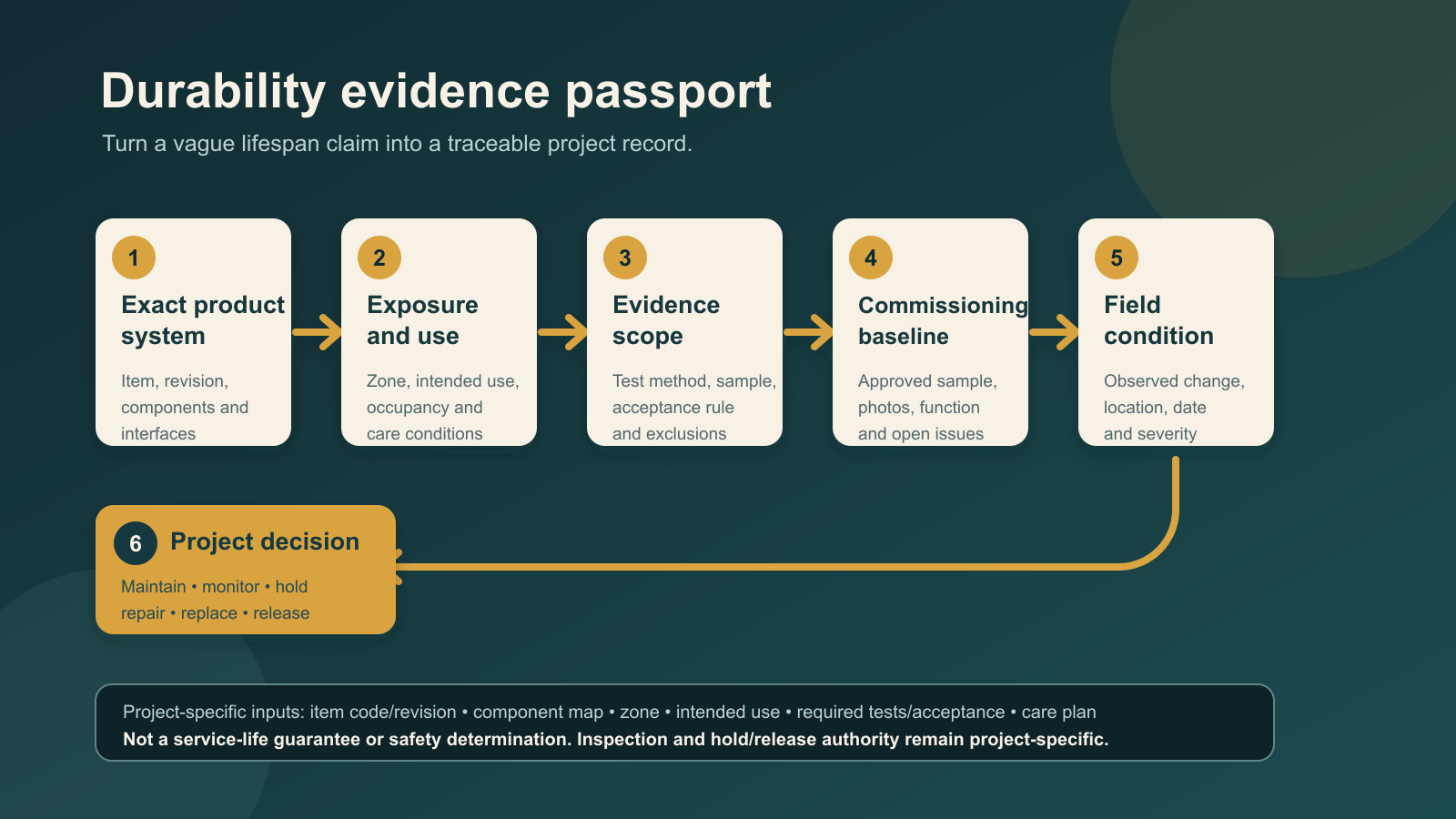
The passport is a compact index, not a new certification. It joins six records: exact product system, exposure and use, evidence scope, commissioning baseline, field condition and project decision. Each entry should carry a date, revision and owner so the team can see which information is current.
For procurement, the passport exposes gaps before volume production: an unconfirmed sample, a material revision without linked evidence or a test report with the wrong product scope. For operations, it creates a consistent place to record changes. For the next project, it converts field history into better questions instead of repeating a generic specification.
Establish a commissioning baseline
Later change cannot be judged consistently without a known starting point. At handover or another project-approved stage, create a baseline card for each item family and zone. Reference the accepted sample or approval record, count the installed population and record the observable starting condition of the components the project has chosen to monitor.
Use repeatable views when photographs are required: overall item, critical interfaces and a location reference. Note unresolved snags separately; do not let them disappear into the baseline as if accepted. Record who reviewed the card and what document controls acceptance.
A baseline is not a promise that nothing will change. It is the comparison point that lets a later reviewer distinguish a current observation from an undocumented memory. If a repair or component replacement occurs, add a new dated state while preserving the prior record.
Inspect by failure mode, not by material label
A fleet review should look for defined changes at components and interfaces. Examples of observation categories include loss of stability, movement at a connection, deformation, breakage, surface change, water-management issue, textile damage, missing foot or fastener, and a repair that no longer matches the approved record. These are categories for recording—not diagnoses.
Build a failure-mode register with the item family, component, observable trigger, inspection view, escalation owner and evidence needed to close the issue. The project must set the cadence and thresholds. This article cannot determine whether an item is safe, whether damage is structural or whether a repair is acceptable.
Compare like with like. Group observations by item revision and zone, then look for concentration: one isolated item, one exposure zone, one production lot or a repeated component. That pattern helps the responsible team ask whether it faces accidental damage, a care problem, an interface issue, a product population question or another cause. It does not prove the cause by itself.
Use four condition states for action
A simple state model keeps observations from becoming informal judgments. The names and criteria must be approved for the project, but a working structure can contain:
- Serviceable: no recorded trigger requiring another action under the current project criteria. This is not a guarantee of future performance.
- Monitor: an observable change needs a named review, interval or evidence request, while the responsible authority has not placed the item on hold.
- Hold: use or release is suspended under the project process pending inspection, missing evidence or a disposition from the responsible party.
- Retire or replace: the authorized project decision has determined that repair or continued use is not the accepted route.
Keep repair as an intervention, not an automatic state change. After work is completed, link the method, parts, date and acceptance record, then let the named authority assign the new condition. Never return an item to service only because the visible symptom appears reduced.
Feed field evidence into the next specification
A condition map becomes valuable when procurement, design, manufacturing and operations review it together. Repeated issues can generate a sharper prototype check, a clarified component requirement, a different inspection view, a replaceable-part plan or a more explicit care responsibility. Record the decision and carry it into the next schedule rather than copying a vague phrase such as “commercial grade.”
Gainwell’s current outdoor furniture scope covers hospitality pools, terraces, resorts and other high-exposure applications. It asks project teams to confirm drawings, quantities, target materials and finishes, required tests, destination, approval route and programme. Exact tolerances, tests, certificates, warranty terms and acceptance requirements still need confirmation against current project records.
Material selection is one input, not the whole durability decision. Use the separate outdoor material guide for that comparison, and keep task-specific care in the current outdoor furniture cleaning guide. Gainwell’s project capabilities describe technical development, samples, production, inspection, packaging, delivery and site support that can connect a confirmed brief to controlled execution.
To review a hotel outdoor furniture package, send the current furniture schedule, drawings, zones, intended use, material and finish targets, required evidence, quantities, destination, programme and open decisions through the Gainwell contact route. Ask for the exact product and project record—not a universal service-life promise.
Frequently Asked Questions
How long does outdoor furniture last?
There is no universal number that responsibly covers every product and hotel condition. Track the exact item, components, zone, intended use, evidence scope, care state and field condition. Use project-defined triggers and authority to decide whether to maintain, monitor, hold, repair, replace or release it.
What type of outdoor furniture lasts the longest?
No material or furniture type wins in every project. Compare the complete product system, including joints, finishes, textiles, replaceable parts and interfaces, against the intended exposure and use. Confirm what each test or approval actually covers instead of ranking products by material name alone.
Can outdoor furniture stay outside all year?
Only the applicable product instructions and project team can answer that for the exact item and location. Exposure, operating season, care, storage plan and local requirements matter. If the permitted state is not documented, treat it as an open project decision rather than assuming year-round exposure is acceptable.
How do you know when outdoor furniture needs replacing?
Use observable project triggers, a defined inspection route and a named decision authority. Age or appearance alone is not enough. An item may be monitored, held for assessment, repaired under an accepted method or replaced after the responsible party reviews its condition and records.
What durability evidence should a hotel request before approval?
Request the exact product and revision, component and material references, required test methods, tested sample identity, results, acceptance criteria, exclusions, approvals and unresolved issues. Make sure each record applies to the specified configuration and project use; do not convert one result into a guaranteed lifespan.
How should a hotel track outdoor furniture condition by zone?
Create a fleet map that links stable zone IDs to item codes, revisions, quantities and commissioning baselines. Record dated observations by component, state, issue owner, required evidence and final disposition. Comparing the same family across zones can reveal patterns for investigation without claiming a cause prematurely.