

How should a hotel clean metal outdoor furniture? Do not start with a generic “metal cleaner.” Identify the exact item, its documented metal or substrate claim, and the finish on each component. Map the dry condition before water changes the evidence. Isolate any unstable item or damaged coating, use only a compatible approved method, test a small matching area, clean and rinse the authorized boundary, and inspect faces, seams, fasteners, feet and drain paths after drying. Record one of four outcomes: return to service, hold, coating review or repair review.
Aluminum, steel, iron, stainless steel, plated parts, anodized surfaces and painted or powder-coated components are not interchangeable care categories. A color or metallic appearance does not identify them. Nor does an orange-brown or white mark prove the substrate, corrosion mechanism or remedy. Cleaning should remove an approved contaminant without turning an uncertain coating or structural condition into an improvised repair.
Build a metal surface-system card
Open the asset register, approved submittal, shop drawing, finish schedule, sample record, purchase file, care manual and supplier instructions. Record the property, zone, item code, drawing revision, component, quantity and batch or asset reference. Then capture five surface-system fields: documented base-metal claim; pretreatment or conversion layer if known; coating, plating, anodizing or finish; prior field repair; and contacting materials such as fasteners, glides, inserts, textiles or tabletops.
Do not replace missing information with a magnet test, color guess or internet photograph. The Fenestration and Glazing Industry Alliance publishes maintenance guidance covering both painted and anodized architectural aluminum. That architectural scope is not a furniture instruction; it illustrates why “aluminum” alone does not define one care route. If the metal or finish record is missing, keep the method on hold and ask the responsible supplier or technical party to identify the system.
Map the dry surface before water changes the evidence
Photograph the item in its service position, then add close views with a neutral size reference. Record whether the mark is on an open face, horizontal ledge, underside, weld, tube opening, joint, fastener, foot, glide or interface. Preserve wet and dry history, recent spills, irrigation, coastal or pool adjacency, cleaning attempts and known chemical contact as observations—not diagnoses.
| Dry observation | Record before cleaning | Initial route |
|---|---|---|
| Loose dust, sand or debris | Coverage, particle size and where it collects | Approved dry removal, then reassess |
| Adherent deposit or spill | Known/unknown substance, time, edge and affected materials | Compatible patch test |
| Orange-brown, white or dark mark | Color, texture, transfer, location and coating continuity | Do not diagnose from color; hold if uncertain |
| Scratch, chip, blister, lifting or chalk-like transfer | Size, edge, depth appearance and exposed layer | Coating review |
| Loose weld, fastener, foot, sharp edge or deformation | Movement, stability and guest-contact risk | Repair review and isolation |
Keep mixed findings separate. Removing surface soil may reveal a finish condition, but it does not authorize abrasive removal, corrosion conversion or paint touch-up.
Set the cleaning boundary around the existing finish
The method must name the approved product, concentration or preparation, tool, contact time, rinse or removal step, temperature and safety controls from the exact current instructions. It must also name excluded components. A cleaner accepted for one coating may not be accepted for upholstery, stone, plated hardware or another finish on the same item.
AkzoNobel’s current guidance for its pre-painted metal systems advises checking cleaner compatibility, using non-abrasive tools, rinsing residues and testing an inconspicuous area. Its Interpon D guidance similarly applies to a named powder-coating family. These are useful control principles, but not permission to apply a specific detergent, pH, solvent or frequency to unidentified hotel furniture. The product record and authorized project criteria control.

Run a compatibility patch
Select a small inconspicuous area on the same component, finish, color and exposure condition—not a hidden underside with a different system. Record the location, comparison boundary, product and lot where relevant, prepared solution, tool, start time, operator and ambient conditions. Apply only enough of the proposed method to answer whether it is compatible.
Inspect the test after the instruction-defined rinse or removal and again when dry. Use three states:
- Compatible within the observed criteria: no new color or gloss difference, softening, tackiness, transfer, scratching, lifting, residue line or change at the coating edge. Proceed only within the tested boundary.
- Adverse response: stop, protect the area and route it to coating review.
- Inconclusive: hold. Do not increase concentration, pressure or abrasion to force a result.
Clean from open faces toward joints
Work in small controlled sections. Protect adjacent materials and remove loose particles with the approved dry method. Apply the tested product and tool to the open face without flooding tube openings, seams, bearing points or concealed cavities. Continue toward edges and reachable intersections only when the method covers them. Capture unexpected transfer, color change, coating movement or residue immediately.
Complete the instruction-defined rinse or removal before the product dries outside its permitted condition. Collect runoff according to the site’s procedure. Do not return cushions or accessories while liquid remains on contact surfaces, inside recesses or around hardware. Do not mix cleaners or improvise a stronger treatment for a stubborn mark.
Use the surface-system release route
The route below keeps a visible mark from jumping directly to grinding or repainting. Record the item and finish; map the dry evidence; test the approved method; rinse and inspect joints; then release or route the item. Cleaning is one branch. Unknown identity, coating damage and structural instability have different owners and evidence needs.
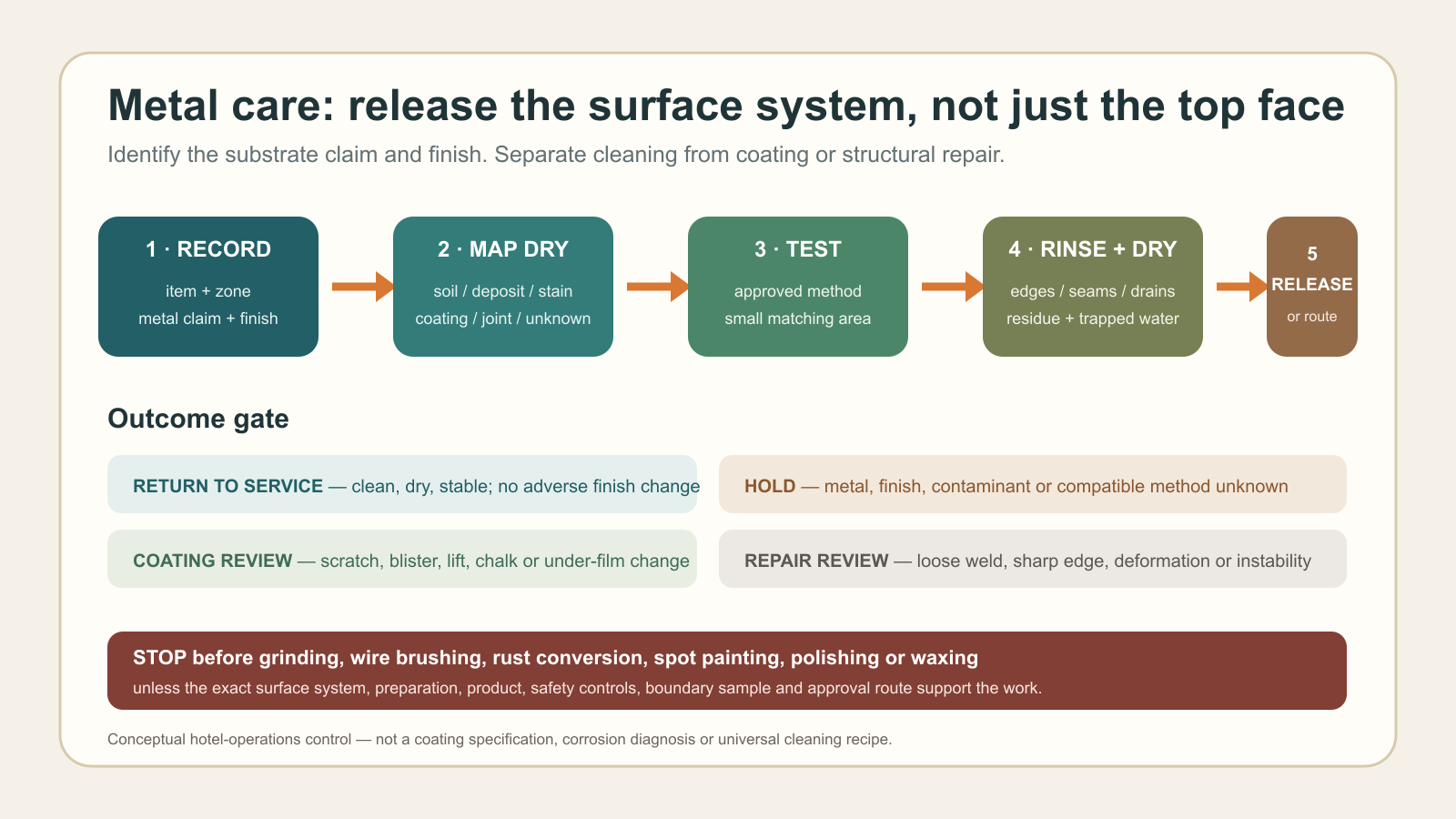
Stop before grinding, wire brushing, rust conversion, spot painting, polishing or waxing unless the exact surface system, preparation, product, safety controls, boundary sample and approval route support the work. Those actions can change the finish or substrate and belong to a separate technical scope.
Inspect seams, feet, fasteners and drain paths when dry
An open face can look clean while residue or water remains at intersections. After the defined dry interval, inspect the underside of arms and seats, weld transitions, fasteners, tube ends, drain holes, tabletop edges, feet, glides and boundaries with textiles or stone. Check for residue transfer on a method-approved inspection cloth where the project procedure permits it; do not use that check on a surface that could be burnished or marked.
Completion is observable: the approved soil boundary is removed; no cleaner or removable residue remains; the finish shows no new adverse change under agreed lighting; joints and drain paths are clear; the item is dry; glides and hardware are present; and the assembly is stable in its service position. A cosmetic pass cannot override a safety concern.
Separate corrosion response from cleaning
The Association for Materials Protection and Performance defines corrosion broadly as deterioration caused by chemical or electrochemical reaction with the environment and notes that material, surface and environmental factors matter. AMPP also explains that protective coatings may isolate a metal substrate from its environment. These are general technical boundaries, not a diagnosis of a chair.
If the team sees metal loss, recurrent staining from a coating breach, blistering, under-film change, a loose weld, perforation, sharp edges or instability, isolate the item and preserve the evidence. The technical reviewer may need the substrate, pretreatment, coating build-up, exposure, previous repair and compatible preparation information before defining a remedy. Routine cleaning staff should not select an abrasive, converter, primer or topcoat from color alone.
Close the metal-furniture return-to-service ticket
One ticket should contain the property and zone; item and component IDs; metal and finish claims with source documents; dry observation map; isolation status; approved product, tool and instruction revision; patch location and result; cleaned boundary; before, test and dry-after images; seam, foot, fastener and drain checks; exceptions; reviewer; and next permitted action.
Use one outcome only: returned to service, held for missing identity or compatibility, coating review, or repair review. State whether the decision applies to one item, one documented batch or an authorized furniture family. A pass on one component does not silently approve a different finish, color, repair history or exposure zone.
Send a reviewable metal-care brief
Use Gainwell’s live outdoor furniture cleaning guide for the broader cross-material route and the Outdoor Material Guide when the project is still defining material questions. Gainwell’s Capabilities page places technical development, samples, production control and inspection in one workflow.
For a project review, send the item schedule, drawings, substrate and finish record, controlling sample, exposure zone, existing care instructions, dry evidence map, proposed method, patch record, coating or structural exception, acceptance criteria and decision owners through the Gainwell project contact. The property and authorized parties retain responsibility for chemical approval, site safety, repair scope and return to service.
Frequently Asked Questions
How do you clean metal outdoor furniture at a hotel?
Identify the item, documented metal and current finish; map the dry condition; isolate coating or structural damage; test the approved cleaner and tool on a small matching area; clean and rinse the authorized boundary; inspect joints and drain paths when dry; then record release or escalation.
Does aluminum outdoor furniture need a different cleaning method?
It may. “Aluminum” does not reveal whether a surface is anodized, painted, powder coated, plated, previously repaired or combined with other materials. Use the exact finish and supplier record. Do not choose a cleaner or abrasive from the metal name alone.
Can the same process be used for wrought iron, steel and aluminum furniture?
The control sequence can be shared, but the treatment cannot be assumed identical. Each item needs its own substrate and finish record, approved product instructions, patch result and completion criteria. Corrosion or coating damage also requires item-specific technical review.
Should hotel staff remove rust during routine cleaning?
Not as an improvised housekeeping step. First isolate unsafe items and document the metal, finish, breach and extent. Grinding, wire brushing, chemical conversion, priming and repainting alter the surface system and require an approved repair method, safety controls, boundary sample and sign-off.
Can hotel metal outdoor furniture be pressure washed?
Do not make pressure washing the default. Use it only when the exact furniture and finish instructions authorize the equipment, pressure, nozzle, distance, direction and exclusions; the site controls runoff and safety; and a bounded test passes. Otherwise select a less aggressive approved method.
When should hotel metal furniture remain out of service after cleaning?
Keep it out of service when metal or finish identity is unresolved; a test is adverse or inconclusive; residue or trapped water remains; a coating is lifting or breached; or a weld, fastener, foot, edge or frame is unstable. Release only after the responsible reviewer records the next permitted state.