
“HDPE,” “poly lumber,” “recycled plastic” and “composite” are often used as if they describe the same finished outdoor product. They do not. One term may name a resin, another a board profile, and another a mixture or environmental attribute. None of them, by itself, identifies the complete chair, table or lounger that a hotel is buying.
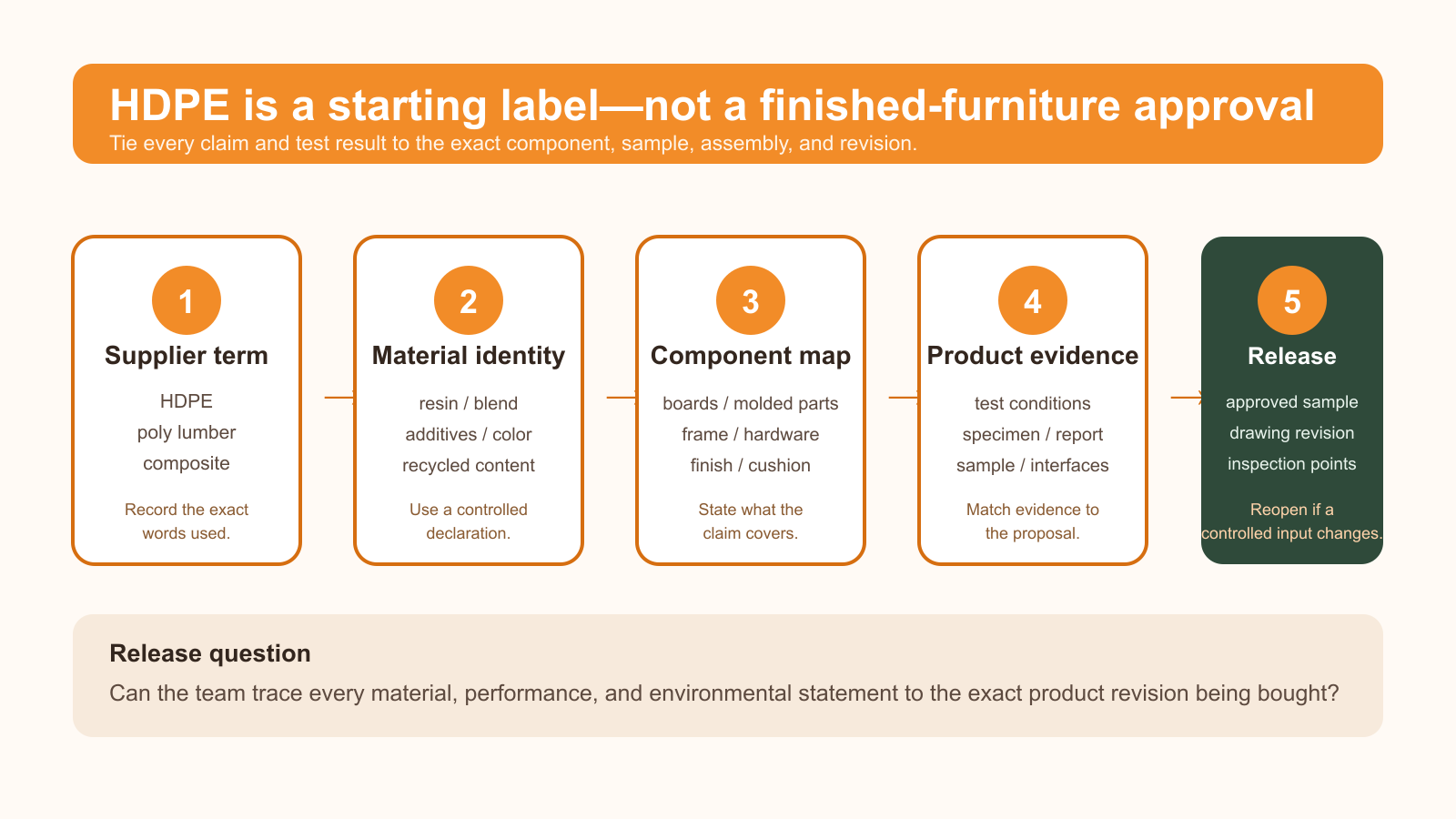
To specify HDPE outdoor furniture for a hotel, turn the supplier label into a traceable product record. State what each term covers, map every material and interface in the finished assembly, match evidence to the exact formulation and application, inspect a representative sample, and carry the approved combination into production.
This guide is a verification workflow, not a declaration that HDPE is universally the best outdoor furniture material. Climate, exposure, cleaning, guest use, storage, local requirements and the complete furniture design still control the project decision.
Translate every supplier term into a controlled statement
Start by copying the supplier’s exact words into the review record. Then ask what object, component and evidence the words refer to. Do not silently convert one label into another.
| Term in a proposal | What still needs to be declared | What the term does not prove |
|---|---|---|
| HDPE | The exact resin or formulation reference, color, additives where relevant, supplier and component using it | The composition of the whole product, weathering result, recycled content or service life |
| Poly lumber | How the profile is made, its material declaration, dimensions, reinforcement, finish and intended application | That every profile is the same polymer or that a board result applies to the assembled chair |
| Composite | Which materials are combined, their proportions or controlled specification, and which component contains them | That the proposal is identical to an HDPE-only formulation |
| Recycled plastic | Whether the claim covers post-consumer, pre-consumer or other recovered material; the percentage; product scope; and evidence owner | That the complete furniture item is recycled, recyclable or environmentally preferable |
| Resin identification code | Which manufactured plastic article carries the code and which resin it identifies | Recycled content, recyclability, local collection systems or finished-product performance |
ASTM D7611/D7611M-26 states that a Resin Identification Code is used to identify plastic resin and is not a recycling code. Its presence does not mean the article is recycled or that systems exist to reclaim it. For procurement, record that boundary instead of using a resin symbol as a product certificate.
Map the material through the finished furniture system
A hotel purchases an assembly, not an isolated resin. Create a component map from the approved drawing and bill of materials. Mark the parts declared as HDPE or composite, then identify everything that can change how the product is built, moved, cleaned or repaired.
- seat, back, arm, slat, panel, tabletop or molded shell;
- internal frame, reinforcement, insert or support that is not visible in a material sample;
- fasteners, brackets, hinges, glides, feet and caps;
- coatings, textures, edge treatments, color references and permitted visual variation;
- cushions, covers, ties, zippers and drainage details where included;
- packaging, assembly instructions, spare parts and replacement ownership.
The useful output is a marked drawing with one material code per controlled component. If a supplier report covers an extruded profile, attach it to that profile—not to the whole chair. If a chair combines plastic slats with a different frame and metal hardware, the release record should preserve those distinctions.
Match the evidence to each hotel application
Do not release one generic evidence pack for every outdoor location. Divide the schedule into application families, then record the site inputs that the responsible project team wants evaluated.
| Application family | Project inputs to record | Sample or coordination focus |
|---|---|---|
| Guestroom balcony | Available footprint, doorway and housekeeping route, wind-management plan, façade interfaces, storage and movement rules | Stability strategy, glides, edges, clearances and the method for moving or securing furniture |
| Poolside lounger | Water and chemical-adjacent operation, wet-use routine, towel or cushion handling, drainage and daily reset | Water-shedding geometry, joints, adjustable mechanisms, contact edges and replaceable parts |
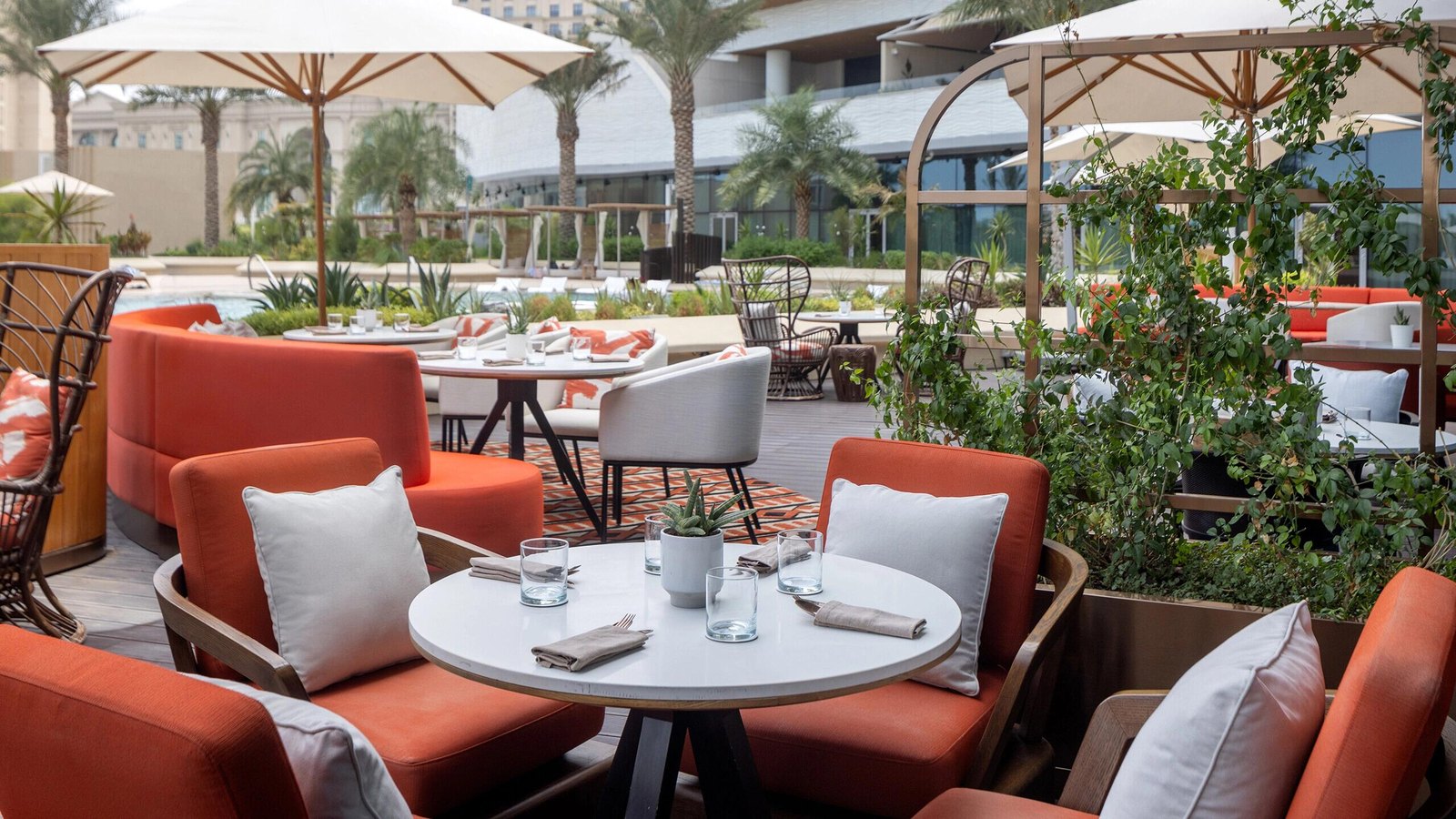
| Outdoor dining | Table service, spills, cleaner compatibility, floor conditions, chair movement, stacking or storage if required | Tabletop-to-base connection, seat and arm interfaces, glides, gaps and cleaning access |
| Beach or exposed terrace | Sun, heat, moisture, wind-blown particles, saltwater influence where applicable, storage and maintenance plan | Product-specific exposure evidence, hardware and joint review, color/appearance reference and inspection interval |
A location name is not a test specification. The project team should define the relevant conditions and acceptance criteria for the destination, then ask the supplier to show how the proposed product and evidence address them. If several zones share the same furniture code, record the most demanding approved application or separate the codes.
Read weathering evidence with its test boundary intact
Ask for the complete report or a controlled extract for the exact proposed formulation, color and specimen. Record the test method and edition, laboratory, dates, specimen preparation, exposure cycle, duration, measured properties, comparison basis, photographs where supplied, result and stated limitations. Then identify which product component the report supports.
ASTM D4329-26 covers controlled fluorescent-ultraviolet and water exposure procedures for plastics. The standard notes that results depend on the operating conditions and that the practice does not simulate every localized weather phenomenon, including saltwater exposure. A report that cites the method without its conditions, specimen and evaluated properties is therefore not a complete hotel approval record.
Do not convert accelerated exposure hours into a promised number of outdoor service years. Do not assume a result for one color, additive package, profile, molded part or supplier formulation applies to another. Ask the responsible professional to define the evidence and acceptance criteria needed for the project’s location and intended use.
Inspect the complete sample, not only the plastic surface
Use the sample to close visible and functional interfaces. The review should include the most demanding corner, span, joint, fastener and moving part in the proposal. Check the approved color and texture reference, edge condition, surface consistency, gaps, drainage paths, glides, caps, visible hardware, reinforcement and contact between unlike materials. Operate adjustable or folding elements through the agreed review sequence.
Reconcile cleaning instructions with the hotel’s nominated products and routine. The exact supplier should identify compatible methods, prohibited treatments and any spot-test instruction. A low-maintenance description does not remove the need for cleaning access, inspection, tightening where applicable, spare parts and a response to damaged components.
Record every comment against the sample ID and drawing revision. A photograph of an approved face is not enough when the underside, fasteners, internal support or drainage route remains different or undocumented.
Build a product evidence passport for one revision
Consolidate the decision into a single passport instead of leaving declarations, drawings and test reports in separate email chains. The passport should identify:
- furniture code, application family, quantity, destination, drawing and bill-of-materials revision;
- supplier and exact material/formulation references for every controlled component;
- color, texture, profile or molded-part references and the approved physical sample;
- recycled-content or other environmental claim wording, scope, percentage where applicable, and substantiating record;
- test reports linked to the exact specimen and component, including method, conditions, result and limitation;
- hardware, reinforcement, joint, drainage, glide, cushion and interface details;
- cleaning, inspection, storage, repair, spare-part and replacement inputs;
- full-assembly sample ID, comments, approval owner, open conditions and release status.
Use a simple status for each row: accepted, accepted with a stated condition, revise and resubmit, or hold. A hold should remain attached to that component or claim until matching evidence closes it. It should not be bypassed by approving a later photograph or a different supplier data sheet.
Qualify recycled-content and environmental claims
Keep composition evidence separate from environmental conclusions. The FTC Green Guides are designed to help marketers make environmental claims that are truthful, substantiated and appropriately qualified. The FTC’s environmental-claims summary cautions against broad, unqualified claims such as “green” or “eco-friendly” and says claims for products made partly from recycled material should be qualified.
For a proposed furniture item, write the claim exactly as it will appear, then identify the component covered, the percentage and basis, the evidence owner and any geographic or programme limitation. “Contains a supplier-declared percentage of recycled material in specified slats” is a different statement from “the chair is recycled” or “the chair is recyclable.” The project team should obtain legal or regulatory review where required; this workflow does not provide it.
Release the product only when the evidence follows the revision
Release when the material declaration matches the bill of materials; each report matches the proposed formulation, color, specimen and component; the application-specific inputs are recorded; the full assembly sample closes the critical interfaces; maintenance and spare-part inputs are accepted; and environmental statements use approved, substantiated wording.
Reopen the affected approval when the resin or blend, recycled-content basis, additives, color, supplier, profile, molded component, reinforcement, hardware, joint, finish, cushion, cleaner, drawing or manufacturing method changes. The new review can be focused, but it must identify why the earlier evidence still applies or what must be repeated.
At resort scale, keep the passport connected to inspection lots and replacement parts. This allows the team to compare production units with the approved sample and prevents a later substitute from inheriting an unrelated HDPE label.
Use Gainwell’s commercial outdoor furniture scope for the product enquiry, and use the outdoor material guide if the material family has not yet been selected. For an HDPE proposal, share the application schedule, material declaration, drawings, evidence passport, sample comments and maintenance inputs through the Gainwell project enquiry.
Frequently Asked Questions
What is HDPE outdoor furniture?
HDPE means high-density polyethylene. In a furniture proposal, however, the term may refer to one profile, slat, panel or molded component rather than the complete product. Ask for the exact material declaration and a component map before treating “HDPE furniture” as a controlled specification.
Is HDPE suitable for hotel outdoor furniture?
It can be evaluated for hotel applications, but suitability is product- and project-specific. Review the exact formulation, color, component design, joints, reinforcement, hardware, cleaning inputs, application conditions, test evidence and full assembly sample. Do not infer a universal result from the material name.
Is composite outdoor furniture the same as HDPE furniture?
Not necessarily. “Composite” indicates that materials are combined, but it does not identify the ingredients, proportions or component without a declaration. A supplier may also use “poly lumber” for profiles made through different formulations or processes. Record the exact controlled description instead of treating the terms as synonyms.
What evidence should a hotel team request before approving HDPE furniture?
Request the component-level material declaration, current drawings and bill of materials, exact color and sample references, product-specific test reports with conditions and limitations, hardware and assembly details, maintenance instructions, substantiation for environmental claims, and a reviewed full-assembly sample tied to one revision.
Does HDPE outdoor furniture need maintenance?
Every outdoor furniture system needs an operating plan. Follow the exact supplier’s cleaning and inspection instructions, review joints, fasteners, glides, caps, drainage, cushions and moving parts, and define repair and spare-part ownership. Avoid interpreting “low maintenance” as “maintenance-free.”
Does an HDPE label prove recycled content or recyclability?
No. ASTM D7611/D7611M-26 separates resin identification from recycling claims. Recycled-content and recyclability statements need their own scope, qualification and substantiation. Identify the covered component, percentage and evidence, and confirm that the final wording suits the market where it will be used.