

A material family cannot be approved for hotel seating. “Leather,” “fabric,” “performance textile” and “contract grade” are starting labels, not complete specifications. Approval should apply to one exact cover article, color and construction on one defined furniture item and use case, supported by evidence that matches that material and by a prototype and control sample that preserve the intended result.
The practical tool is a material evidence passport. It connects the seat’s zone and use to supplier identity, construction, test scope, upholstery build-up, approved appearance and production lot. This makes a commercial upholstery decision reviewable without claiming that one material is universally best.

Start with the seat and use case
Build one use-case card for every upholstery line before comparing samples. Record the furniture item and revision, hotel zone, intended users, contact surfaces, likely frequency and type of use, lighting and exposure context, housekeeping method, expected replacement route, destination market and project authority. Keep requirements as project inputs, not generic assumptions.
A lobby lounge, guestroom chair, dining seat and decorative panel can ask different things of a cover even when they share a color. The seat may experience continuous body contact; an outside back may be touched but not sat on; a cushion may be removable; a vertical panel may be primarily visual. Map those surfaces separately if the material, seam, cleaning or evidence requirement differs.
Record unknowns explicitly. If the cleaning products, destination requirement or item geometry is not confirmed, the material cannot yet be approved for that condition. It may remain a design candidate while the missing decision is assigned to an owner.

Name the exact material—not just its family
Two materials described as seat upholstery leather can have different identities and evidence. The passport should carry the supplier, collection, article, color, construction, composition statement supplied for the product, backing or substrate, surface finish, thickness or weight where relevant, usable width, pattern direction or repeat, batch or dye-lot reference, current technical sheet and current care instructions.
Use the supplier’s exact terminology and preserve its definitions. Do not relabel coated fabric, bonded material or another leather-look surface as leather because the sample appears similar. For leather, preserve the applicable grade, finish and hide identification supplied with the approved article. For woven, knit or coated material, preserve the construction and face/backing description.
The identity record also needs a change rule. A different color, backing, finish, production location or article revision is not automatically covered by the earlier approval. Ask the supplier which evidence still applies and route the delta through the project’s review process.
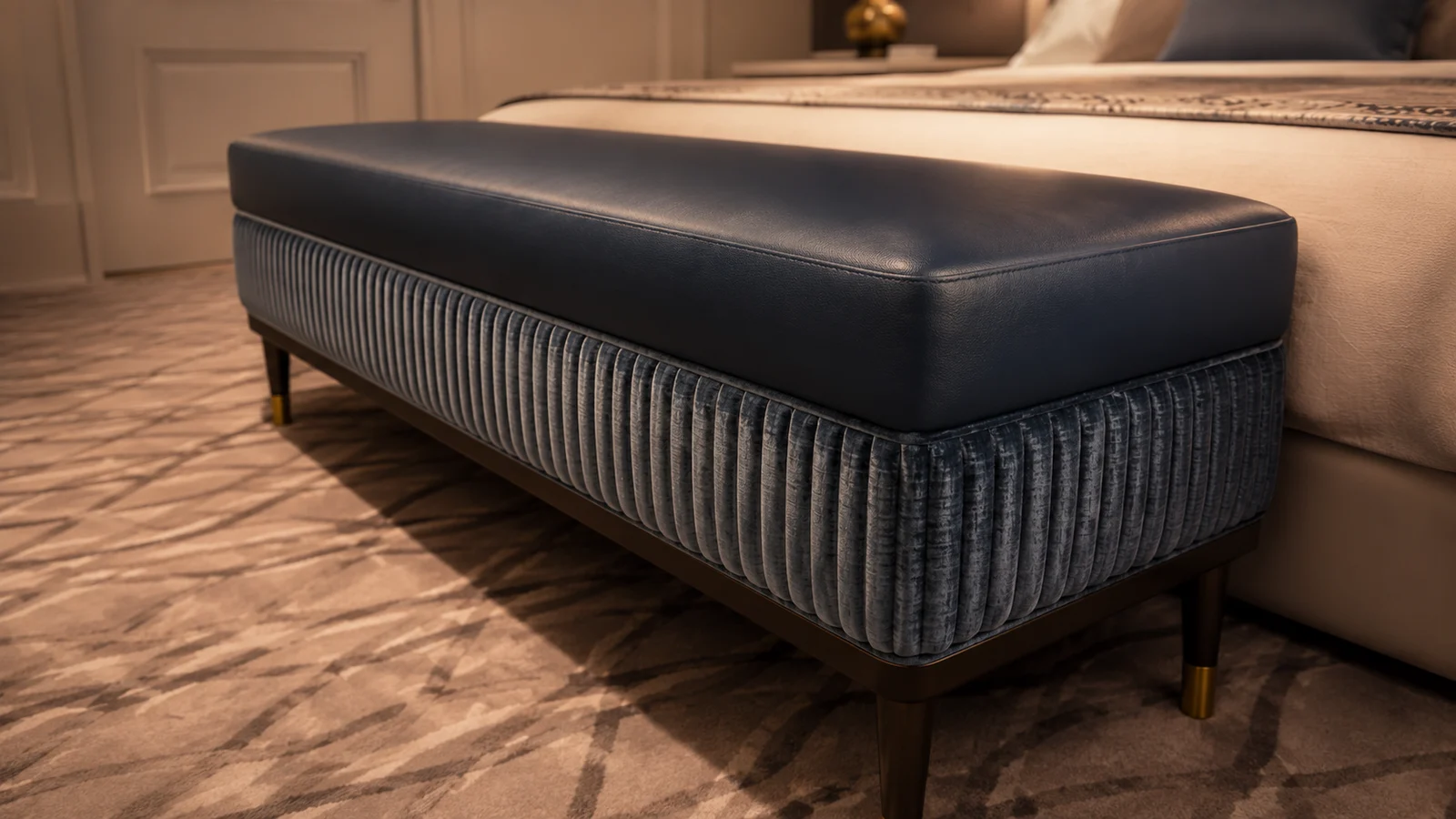
Compare construction and application without choosing a universal winner
The Association for Contract Textiles distinguishes woven, coated and knit fabrics and says its voluntary guidelines depend on three variables: construction, intended application and indoor or outdoor use. That is a useful discipline for a project matrix. Leather requires its own identity and evidence route; ISO 16131 addresses sampling, test methods and recommended values for furniture upholstery leather.
| Candidate family | Identity question | Application question | Evidence question |
|---|---|---|---|
| Woven or knit textile | What are the exact article, fiber statement, construction, direction and backing? | How will the surface, seam and pattern behave on this geometry? | Do methods and samples apply to this exact construction and use? |
| Coated fabric | What are the coating, substrate, finish and article revision? | Are the item interfaces and approved care products compatible? | Was the coated surface tested under the relevant method and condition? |
| Upholstery leather | What exact leather, grade, finish, color and hide-control record apply? | How will natural variation and the cut plan be approved? | Does the cited leather method cover the required property and sample? |
| Mixed upholstery | Which material belongs to each panel, seat, back and accessory? | Where do different surfaces meet and how are they serviced? | Is every component evidenced and approved separately? |
This matrix does not rank the families. It exposes what must be known before a comparison is valid. The correct outcome may be one cover throughout, different covers by zone or surface, or a hold pending better evidence.
Match every test to the material construction
A test title is not enough. For each report, record the method, edition, laboratory, tested sample identity, conditioning and test parameters shown, result, project acceptance criterion, issue date and exclusions. Confirm that the report belongs to the same article, color or construction required by the project—or document why the evidence is transferable.
Scope differences matter. ISO 12947-2:2016 specifies a Martindale procedure for determining textile-fabric specimen breakdown and explicitly excludes coated fabrics. It directs coated-surface abrasion to the ISO 5470 family. ISO 5470-2:2021 applies Martindale abrasion methods to coated surfaces, not the uncoated side of a coated fabric.
Leather has another route. The published ISO 16131:2012 covers selection characteristics for furniture upholstery leather through sampling, test methods and recommended values. ISO currently marks it for revision and lists a draft successor, so a project should confirm the edition it requires rather than assuming the reference is static.
None of these pages sets the complete hotel specification. The destination authority determines applicable compliance, fire, chemical, safety and documentation requirements. Keep those decisions in the project record and have qualified parties review them.
Read abrasion results inside their limits
Abrasion evidence can answer a defined question about a defined specimen under a defined laboratory method. It cannot, by itself, predict how many years a sofa or chair will remain acceptable. The active ASTM D4157-13(2022) method covers oscillatory-cylinder abrasion for woven textile fabrics and explains that fibers, yarns, fabric construction, finishes and test conditions all affect results. It also states that abrasion is only one factor in actual durability.
Do not convert Martindale cycles into Wyzenbeek double rubs, compare results from unlike methods as though they share one scale, or infer that twice the reported number means twice the service life. Instead, ask whether the required method, specimen and acceptance criterion match the material and use-case card.
Also separate breakdown from appearance. A project can care about visible change, pilling, seam behavior, color transfer, light exposure, cleaning compatibility and other properties as well as surface abrasion. Each needs its own stated requirement and applicable evidence. More test rows do not improve a passport when their purpose is unclear.
Review the cover as part of the seating system
The same cover can look and behave differently when applied to another foam, seam, panel size, edge radius, tension or support geometry. Approve the material on the actual furniture prototype or a representative project-approved mock-up, not only on a loose memo sample.
The review record should identify the cover article and color, foam and upholstery build-up, pattern or grain direction, seam and stitch reference, piping or edge detail, panel transitions, closures or removability, comfort comments, appearance comments and unresolved interfaces. Use repeatable viewing conditions for appearance decisions and record who can accept the result.
A cover report still does not prove the complete seat. Structure, stability, strength, fire behavior and other system requirements follow their own project routes. Conversely, a seating test does not automatically approve surface color, cleanability or production appearance.
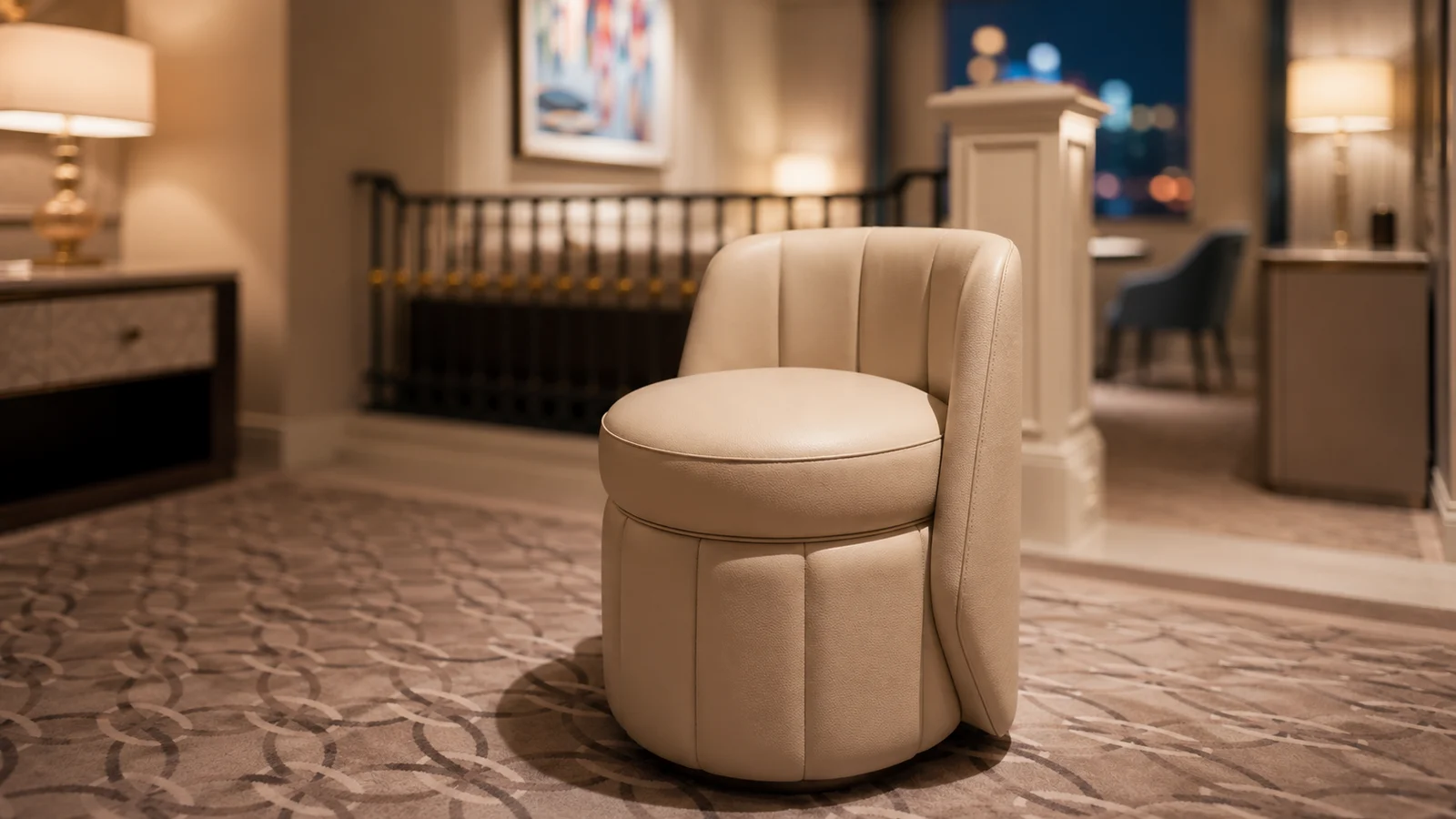
Freeze an observable control-sample state
When the prototype is accepted, create a control-sample card. Link the signed drawing revision, exact material passport, approved furniture sample, finish references and consolidated comments. Add dated photographs under defined viewing conditions when they help preserve color, pattern direction, panel alignment, seam position and surface appearance.
Define which variation is expected and who decides whether production remains within the agreed state. Natural material variation, textile texture and manufacturing tolerances should not be judged against an idealized screen image. Use the physical control reference and the project’s accepted criteria.
Keep the approved sample protected and identifiable. If it is replaced, record the superseded state. Production teams and inspectors need one current reference, not several samples bearing conflicting comments.
Control cutting, batches and production release
Translate the approval into a lot-release checklist. Confirm incoming identity and quantity against the purchase record, retain the supplier batch or dye-lot references, and link rolls or hides to the cut plan where the project requires traceability. Verify usable width, direction, repeat, panel allocation and approved handling against the exact material instructions.
At first-production review, compare workmanship and appearance to the current control sample. Record deviations by item, component, quantity and lot; assign disposition through the project authority. Do not repair, recut, mix lots or release affected pieces through an undocumented shop-floor decision.
The record should survive packaging and delivery. Gainwell’s current Seating & Upholstery page describes custom chairs, sofas, benches and stools developed from approved drawings and samples. It also describes prototype review and controlled production checkpoints while stating that exact tests, quantities, tolerances, dates and warranty terms remain project-specific.
Route every substitution through a delta review
A proposed substitute begins a new comparison, not a name change. Create a delta log showing original and proposed supplier, article, color, construction, backing, finish, dimensions, evidence, care instruction, pattern direction, availability and commercial or programme impact. Mark each row as same, different, missing or not applicable.
Then repeat only the approval work affected by those differences. A new backing may change the evidence and upholstery behavior; a color change may require a new appearance and batch reference; a different construction may require a new test route and prototype review. The responsible project team decides the scope.
Do not let urgency erase traceability. If evidence or a representative sample is unavailable, record the hold and decision owner. A signed substitution should identify which earlier approval it replaces and which production population it affects.
Run one complete material approval chain
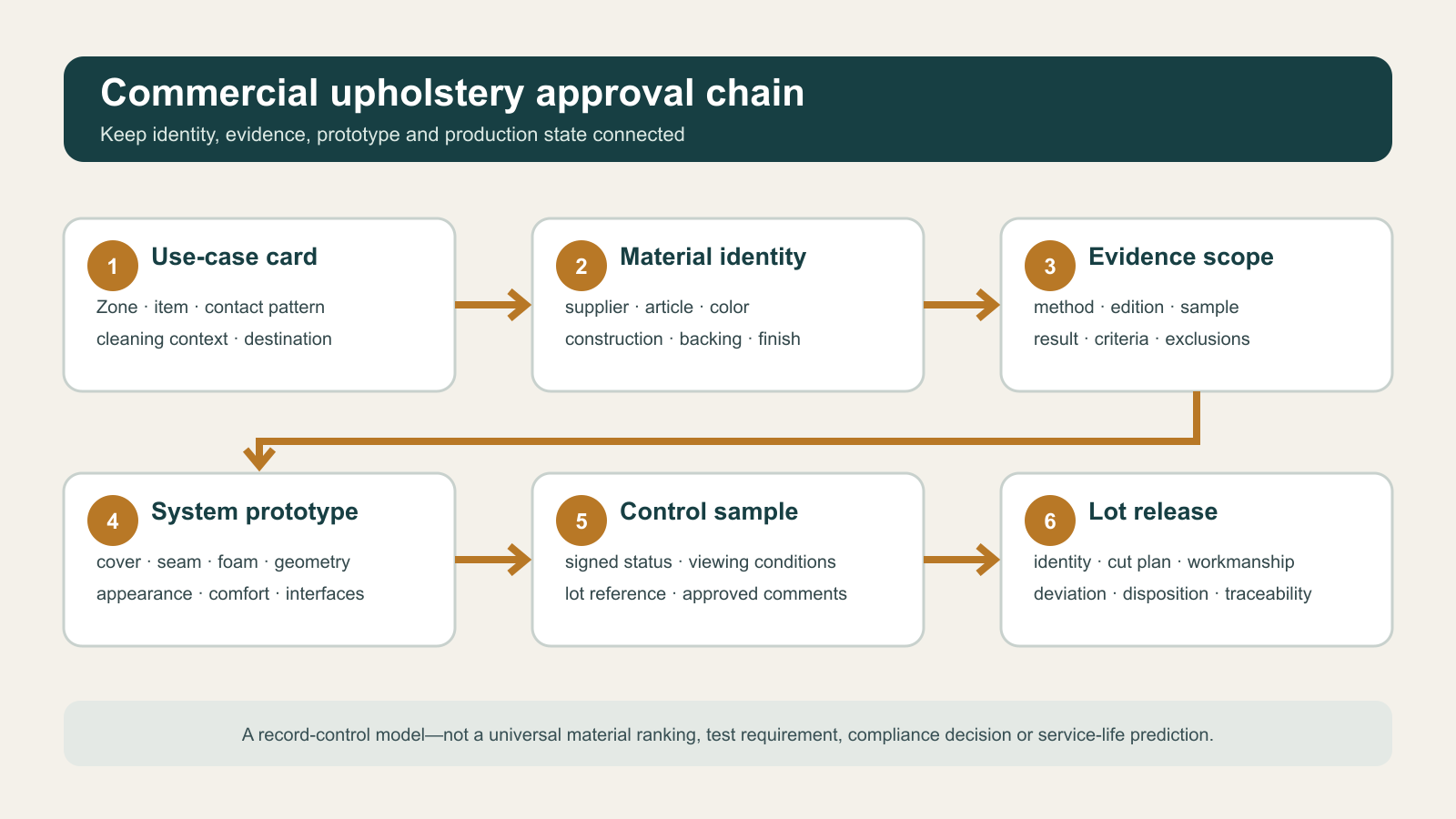
Before production release, trace one upholstery line end to end: use-case card, exact material identity, evidence scope, system prototype, control sample and lot-release record. Verify that the same article and color appear at every stage and that open decisions have owners. Then test the substitution path with one hypothetical change.
Gainwell’s capabilities cover technical development, prototypes or samples, production control, inspection, packaging, delivery and site support. To prepare a seating review, share current drawings, quantities by zone, material schedule, supplier data, required evidence, destination, approval route, programme and open decisions through the Gainwell project contact. Exact scope is confirmed against the current brief and commercial agreement.
Frequently Asked Questions
What is the best material for commercial upholstery?
There is no universal winner. Define the exact seating item, zone, use, contact surfaces, cleaning context, destination requirements and replacement route. Then compare named material articles using evidence that applies to their construction and use. Approve the chosen cover on the actual upholstery system and preserve a control sample for production.
Is leather or fabric better for commercial seating?
Either can be appropriate when the exact article meets the project brief. Compare identity, finish or construction, care instructions, evidence scope, appearance on the prototype, batch control and service plan. Do not decide from the family name or a loose sample. Leather, woven textiles, knits and coated fabrics follow different evidence routes.
What does contract-grade upholstery mean?
Treat “contract grade” as a claim that needs definition, not an automatic approval. Ask which construction, application, indoor or outdoor use, test methods, samples, results and acceptance criteria support it. Confirm the destination’s project requirements separately; one supplier label cannot represent every hotel zone or jurisdiction.
Does a higher abrasion result mean a longer upholstery life?
Not necessarily. Abrasion tests describe a specimen under a named laboratory method. ASTM D4157 notes that actual durability involves additional factors and that wear-life prediction needs end-use correlation. Keep Martindale and Wyzenbeek results in their own methods, and never treat twice the number as twice the service life.
What documents should be included in a hotel upholstery approval?
Include the use-case card, exact supplier and article identity, current technical and care data, applicable reports, project criteria, prototype record, signed control sample, consolidated comments, batch or dye-lot reference, cut-direction requirements, first-production review and exception log. Link each document to the current furniture and drawing revision.
How should a commercial upholstery substitution be approved?
Compare the proposed material with the approved one field by field. Record every changed or missing identity, construction, finish, instruction, evidence, appearance, availability and programme input. Repeat the affected evidence and prototype checks, then obtain project approval that identifies the superseded material and affected production population.