
Hotel furniture sourcing is rarely a single-country decision. Most projects carry several furniture packages with different construction, tolerance and volume profiles, and those packages do not all belong in the same place. This guide helps owner-side and procurement teams build the decision from landed cost rather than factory quotes, split packages by what each origin actually does well, and verify that a stated production location is a real facility before an order depends on it.
Start with landed cost, not the factory quote
A factory quotation typically represents 60–70% of what a furniture package finally costs to place in a guestroom. The remainder sits in freight, duty, inspection, drayage, storage and installation — and that remainder is not proportional between origins.
Comparing two quotations without their remainders is not a comparison. It is two partial numbers with different tails.
| Landed-cost component | What moves it | Where teams under-budget |
|---|---|---|
| Ex-factory price | Specification, quantity, finish complexity | Rarely — this is the visible number |
| Ocean freight | Origin port, container utilisation, season | Under-filled containers on mixed packages |
| Duty and fees | Tariff classification, origin, entry value | Treated as a fixed planning constant |
| Third-party inspection | DUPRO and pre-shipment scope | Omitted entirely on first-time suppliers |
| Drayage and storage | Distance to site, site readiness date | Storage when construction slips |
| Installation and making good | Package type, site access, sequencing | Millwork and fixed items in particular |
The freight, storage and handover portion of this model is covered in more depth in our guide to FF&E logistics for hospitality projects, which treats delivery as a chain of controlled handovers rather than a freight booking. Build this table for each candidate origin before you rank quotations. On mixed packages the ranking frequently inverts once freight utilisation and inspection scope are included.
Put every quotation on one incoterm before comparing
EXW, FOB and DDP answer three different questions about who carries which risk and cost. A DDP number that looks high against an EXW number may in fact be lower once the EXW tail is priced.
Fix a single incoterm in the RFQ, state it in the instruction to bidders, and reject returns that quote on a different basis rather than normalising them yourself. Normalising someone else's assumptions is where comparison errors originate.
Treat duty as a live figure, not a planning constant
Tariff positions applying to furniture have moved repeatedly, and the gap between origins has been the single largest variable in origin selection over recent cycles.
Do not carry a duty rate from a previous project, a supplier's presentation or a published guide. Confirm the current rate against the specific classification of your goods, in the week the quotation is being priced, and state the date of that confirmation in the cost model. A rate that is correct today and wrong at shipment is a budget failure, not a rounding error.
Where a project spans several months of production, model the duty exposure as a range rather than a point, and identify which party carries the difference in the contract.
Split the decision by package, not by country
The useful question is not "China or Vietnam." It is "which of my packages belongs where."
A guestroom program typically contains at least four package types with different manufacturing demands:
- Technical development and mock-up — turning design intent and interior drawings into production drawings, then building one physical room for approval.
- Mixed-material and shaped items — pieces combining timber with metal, stone, glass or integrated lighting, or with curved and non-rectangular geometry.
- Volume timber casegoods — the same item repeated across a large room count, in wood, with a paint, stain or veneer finish.
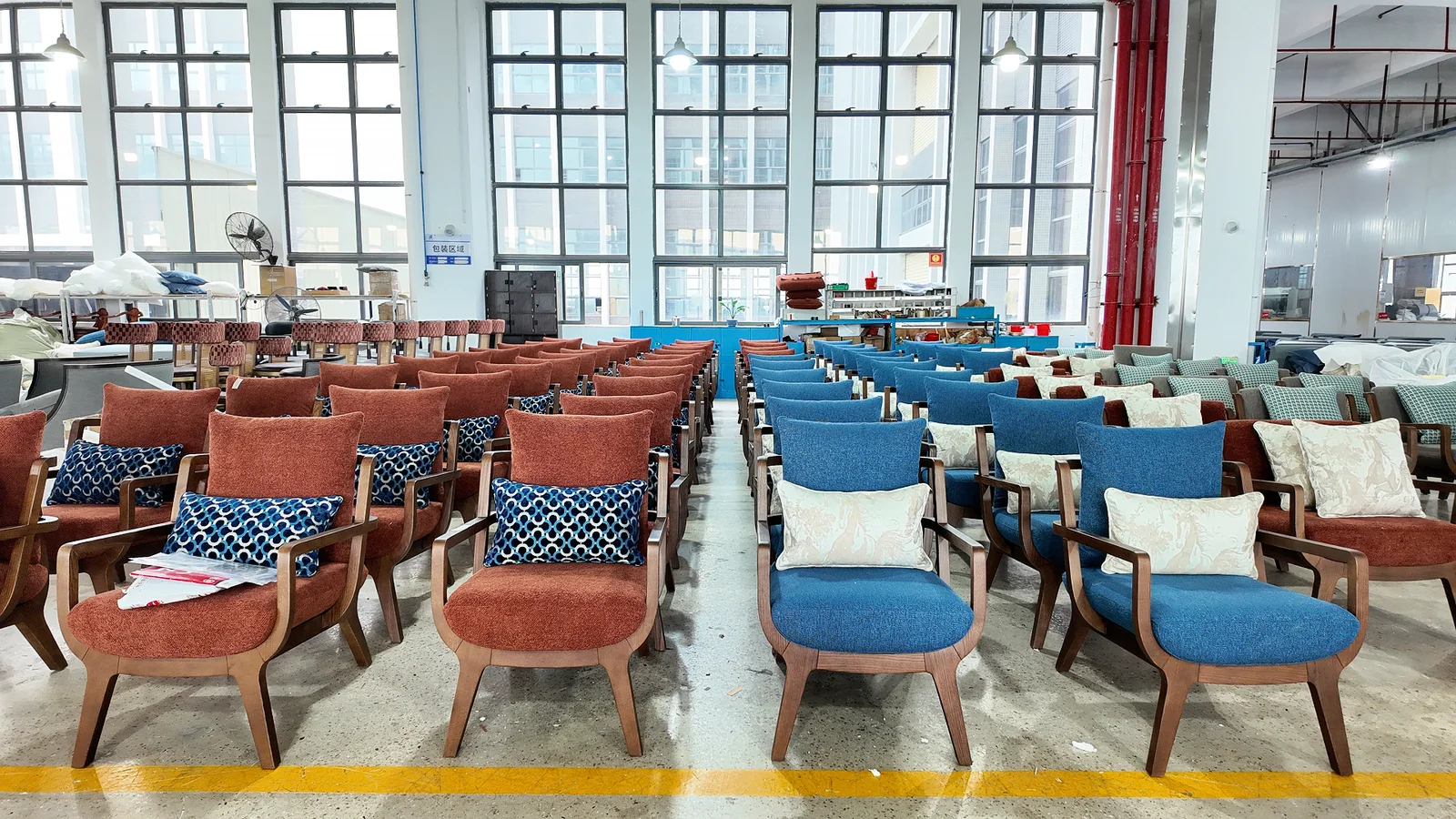
- Upholstery and loose seating — frames, foam, fabric and finishing, with its own labour and material profile.
These four do not share an optimal origin. Treating them as one decision produces a compromise that is wrong for at least two of them.
Where China's supply depth changes the outcome
The manufacturing cluster around Guangdong carries unusual supplier density in metals, stone, glass, hardware and lighting components. For a piece that combines those materials, the practical consequence is that it can be built in one facility rather than subcontracted across three, which removes the tolerance stack-up and the coordination failures that subcontracting introduces.
The same density supports technical development. Turning an interior designer's drawings into manufacturable shop drawings is an engineering activity, and it depends on an in-house team that has done it across many brand programs.
Packages that generally belong in China:
- Public-area and feature pieces with mixed materials
- Curved, radiused or otherwise non-rectangular geometry
- Items with integrated lighting, concealed mechanisms or specified hardware
- Technical development, sampling and the physical mock-up room
- Millwork and fixed furniture requiring site-condition coordination
Where Vietnam's cost position changes the outcome
Vietnam's strength in hospitality furniture is solid timber and painted or stained finishes produced at volume. Where a package is the same casegood repeated several hundred times, in wood, without mixed-material complexity, Vietnamese production is generally cost-competitive and the duty position has been more favourable for several destination markets.
The corresponding limitation is supply-chain depth. Mixed-material and heavily shaped work draws on a narrower local supplier base, which reintroduces the subcontracting that the package split was meant to avoid.
Packages that generally belong in Vietnam:
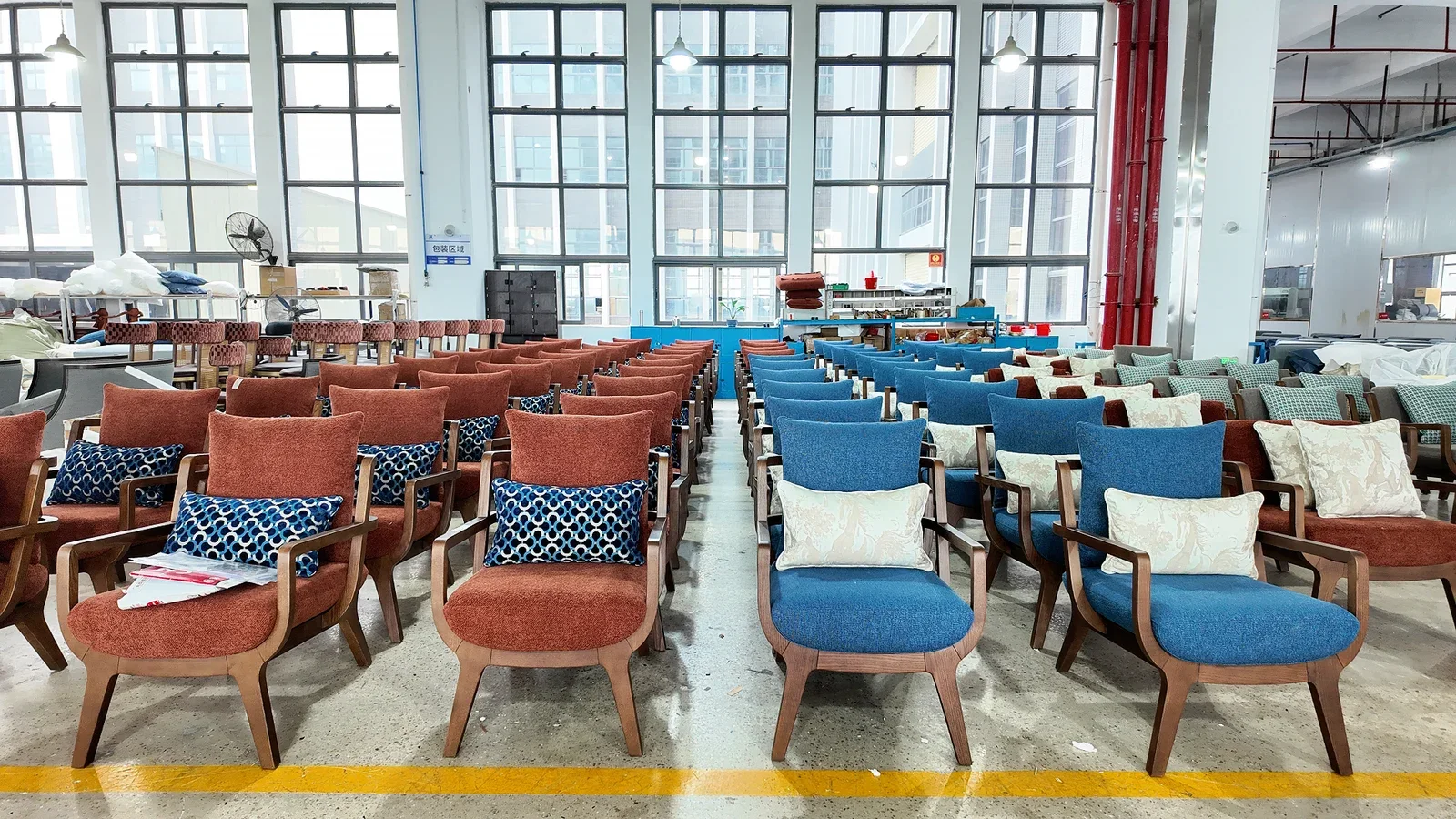
- Repeated timber casegoods at volume
- Paint and stain finish programs
- Straightforward geometry with standard hardware
- Programs where unit cost dominates and complexity is low
Gainwell operates on this basis across both origins, and our manufacturing capabilities are organised around exactly this split. Our Zhongshan facility carries the technical development team — 94 R&D staff alongside 450 production personnel, with an annual capacity of approximately 8,000 keys — and handles mock-ups, mixed-material work and shaped items. Our Vietnam facility at Bình Dương Province runs 30,000 m² with 600 workers and monthly output of around 300 containers, weighted toward timber casegoods and painted finishes. A second Vietnamese site at Quy Nhơn is being delivered in two phases.
Test whether a stated Vietnam facility is production or transshipment
Origin claims carry commercial and regulatory consequences. Verify before an order depends on the answer.
| Evidence to request | What it demonstrates | What a weak answer looks like |
|---|---|---|
| Certificate of origin and issuing authority | Formal origin position | Vague references to "our partner" |
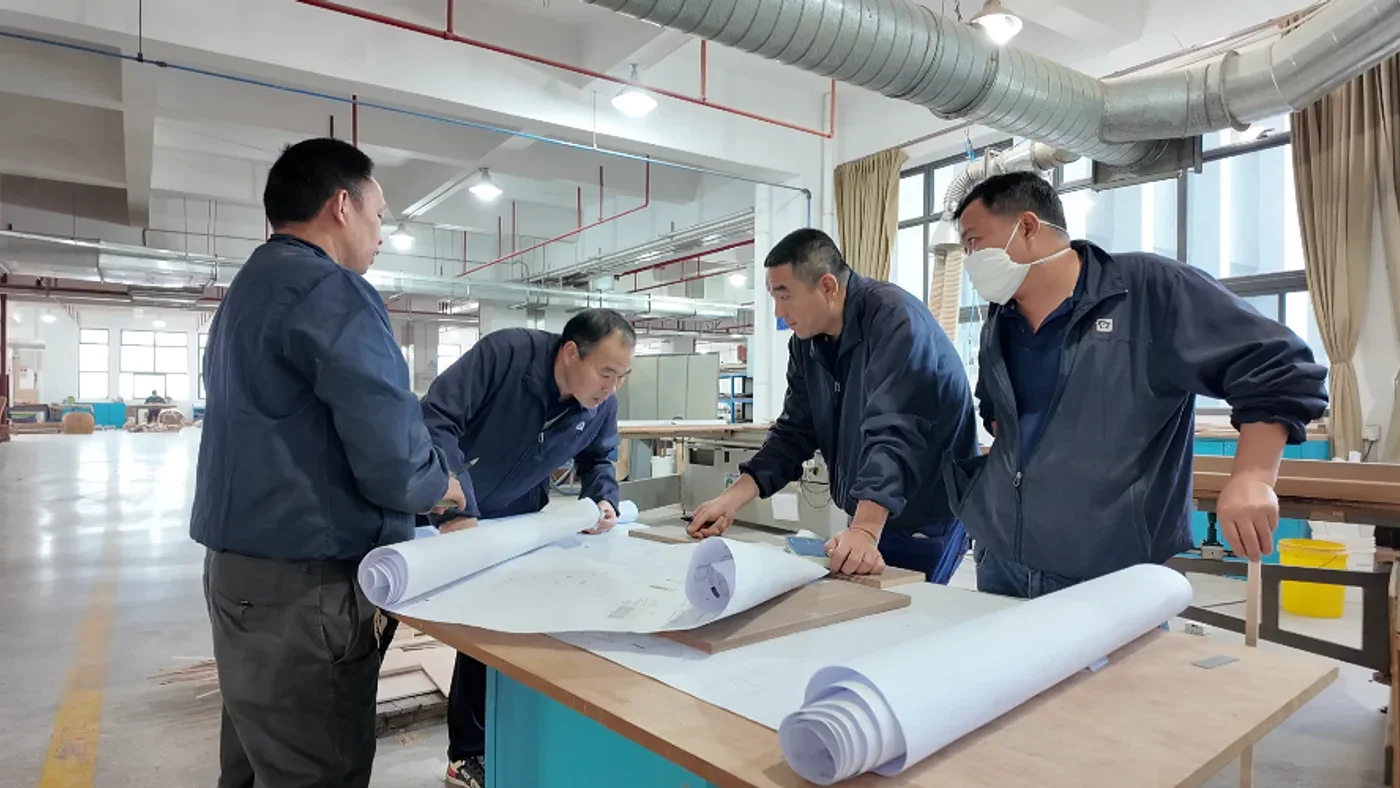
| Production-line photography showing the specific equipment your package needs | Capability, not just premises | Gate signage and exterior shots |
| Headcount and monthly container output | Scale consistent with your order | Numbers that do not reconcile with the order accepted |
| Unscheduled video walk-through of the floor | The facility is operating | Only pre-recorded material |
| Ownership relationship between the quoting entity and the operating factory | Who you are actually contracting | A trading company using factory imagery |
The last item deserves particular attention. Confirm that the legal entity receiving payment is the entity operating the plant.
Set the volume threshold below which neither origin applies
Direct import from either country stops being economic below roughly one container of matched goods — in guestroom casegoods terms, approximately 30–40 rooms. Below that point, minimum order quantities, extended lead times and the inspection burden that the buyer carries generally exceed the unit-cost saving.
Three further conditions point away from overseas production regardless of quantity:
- A programme timeline shorter than about four months from drawing freeze to site delivery
- A requirement for local warranty attendance, where someone must physically return to the property
- An absence of drawings and a specification, where the buyer is not in a position to define what is being built
These are not disqualifications of any particular supplier. They are conditions under which domestic or dealer supply produces a better project outcome.
Worked example: splitting a 180-key project
A 180-key upper-upscale property, drawings issued, delivery to a North American port.
Single-origin approach. All packages to one factory. The mixed-material lobby pieces are subcontracted locally by the factory, adding a coordination layer the buyer cannot see. The vanity units, with stone tops, are produced in a facility whose stone supply is external. Total quotation appears competitive; two packages carry hidden interface risk.
Split approach. Development and mock-up in China. Vanities, lobby feature seating and any shaped items in China. Guestroom casegoods in Vietnam. Loose seating quoted from both and awarded on landed cost.
The split adds a second origin to coordinate and a second set of shipping documents. It removes subcontracting from the two packages where tolerance and finish consistency matter most, and takes the duty position on the largest package — the repeated casegoods — from the less favourable origin to the more favourable one.
The comparison is not which is cheaper on the quotation. It is which carries less unpriced risk at the same landed cost.
Plan for the seams when one project uses two origins
Two origins create interfaces, and interfaces are where projects lose time.
- Finish matching across origins. Approve one control sample set and require both facilities to match it, not each other. Colour and sheen drift between sites is the most common rejection at installation.
- Shipping sequence. Items installed together should arrive together. Build the consolidation plan before production, not after.
- Documentation. Two origins, two sets of entry documents, two duty positions. Confirm who prepares them.
- Single point of accountability. Where both origins sit with one manufacturer, the interface is internal. Where they sit with two suppliers, the buyer owns it — price that.
Know what changes if tariff positions move mid-project
Production programmes for hospitality furniture run across months, and duty positions have moved inside that window before.
Address it in the contract rather than in hope. Define which party carries a change in duty between order and entry, whether a defined movement triggers renegotiation, and whether any part of the programme can be re-routed to the other origin without re-development. The last point is only available where the manufacturer holds both origins and the package has been drawn for both.
Prepare an origin decision pack for project review
Before origin selection goes to the project team, assemble:
- Package-split map with a stated reason for each assignment
- Landed-cost model per package, per candidate origin, on one incoterm
- Duty confirmation with classification and date
- Verification evidence for each facility named
- Volume and timeline check against the thresholds above
- Interface plan covering finish control, consolidation and documentation
- Contractual position on duty movement
Where the pack is complete, it feeds directly into the procurement sequence set out in our guide to hotel furniture procurement from scope freeze to shipment release. A decision recorded with its reasoning survives a change of personnel. A decision recorded as a price comparison does not.
Frequently Asked Questions
Is China or Vietnam better for hotel furniture manufacturing?
Neither origin is universally better. Compare the actual factory's engineering, materials, finish capability, quantity fit, export route and landed cost for each package. A project may place complex development work in one location and repeated production in another, provided the interfaces and approval standards remain controlled.
What should be included in the landed cost of hotel furniture?
Use one commercial basis and include the product price, packaging, inland transport, export charges, freight, insurance, duties, taxes, customs services, destination handling, storage, final delivery, installation and expected quality-control costs. Keep uncertain items visible instead of hiding them inside a single allowance.
When should a hotel furniture project split packages between China and Vietnam?
Consider a split when different packages have materially different engineering complexity, repeatability, quantity, origin exposure or logistics needs. Record the reason for each assignment, then control shared finishes, hardware, drawings, consolidation and installation sequencing. A split that creates unmanaged interfaces can cost more than it saves.
How can a buyer verify that a Vietnam furniture facility is real production rather than transshipment?
Verify the legal entity, address, machinery, workforce, production flow and records for the specific package. Connect the purchase contract, factory audit, material receipts, production evidence, inspection records and export documents. A shipping address or country-of-origin statement alone does not prove where substantial production occurred.
What happens if duty rates change during a hotel furniture project?
The contract should state which party carries a duty change, what date or event controls the calculation, when a movement triggers review and whether the package can move to another approved origin. Any change must also account for new drawings, samples, origin evidence, production capacity and schedule consequences.