Custom hospitality furniture since 1995 · China & Vietnam manufacturing

What Is an FF&E Schedule? Fields, Ownership and Approval Control

A chair can be item CH-104 in an interior layout, CH-014 in a quotation, “lounge chair” in a sample log and Package 7 on a packing list. Each document may look complete, yet the project has no reliable answer to a simple question: are they all the same approved item?

An FF&E schedule is the controlled item register that prevents that break in identity. Each row gives one furnishing item or controlled variant a stable code, location and quantity basis; links it to the current technical and approval evidence; and exposes its latest authorized state.

The schedule is not valuable because it contains many columns. It is valuable because every drawing, sample, quotation, order, package label, site record and handover entry can point back to the same item lineage.
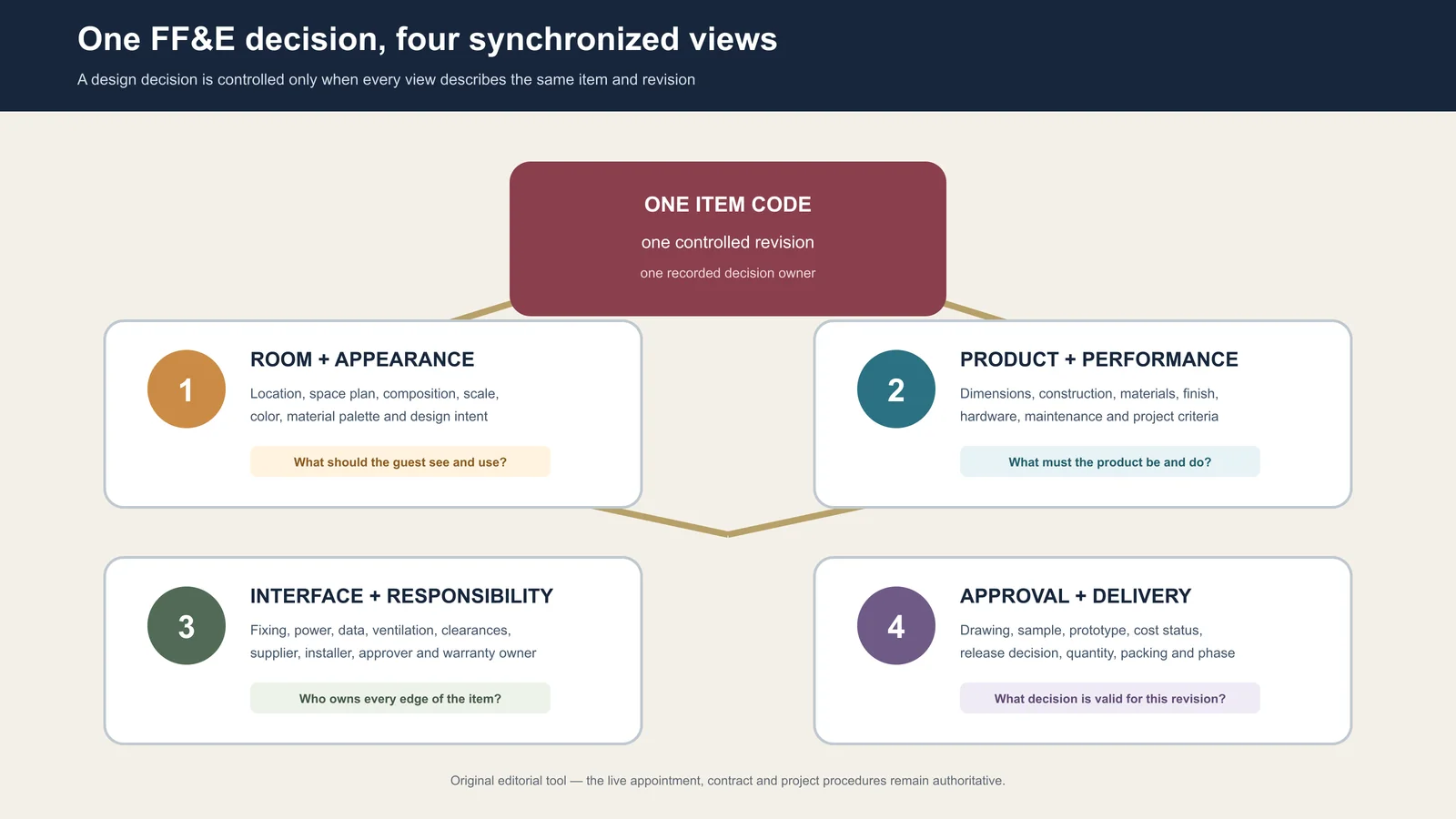
One FF&E item code connected to four synchronized project views
One controlled identity can feed several working views. The schedule fails when those views silently describe different items or revisions.

What does an FF&E schedule control?

In practice, “schedule” can mean a product-selection sheet, an item register or a timeline. For this guide, it means the item-level register. Dates and milestones can appear in it, but the project master programme remains a separate control. Likewise, the schedule should link to specifications, budgets and approval files rather than trying to replace them.

RecordPrimary questionRelationship to the FF&E schedule
FF&E scheduleWhich item, where, how many, against which evidence, and in what state?Holds the item identity and links the other records
Specification or data sheetWhat must the item be, include or achieve?Appears as a controlled document reference and revision
Project programmeWhen must coordinated activities and milestones occur?Receives item or package milestones without becoming an item database
Commercial registerWhat has been quoted, committed, varied and paid under the authorized basis?Reconciles through the same item and package codes; access may be restricted
Asset or handover registerWhat was accepted, where is it, and what operational information follows it?Receives the final scheduled identity and accepted evidence
Depreciation scheduleHow are assets treated for accounting purposes?A separate accounting record outside this article’s intent

Define what one row means before adding columns

The row is the grain of the schedule. If the grain is vague, totals and statuses are unreliable even when the spreadsheet is beautifully formatted.

A useful starting rule is: one row represents one base item in one controlled variant. A variant is necessary when a difference changes a decision the team must track—for example handedness, size, finish, upholstery, service interface, destination package or approval route. A color difference that shares every other decision may remain one base code plus a controlled finish variant. A minibar cabinet with a different appliance opening should normally be separated because the geometry and evidence change.

Before admitting a row, apply five checks:

  1. Identity: Does the item have one unique, durable code and a plain-language name?
  2. Placement: Can the team state the room type, room, zone or repeated location rule?
  3. Quantity basis: Can the count be traced to locations, repetition and authorized spares?
  4. Evidence: Is there a current drawing, specification, selection or other record that defines the present requirement?
  5. Ownership: Is one role responsible for the row and each controlled decision within it?

A placeholder may enter the schedule with open decisions, but it should not imitate a released item. Mark what is unknown, who must resolve it and which next use is blocked.

Build a stable identity spine

The fields that survive from concept to handover form the schedule’s identity spine. Keep them stable even as later views add information.

Field groupMinimum useful fieldsControl question
IdentityItem code, controlled variant, short name, category, packageCan every document name the same object?
LocationProperty, building, floor, room type, room or zone ruleCan the item be counted and found?
Quantity basisUnits per location, location count, spares basis, current quantity statesCan every total be reproduced?
Technical referenceDrawing, specification or data-sheet number and revision; finish or sample referenceWhich controlled evidence describes the current requirement?
Decision stateStatus, reviewed object, authority, date, conditions and open commentsWhat exactly may proceed?
ResponsibilityField owner, transition owner and next action ownerWho can prepare, change, approve or close the data?
Physical lineageSupplier item reference, batch or package code, destination and accepted locationCan the received object be traced back to the scheduled decision?

Do not make a product image, a long description or a supplier model number the primary identity. Those values can change. The project item code should remain the durable key, with supplier and document references attached to it.

Use five views of one record, not five competing schedules

Different teams need different columns. That does not require duplicate master files. Maintain one governed record and issue role-specific views.

  1. Design view: item, location, composition, scale, finish direction and current design reference.
  2. Approval view: required evidence, submitted object and revision, reviewer, authority, decision, conditions and next action.
  3. Procurement view: tender package, comparable quantity, selected basis, supplier reference, commitment state and surviving exclusions.
  4. Delivery and installation view: package identity, destination, shipped and received quantities, zone, installation state and exception reference.
  5. Handover view: accepted location and quantity, final reference set, care or warranty document where contracted, spare identity and open closeout item.

Commercial access can be restricted while the item code remains shared. A site team may not need unit cost, and a designer may not need container data. Both still need the same item identity and approved revision.

Labeled finish containers and sample boards on storage shelves
A finish direction becomes usable when the project identifies the controlling reference, reviewed attributes, permitted variation and current status.

Keep quantity states separate: a worked example

A single “Qty” column hides the difference between a design calculation and a physical acceptance. Use separate states when the underlying decision differs.

Consider an illustrative minibar cabinet, code CG-214. One approved room type has 18 rooms, each using one cabinet. The owner also authorizes two spares. The planned quantity is therefore:

Planned quantity = 18 rooms × 1 cabinet per room + 2 authorized spares = 20

Quantity stateIllustrative valueEvidence neededDo not infer
Planned20Room-type count, units-per-room rule and spare approvalThat 20 has been bought
Committed20Authorized order or contract line tied to CG-214That 20 has been produced or shipped
Received19Receipt by package, identity, quantity and observable conditionThat all 19 are installed or accepted
Accepted18Accepted location and closeout or exception recordThat the remaining two are lost; one may be a spare and one may remain open

The values are fictional and show the logic only. A live project may add produced, inspected, shipped, damaged, rejected, replaced or installed states. The important rule is that a later update must not overwrite the evidence behind an earlier state.

Reference dimensions and specifications; do not copy them blindly

The schedule needs enough technical data to identify and filter the item, but detailed geometry belongs in the controlled document best suited to show it. Record the drawing or data-sheet number, revision and dimension status. Distinguish design dimensions, supplier-confirmed dimensions and field-verified dimensions where the difference affects fit.

Gainwell team reviewing furniture drawings at a factory worktable
The schedule should name the controlling drawing and revision; the drawing remains the source for the detail it contains.

Copying every dimension, material note and construction clause into the schedule creates two editable sources. When a shop drawing changes but the copied cell does not, the row looks current while describing the wrong object.

For an interface-sensitive cabinet, the schedule might record “overall width—refer to drawing GW-CG214-05, Rev C; appliance opening—field or selected-model input pending.” The drawing holds the geometry. The schedule exposes which reference controls and which decision is still open.

Record approval as a five-part decision

“Approved” is not a self-contained status. A usable approval tuple identifies:

  1. Object: drawing, sample, mock-up, quotation basis or other reviewed evidence.
  2. Revision: the exact issue reviewed.
  3. Scope: the attributes covered—for example finish only, geometry only or full fabrication release.
  4. Authority: the named role permitted to make that decision under the project procedure.
  5. Condition: decision date, open comments, exceptions and the next permitted action.

A finish sample approval should not imply approval of dimensions, hardware or construction. A reviewed drawing should not silently approve an unshown material. Store each decision against the relevant evidence and let the consolidated item state reflect only the actions that are actually permitted.

Change the schedule through a delta record

Do not correct a released row by quietly replacing its old value. Preserve the last controlled baseline and issue a delta that records:

This delta is an editorial planning tool, not a substitute for the formal instruction or contract change. Its purpose is to stop one cell edit from becoming an invisible contradiction across five working views.

Furniture panels organized in production groups inside a workshop
A management total becomes reviewable only when it can be traced to an asset population, quantity basis, cost boundary and current evidence state.

Assign owners to fields and state transitions

“The designer owns the schedule” is too broad. The designer may own item identity and design references, procurement may own commercial fields, the manufacturer may prepare shop-drawing and production updates, logistics may update custody, and the site or owner team may record acceptance. The appointment and project procedure decide the actual roles.

For each controlled field group, name who may prepare it, who verifies it and who authorizes a state change. Then name the transition owner. Moving an item from “sample submitted” to “finish approved” is a decision; moving it from “approved” to “released for production” may be a different decision with a different authority.

Use controlled status values with written definitions. Avoid color as the only signal and avoid phrases such as “nearly approved.” A useful state must tell another team what can happen next.

Run three reconciliations before issuing the schedule

  1. Location-to-quantity: Recalculate totals from room types, zones, repeated locations and spares. Investigate every manual override.
  2. Evidence-to-state: Test whether the current drawing, specification, sample and approval records support the published item state.
  3. Digital-to-physical: Select received or installed items and confirm that package labels, locations and exception records resolve to the scheduled code and variant.

A schedule can pass one test and fail another. The room count may be correct while the drawing revision is stale. The delivery count may reconcile while three pieces have the wrong variant. Record each failure as a named exception instead of forcing the row to display a reassuring green status.

Close the lineage at handover

Handover should not create a new asset identity. Carry the scheduled code into the accepted location and connect the final approved reference, accepted quantity, outstanding exception, care information, spare code and warranty document where these are part of the contracted deliverables.

Close a row only when the project’s completion rule is observable. “Installed” may mean placed in the correct room; “accepted” may require inspection and closed exceptions; “closed” may require documents and spare information. Define those meanings before site reporting begins.

What should you send Gainwell for a schedule review?

Gainwell’s current product directory covers custom loose furniture, casegoods, seating, tables, outdoor and specialty products, plus architectural millwork and fixed furniture. Its public capabilities workflow describes shop drawings, material and finish coordination, prototypes or samples, manufacturing checkpoints, inspection records, project coding, packaging and delivery support.

Those are company-level capabilities, not an automatic scope for every project. For a useful review, provide the current item schedule, room and area counts, drawing and specification index, dimension status, finish direction, approval route, destination and the exact technical, manufacturing or delivery responsibilities you want assessed.

Start with one representative repeated item and its controlled variant rather than sending an unqualified workbook. Share the FF&E schedule and project brief with Gainwell so the team can confirm which inputs, deliverables and services fit the live proposal.

FF&E Procurement: Process, Roles and Control Gates

FF&E procurement is broader than purchasing. It defines what a project will buy, organizes the supply market, compares proposals, controls approvals and changes, authorizes commercial commitments, and keeps each delivered asset traceable to the requirement the owner accepted.

Purchasing creates and administers orders inside that system. Sourcing identifies possible suppliers. A procurement company may perform both, but its name does not prove that it also owns design, manufacturing, freight, installation or final acceptance. The appointment and responsibility schedule must state those boundaries.

For a hotel owner or procurement lead, the practical goal is not simply to place orders. It is to make every commitment from enquiry to handover with the right information, authority and evidence.

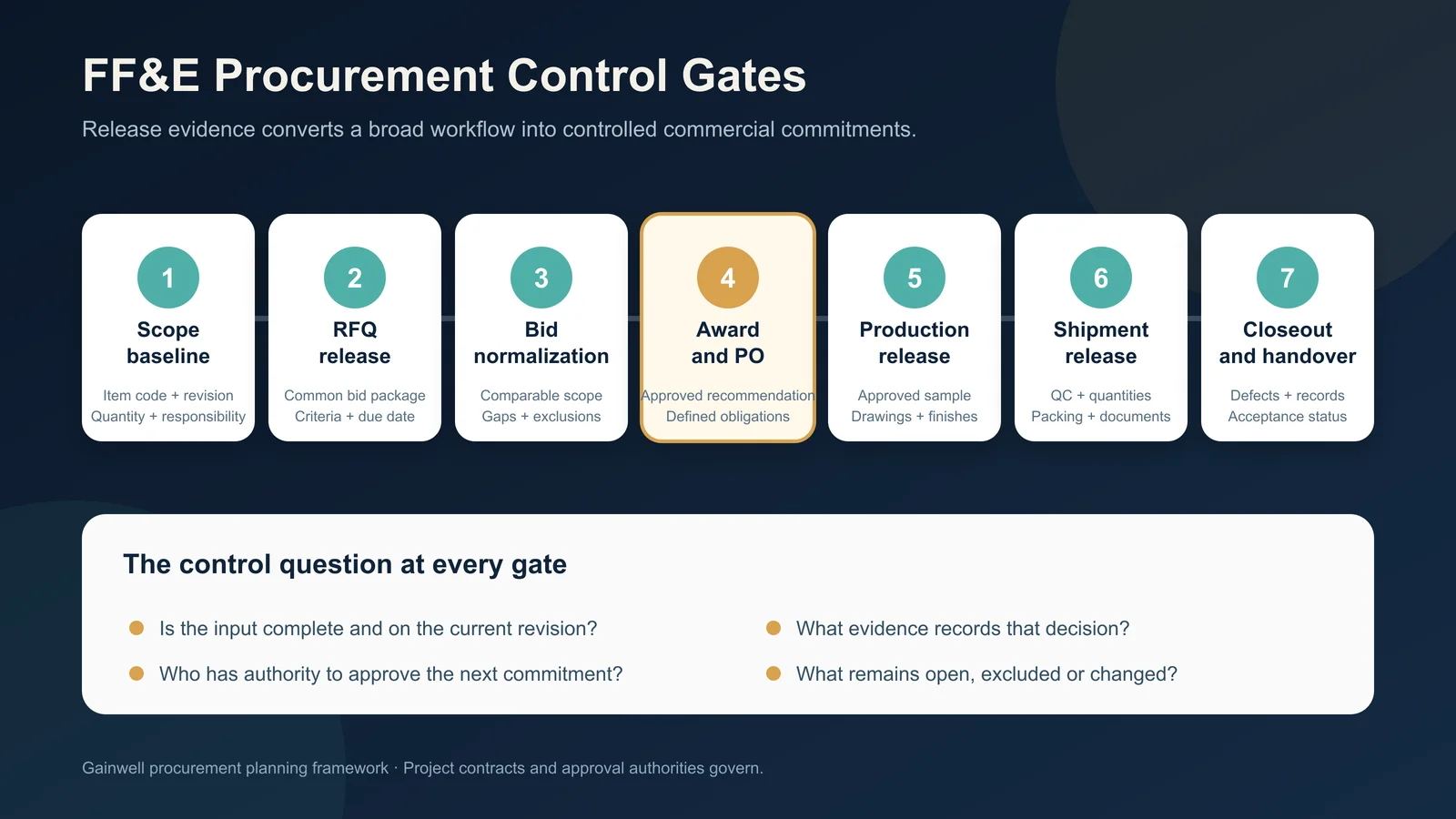
Seven FF&E procurement control gates from scope to handover
Each gate asks whether the next commitment has a current input, an authorized decision and a durable record.

Choose the procurement operating model before building a supplier list

The best operating model depends on the owner’s team, package diversity, design maturity, geography, reporting needs and appetite for direct contracts. Choose how the work will be governed before asking which company should do it.

Operating modelWhere it may fitBoundary to make explicit
Owner-managed direct purchasingThe owner has experienced procurement resources and wants direct control of supplier contractsWho prepares specifications, normalizes bids, expedites orders and coordinates delivery exceptions?
Independent procurement companyThe owner wants one team to run tenders, purchasing, reporting and supplier coordination across categoriesIs the company an adviser, purchasing agent, reseller or contracting principal, and how are fees or margins disclosed?
Designer-led procurementSelection continuity and specification control are central, with commercial administration added to the design serviceSeparate design approval, buying authority, financial reporting and post-order management
Manufacturer-led packageA defined custom furniture package benefits from direct technical development, prototyping and production controlDo not assume that one manufacturer controls unrelated FF&E categories, owner-side tendering or site-wide logistics
Hybrid package modelDifferent categories need different routes—for example, direct custom furniture plus an agent for mixed standard productsAssign one owner for shared schedules, interfaces, consolidation and closeout records

A hotel can use several models at once. What matters is that each item code has one buying route and that interfaces between routes remain visible.

Map decision rights, not just job titles

List the decisions that change scope, money, time or acceptance. Then name who prepares the recommendation, who reviews it, who can approve it and which record proves the decision. Typical rights include releasing an RFQ, approving an alternative, selecting a supplier, issuing a purchase order, approving a sample, accepting a price change, releasing production, authorizing shipment and accepting closeout.

Job titles are unreliable shortcuts. A designer may approve appearance without authority to change price. A procurement agent may issue an order only after owner approval. A manufacturer may propose a buildable alternative but cannot approve it for the project. An operator may review maintenance needs without owning the construction interface.

Current ISO/TC 176/SC 2 guidance for ISO 9001:2015 links to official papers on the process approach and documented information. Those principles are useful here, but they do not certify a procurement program or determine its commercial authority.

Create one baseline before asking the market to price

A procurement baseline is the controlled set of information against which proposals and later changes are measured. It should be complete enough to expose uncertainty, not pretend that every design decision is final.

Give the baseline a revision and issue date. Mark gaps as an assumption, allowance, option or hold point so every bidder treats them visibly.

Gainwell team reviewing hotel furniture drawings in the factory
A furniture package should connect its room or area demand to the current drawing, finish, interface and decision record.

Use seven gates to control commercial commitment

  1. Scope baseline: authorize the coded items, quantities, current references and responsibility boundaries for market enquiry.
  2. RFQ release: confirm that invited parties receive the same issue set, response format, clarification route and due date.
  3. Bid normalization: reconcile qualifications, substitutions, omissions, delivery bases and commercial assumptions before scoring.
  4. Award and purchase order: record the accepted technical and commercial basis, required approvals and unresolved conditions.
  5. Production release: connect current drawings, quantities, samples, finishes and authorized changes to the work being made.
  6. Shipment release: reconcile inspection status, quantities, packing, labels, documents, delivery basis and destination readiness.
  7. Closeout and handover: reconcile received assets, exceptions, accepted records, spares, care information and contracted warranty data.

At every gate ask four questions: Is the input current? Who has authority? What evidence records the decision? What remains open, excluded or changed? A gate can hold one package without freezing unrelated packages.

Write an RFQ that makes uncertainty comparable

The RFQ should tell bidders how to respond when information is incomplete. Require a base response against the issued requirement, then separate any proposed alternative. Ask each bidder to identify exclusions, qualifications, assumed quantities, unpriced inputs, proposed production location, approval work, packaging, delivery basis and subcontracted services.

Use one clarification register. Distribute material answers to every affected bidder, version the response and state whether it changes the issued baseline. Private answers create different pricing assumptions even when the original RFQ was identical.

Do not use a verbal assurance to close a material gap. Convert it into a written clarification, revised schedule, proposal qualification or contract obligation before award.

Normalize proposals before evaluating the total

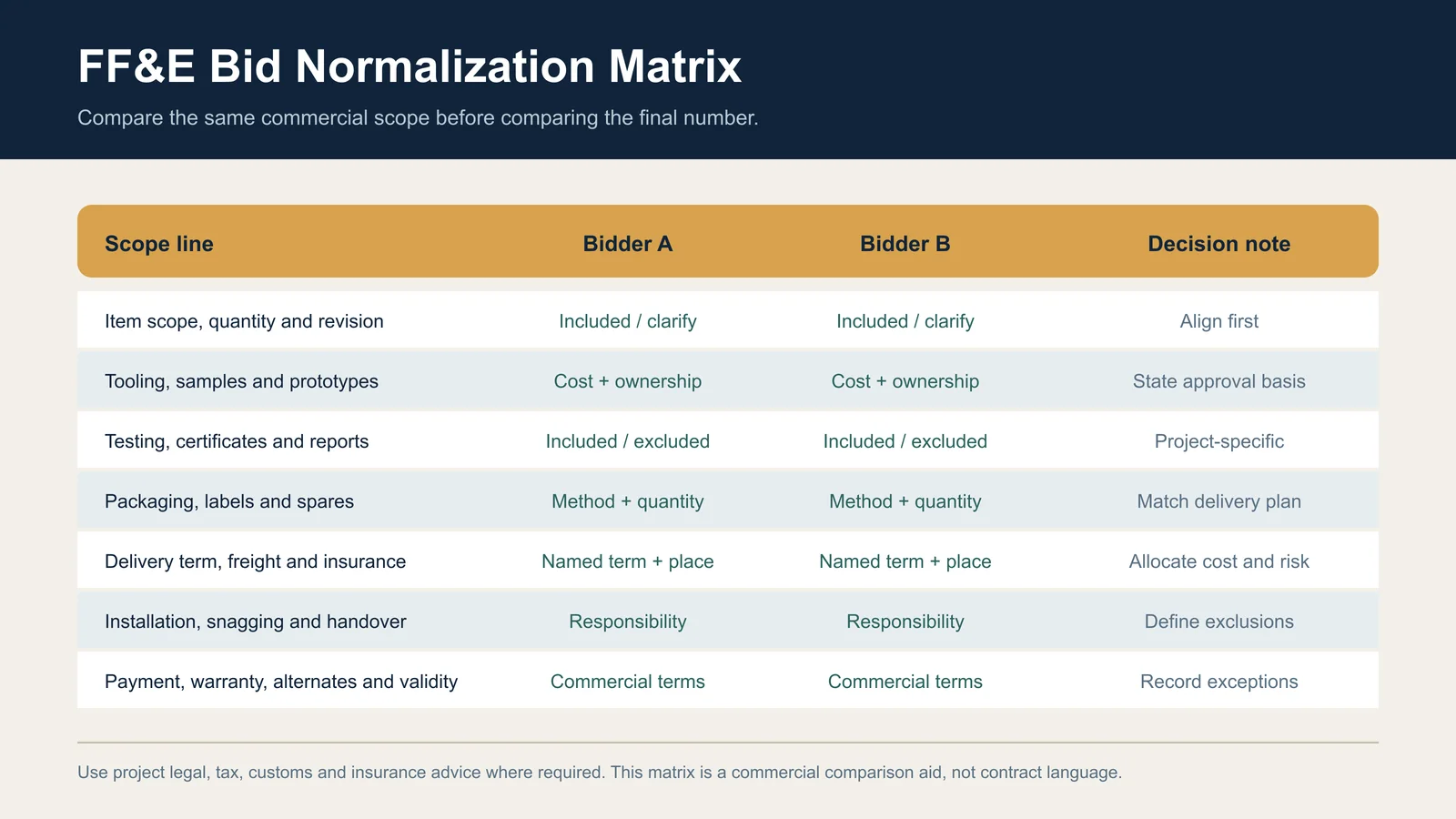
FF&E procurement bid normalization matrix
The comparison total becomes meaningful only after the project records what each proposal includes, excludes or assumes.

Keep the supplier’s submitted price intact, then add a separate comparison layer. This prevents the evaluation team from silently rewriting a bid while still allowing a like-for-like decision.

Comparison layerNormalizeDecision evidence
ScopeItem codes, quantities, configurations and locationsIncluded, excluded, duplicated or awaiting clarification
Technical basisMaterials, construction, hardware, interfaces and required evidenceCompliant basis or clearly described alternative
Approval workShop drawings, finish samples, prototypes, tests and resubmissionsIncluded effort, owner and approval consequence
DeliveryPackaging, labels, spares, freight, insurance and named handover pointComparable responsibility and adjustment basis
Site and closeoutReceiving, storage, installation support, snagging and recordsIncluded service, exclusion or separate allowance
CommercialCurrency, validity, payment milestones, taxes identified and warranty offeredUnadjusted offer plus transparent comparison adjustment

Price is only one evaluation dimension. Assess whether the bidder can demonstrate the technical development, approval, production, reporting and delivery controls required by the actual package. Do not award points for evidence the project has not reviewed.

Rows of upholstered lounge chairs in a Gainwell production area
Repeatability is controlled by the current drawing, approved material and finish references, recorded prototype deltas and defined production checks—not by visual memory alone.

How should an owner evaluate FF&E procurement companies?

Evaluate the appointment model before the marketing claims. Ask whether the company acts as adviser, purchasing agent, reseller or contracting party; which entities will hold supplier contracts and funds; how fees, rebates or margins are disclosed; and which services are performed internally or subcontracted.

Request a proposed responsibility matrix and sample reporting set for a comparable type of project. Useful evidence may include an anonymized procurement schedule, bid comparison, change log, expediting report, payment recommendation, delivery tracker and closeout index. Review how the company handles conflicts of interest, design changes, supplier failure, damaged goods and records after handover.

A company list cannot determine fit without the live scope. The project should compare candidates against the same required services, authority, systems, market coverage and reporting outputs. This article therefore does not rank providers or recommend one universal model.

Turn the award recommendation into managed obligations

The award record should identify the selected baseline, accepted alternatives, quantities, price basis, approval stages, programme dependencies, production and inspection inputs, packaging, delivery point, site services, closeout deliverables and every surviving qualification. Transfer those decisions into the executed order or contract rather than leaving them only in an evaluation spreadsheet.

Where an Incoterms rule applies, the International Chamber of Commerce describes Incoterms 2020 as allocating specified buyer and seller costs, risks and obligations. Use the correct rule, named place and edition with qualified advice. Do not let a trade term stand in for product scope, payment, acceptance, installation or remedies.

Assign an owner for prerequisites the supplier cannot control, such as final dimensions, approved finishes, access to nominated components or site handover dates. A committed order does not make an open input disappear.

Gainwell team wrapping furniture tables before shipment
Packaging should preserve both the furniture and the information needed to identify, handle and route each logistics unit.

Control approvals and changes as commercial events

Separate approval types. A finish sample may approve color and sheen without approving dimensions, construction, comfort or price. A prototype may confirm representative form and interfaces while some tests or production documents remain open. Each approval record should state what was reviewed, what was not reviewed, which item and revision it affects, and whether it releases further work.

For every proposed change, record the initiator, reason, affected items and quantities, revised documents, technical consequence, price effect, programme effect, approval authority and implementation status. Update both the procurement baseline and the supplier obligation after authorization.

Gainwell’s current capabilities workflow connects technical development, prototypes, manufacturing, quality control, project coding and delivery support. This can support a custom furniture package within a wider FF&E program; a live proposal must confirm the exact product and service scope. Gainwell’s product overview shows the current furniture categories to use when defining that package boundary.

Define the procurement-to-delivery handover

Production release and shipment release are different decisions. Production release confirms what may be made. Shipment release confirms what inspected and documented goods may leave for an agreed destination phase. Delivery acceptance confirms what custody and condition reached the named handover point. Installation and operational acceptance may occur later and under different authority.

At closeout, reconcile the as-delivered item schedule, accepted drawings and finishes, location records, exceptions, care information, spare or replacement details, supplier contacts and contracted warranty documents. The operator should be able to identify an asset without searching through procurement email.

What proves the FF&E procurement process is controlled?

A controlled process has one current baseline; named decision rights; comparable proposal records; an award basis transferred into obligations; approvals and changes tied to item codes and revisions; production, shipment and delivery released separately; and closeout records that match delivered assets.

No checklist guarantees supplier performance, cost or opening dates. The value of the control system is that assumptions, decisions and exceptions remain visible early enough for the authorized project team to act.

If Gainwell’s custom loose or fixed furniture falls within your FF&E package, prepare the coded item schedule, current drawings, quantity basis, approval route, destination and requested delivery responsibilities. Share the controlled furniture scope with Gainwell so the team can confirm technical and commercial fit for the live project.

FF&E Budget Planning: Cost Categories, Assumptions and Controls

An FF&E budget is a dated, scope-defined cost model—not a single allowance and not a universal percentage of construction cost. Every amount should identify the assets it covers, the delivery point it reaches, the evidence behind it and its current estimate state. Unpriced exposure should remain visible instead of disappearing inside “miscellaneous.”

That definition matters because three spreadsheets can show the same total while representing different realities. One may include guestrooms but omit public areas. Another may include product but stop before freight and installation. A third may combine quotations, old allowances and committed orders without labeling them. The total alone cannot tell an owner whether the project is affordable or merely incomplete.

Furniture panels organized in production groups inside a workshop
A management total becomes reviewable only when it can be traced to an asset population, quantity basis, cost boundary and current evidence state.

Give every FF&E budget amount four coordinates

Before discussing rates, require four coordinates for each budget line:

  1. Asset population: which item, package, room type, public-area zone or owner-supplied component is represented?
  2. Cost boundary: does the amount stop at product supply, packed factory release, delivered site, installed condition or accepted handover?
  3. Dated basis: which quantity, drawing, specification, rate source, currency, price date and commercial assumption produced the amount?
  4. Estimate state: is the amount an early estimate, defined allowance, current quotation, commitment, actual cost or still unpriced?

This is the FF&E budget boundary map used in this guide. It is an editorial planning model, not an accounting standard. Its purpose is practical: two figures are comparable only when their coordinates are comparable. If a quotation stops at packed goods and the budget line assumes installed delivery, the gap is a scope difference before it is a price difference.

Separate cost categories from estimate states

A common budget error is using one column to describe both what the project buys and how certain the number is. These are separate dimensions:

For example, guestroom casegoods are a product category. Their amount might be a concept estimate today, a comparable quotation later and a commitment after award. Changing the evidence state should not silently change the asset identity or cost boundary.

Projects should define their own account dictionary, approval rules and reporting treatment. The structure below is a completeness prompt; it is not a universal chart of accounts.

Map the cost boundary across eight practical lanes

Cost laneQuestions the budget must answerTypical omission signal
1. Asset and package supplyWhich furniture, fixtures and equipment are included by item, room type or zone? Are FF&E, OS&E, fixed work and owner-supplied items separated as the project defines them?A single “furniture” allowance with no population or location reference
2. Technical developmentAre shop drawings, engineering or interface development, material coordination and value-engineering activity included, excluded or appointed elsewhere?Custom scope priced as if it were a finished catalogue product
3. Samples and prototypesWhich finish samples, mock-ups, room prototypes, testing or approval rounds are assumed, and who bears revisions beyond that basis?“Samples included” with no type, quantity, review route or limit
4. Inspection and project controlWhat production reporting, inspection, third-party review, item coding, documentation or project management is in the cost boundary?Control requirements appear in the programme but nowhere in the budget
5. Packaging and international movementWhat packaging standard, origin point, destination point, freight, insurance, customs activity, duties or taxes are assumed? Which terms govern responsibility?One freight percentage applied without shipment basis or destination
6. Receiving and storageAre unloading, consolidation, warehousing, handling, vertical movement, damage inspection and custody transfer represented?Product is “delivered” but the budget never defines where custody changes
7. Installation and handoverAre assembly, positioning, fixing, specialist connections, protection, cleaning, snagging, touch-up and handover included, excluded or split between parties?Supply scope is mistaken for installed scope
8. Project-defined additionsHow are spares, attic stock, consultant or procurement fees, escalation, currency effects and contingency treated under the project’s approved rules?Several unrelated adjustments are hidden in one “other” line

A lane can be outside the FF&E budget if the owner deliberately carries it elsewhere. The control requirement is not to force every cost into this sheet; it is to record the exclusion, destination account and responsible owner so the project does not omit or duplicate it.

Gainwell team reviewing hotel furniture drawings in the factory
A furniture package should connect its room or area demand to the current drawing, finish, interface and decision record.

Create a basis passport for every budget line

A total becomes defensible when its components retain lineage. Give each material budget line a compact basis passport:

Passport fieldMinimum useful entry
Budget line IDStable code linked to the asset, package, room type or zone
Population and quantity sourceQuantity, unit and controlling schedule or area record with revision
Requirement maturityCurrent drawing or specification basis plus important open decisions
Rate evidenceEstimate method, analogous source, budget quote or current supplier quote with source and date
Commercial boundaryIncluded and excluded services, delivery point, packaging, taxes or duties treatment and any relevant quotation condition
Time and currencyPrice date, currency and project-approved treatment of escalation or exchange assumptions
Uncertainty and triggerWhat could change the amount, the current exposure description and the decision or evidence needed to update it
Owner and approvalPerson responsible for the basis, reviewer, approval state and latest change reference

Do not replace missing evidence with a confidence percentage that nobody can explain. A short statement—“quantity derived from room schedule Rev C; finish and hardware open; planning rate dated May; delivered-site boundary excluded”—is more useful than a green cell labeled “90% certain.”

Use six estimate states without adding them together

The following states can make the evidence behind a forecast visible. Each budget line should occupy one current state for the amount being reported; the states are not six extra cost categories to add together.

  1. Early estimate: derived from a documented method before package detail is sufficient for supplier pricing.
  2. Defined allowance: a management amount for an identified scope whose final quantity, requirement or rate remains open.
  3. Current quotation: a time-limited supplier price against stated assumptions; it is not automatically comparable or committed.
  4. Committed: an amount tied to an authorized commercial commitment and its current scope.
  5. Actual: a recorded cost recognized under the project’s financial rules.
  6. Unpriced exposure: an identified event, decision or missing scope for which the project does not yet have a responsible point amount.

Keep original evidence and transition dates. When a line moves from allowance to quotation, reconcile the difference instead of overwriting the old amount. When scope changes after commitment, separate the authorized base, pending change and disputed or unresolved amount according to the project’s contract and reporting rules.

Build the first budget without manufacturing certainty

An early FF&E budget is allowed to be uncertain; it is not allowed to hide why. Use the best available basis at the level the design supports:

  1. Freeze the current asset and area population, including explicit exclusions.
  2. Assign a budget unit that matches the evidence: item, set, room family, zone, package or another controlled unit.
  3. Choose a dated rate source and record the adjustment logic. Never copy a benchmark without its geography, specification, quantity and cost boundary.
  4. Separate product amounts from project adders whose drivers are different.
  5. List open decisions and unpriced exposure beside the point estimate.
  6. Set the next rebase event: design issue, quantity reconciliation, sample decision, comparable quotation, award or actual-cost update.
Woodworking machines arranged along a furniture production line
A furniture amount should name the design, quantity, production and commercial assumptions behind it; a room count alone is not a pricing basis.

The GAO Cost Estimating and Assessment Guide is not a hotel pricing standard, but its general process is useful here: define the estimate’s purpose and scope, organize the work, document assumptions and data, analyze uncertainty, explain results and update the estimate as actual information arrives.

Large furniture manufacturing campus with connected buildings
A project-control system must keep one authorized decision aligned across every team and record that uses it.

Keep unpriced exposure visible beside the forecast

“Not priced” is not the same as zero. Create an exposure register for decisions that could move the FF&E budget but are not responsibly represented by one point amount. Useful fields include:

Examples may include an unsettled room population, a finish selection that changes process, a delivery term not yet agreed, an installation responsibility gap or a programme shift that invalidates a rate date. Do not turn every open question into contingency, and do not consume contingency merely because a quoted amount is higher. The project’s governance must define what contingency covers, who controls it and how use is authorized.

Explain every movement through a cause-coded budget bridge

A current forecast should reconcile to the previous approved baseline. Use cause codes that describe the reason, not the person blamed:

The following example uses dimensionless planning units. It is not a price, percentage or recommendation:

Bridge lineCausePlanning unitsRequired explanation
Previous known forecastOpening balance1,400Approved basis and reporting date
Added public-area packageSCOPE+90Authorization and affected zones
Room-population correctionQTY+30Old and current quantity sources
Specification and rate rebaseBASIS+45Changed requirement and new evidence date
Receiving added to this budgetBOUNDARY+35Former account and revised responsibility
Approved timing assumptionTIME/CURRENCY+20Project-approved method and effective date
Duplicate item removedCORRECTION−40Affected line IDs and control fix
Current known forecastReconciled result1,580Previous forecast plus documented movements

Suppose unresolved exposure is separately recorded as 0–120 planning units. Do not automatically add the maximum to 1,580 or present the midpoint as fact. Show the known forecast, the governed contingency position and the unresolved exposure according to the owner’s reporting policy, and state where overlap has been removed.

Run five integrity tests before approving the FF&E budget

  1. Coverage test: can every required asset, area and service be found once—and only once—either in this budget or in a named external account?
  2. Basis test: can a reviewer find the quantity source, requirement maturity, rate evidence, date, currency and commercial boundary behind every material line?
  3. State test: are estimates, allowances, quotations, commitments, actuals and unpriced exposure visibly different?
  4. Movement test: does the current forecast reconcile to the prior baseline through authorized cause-coded changes?
  5. Decision test: does each important assumption or exposure have an owner, evidence request, closure event and rule for updating the forecast?

If the sheet passes arithmetic checks but fails one of these tests, it is not ready for an approval conversation. The response should be proportional: close the missing record, isolate the affected package or present a range. Do not imply that the entire project is equally uncertain.

Choose the next action from the evidence state

Current conditionUseful next actionDo not do
Population is incompleteReconcile room, area and asset scope before rate debateImprove the spreadsheet total with a blanket uplift
Population is defined but specification is openUse a labeled allowance or range and name the decisions that close itPresent an early rate as a supplier commitment
Several quotations existNormalize quantity, specification, service and delivery boundaries before updating the lineChoose the lowest headline total
A commitment existsPreserve the authorized base and track pending changes separatelyOverwrite the commitment with the latest forecast
Actual costs are arrivingUpdate the line under the project’s financial rules and retain the forecast-to-actual explanationErase the estimating history
Exposure has no credible rangeRecord “range not established,” request evidence and set a closure ownerEnter zero or invent a percentage
Labeled finish containers and sample boards on storage shelves
A finish direction becomes usable when the project identifies the controlling reference, reviewed attributes, permitted variation and current status.

Build a one-page management review

The detailed budget may contain hundreds of lines, but its approval page should let management interrogate the whole model. Include:

Keep a version snapshot behind every formal review. A useful budget history explains not only that the total changed, but whether the project bought more scope, corrected a population, matured a design, changed a delivery boundary, moved in time or fixed an error.

Prepare a manufacturer review without outsourcing the whole budget

A furniture manufacturer can improve the evidence for packages it is asked to review. It cannot responsibly price every FF&E line or define the owner’s reporting treatment. Send a bounded package that includes current drawings, quantities by room or area, materials and finishes, project-specific test requirements, destination, approval route, programme and requested commercial boundary.

Gainwell’s current product guidance asks for those project inputs and says missing information should be recorded as an open decision rather than assumed. Its capabilities overview describes technical development, value engineering, prototypes, manufacturing control, packaging and international delivery support. The live proposal must confirm which activities, locations, evidence and commercial responsibilities apply.

For an early package review, share only the relevant budget lines and their basis passports—not confidential financing material. Identify the asset population, quantity source, specification status, destination, requested delivery point and open assumptions. Ask Gainwell to review the furniture pricing inputs.

Frequently asked questions

What should an FF&E budget include?

It should include the project-defined FF&E asset population and every cost lane assigned to that budget, with explicit exclusions and account destinations. Product supply, technical development, samples, control, packaging, logistics, receiving, installation, spares and project adjustments may all require a stated treatment, but the exact boundary is project-specific.

How much should a hotel budget for FF&E?

There is no responsible universal amount in this guide. A useful figure depends on the property, asset population, room and area mix, design and specification, quantities, location, price date, currency, logistics, installation and commercial boundary. Relevant benchmarks can be a reasonableness check only when their source and adjustments are disclosed.

Is an FF&E budget the same as a hotel furniture budget?

No. An FF&E budget can cover multiple asset and service categories across the project. A hotel furniture budget is narrower and should calculate manufactured furniture by room type, public-area zone and item population. Combining the two without a boundary creates gaps or duplication.

What is the difference between an allowance and contingency?

In this planning model, an allowance represents an identified scope whose final basis remains open. Contingency is a separately governed provision for uncertainty under the owner’s approved policy. Project contracts and accounting rules may use different terms, so define both before reporting them.

How often should the FF&E budget be updated?

Update it when controlled evidence changes: scope or quantities, design maturity, price evidence, delivery boundary, programme or currency assumptions, commitments, approved changes or actual costs. A calendar reporting cycle is useful, but a material decision should not wait to be recorded.

FF&E Project Management: Roles, Control Gates and Reporting

The weekly FF&E report is green. The approved guestroom finish is recorded in a meeting note, the drawing register still points to the previous finish, the quotation carries a conditional alternative, production is waiting for a release, and the room schedule says nothing changed. Every team is active, but the project has five versions of one decision.

FF&E project management is the control of decision transactions across workflows. Each material issue should identify the affected baseline, evidence required, person with authority, permitted outcome, downstream records to update, verification owner and proof of closure. The goal is not to absorb design, procurement, manufacturing, logistics, construction or installation into one giant checklist. It is to keep an authorized decision intact while it crosses those boundaries.

This guide provides an owner-side control model. The live contract, project governance plan and responsible professionals still determine approval authority, technical review, commercial effect, site release, safety, code and acceptance requirements.

Large furniture manufacturing campus with connected buildings
A project-control system must keep one authorized decision aligned across every team and record that uses it.

Define roles by decision rights, not attendance

A meeting invite shows participation; it does not show authority. For each recurring decision class, name the role that performs each verb:

Decision verbWhat the role ownsEvidence of completion
ProposeStates the requested change or decision as a bounded question and identifies the current baselineIssue statement with source, population and required-by point
AnalyzeAssembles relevant design, technical, commercial, production, logistics, site and operations effectsOptions and impacts linked to controlled evidence
DecideSelects, rejects, conditions or returns the proposal within delegated authorityNamed authority, outcome, conditions and decision timestamp
ImplementUpdates the records, instructions and work packages that consume the decisionNew versions, acknowledgements and affected-population status
VerifyChecks that the approved outcome reached every required consumer and that conditions were closedPropagation and closure evidence

One person may hold several roles when the contract allows it. The map still matters because it shows which capacity that person is acting in. “Everyone agreed” is not a substitute for a named decision right, and “project manager” should not become an unlimited authority label.

Make every material issue a decision transaction

Use one record from question to retirement. Do not split the request, approval, downstream updates and verification across disconnected email chains. A practical decision transaction record contains:

  1. Identity: transaction ID, package, item, room family or area and the exact affected population.
  2. Baseline: the current drawing, specification, finish reference, quantity, commercial record, release or destination plan that may change.
  3. Question: one answerable decision, written without hiding several approvals in the same sentence.
  4. Trigger and need point: why the decision is needed and which downstream commitment will become constrained.
  5. Evidence: the controlled facts, options, limitations and unresolved assumptions supplied for analysis.
  6. Authority: the named decision role and any separate reviewers required by the live project.
  7. Outcome: accept, accept with conditions, return for evidence or reject/retire.
  8. Propagation: every register, drawing, specification, commercial document, work package and team that must receive the outcome.
  9. Verification and closure: who confirms implementation, which conditions remain and what proves the transaction can be closed.

The record is not another minutes template. It is the authoritative route for one decision. Meeting notes may link to it, but they should not create a parallel approval.

Triage incoming work as a decision, action or evidence request

Project queues become noisy when three different kinds of work share one status column. Classify each new item before assigning it:

“Confirm finish” is too vague. If the finish reference is missing, request evidence. If two accepted references conflict, raise a decision. If the finish is approved but one register remains old, assign an implementation action. Triage prevents the decision queue from becoming an undifferentiated list of reminders.

Use one gate contract at every cross-workflow handoff

A control gate should not be a date with a color beside it. Define the contract for passing that gate before the package arrives. The same five-part structure can be used at design release, commercial authorization, production release, shipment release, site work-front release or operational handover without rewriting the specialist process behind each point.

Gate contract fieldQuestion it must answer
Entry evidenceWhich exact records, versions, reviews and unresolved exceptions must be present?
Decision authorityWhich role can release, condition, return or reject the package at this gate?
Allowed outcomesWhat does each outcome permit downstream teams to do, and what remains prohibited?
Propagation targetsWhich consumers must receive the gate outcome and updated baseline before acting?
Exit proofWhat demonstrates that the release was implemented and any conditions were closed?

Use four explicit outcomes: released, conditionally released, returned for evidence and retired. A conditional release must state the permitted work, affected population, exposure owner, expiry or next gate and closure requirement. Otherwise “conditional” becomes an invisible permanent exception.

Gainwell team reviewing hotel furniture drawings in the factory
A furniture package should connect its room or area demand to the current drawing, finish, interface and decision record.

Run a decision-latency clock without inventing a universal SLA

Elapsed time alone does not explain why a decision is stuck. Give the clock a state:

  1. Question forming: the affected baseline or population is not yet clear.
  2. Evidence building: named inputs are being produced or reconciled.
  3. Authority pending: the evidence pack is accepted for decision and awaits the authorized role.
  4. Propagation pending: the decision exists, but one or more consumers have not implemented or acknowledged it.
  5. Verification pending: implementation is reported, but closure proof or a condition remains open.

The project should set its own trigger for review or escalation based on the next affected commitment, delegated authority and contract. Do not import a universal number of days. A recently raised decision can require immediate attention if it controls a wide population; an older question may be harmless if no accepted downstream action depends on it.

Map propagation before authorizing the change

A decision is incomplete if the project cannot name its consumers. Build the propagation map during analysis, not after approval. For each proposed change, ask which of these branches can be affected:

For each affected consumer, record the previous version, required new version, implementation owner, acknowledgement or verification method and status. “Team notified” is not enough if the live work package still carries the superseded baseline.

Grouped upholstered lounge chairs in several fabric combinations
A release decision should identify the population it governs; visible similarity alone does not prove that every unit carries the same approved input.

Worked example: propagate one finish change

Assume a guestroom lounge chair finish is reconsidered after a controlled sample review but before the relevant production release. The example shows governance logic only; the live project team must determine design acceptability, technical suitability, commercial effect and release authority.

Transaction stepExample recordControl question
Bound the populationChair code CH-14 in guestroom families A and B; suites excluded pending a separate checkWhich units would inherit this decision?
Name the baselineCurrent finish reference, drawing revision, sample record and commercial basisWhat exactly would change from what?
Build evidenceRevised finish reference, visible comparison, technical review, cost/schedule analysis and open limitationsIs the authorized role deciding from controlled information?
Record the outcomeApproved for families A and B subject to one named sample condition; suite decision remains openWhat is permitted, conditional or still prohibited?
PropagateUpdate finish schedule, chair submittal, commercial change record, production release, inspection reference and room-family dataHas every consumer received the same decision?
Verify and retireUpdated versions acknowledged; condition closed against its evidence; suite branch remains a separate transactionCan this record close without hiding a surviving obligation?

The project manager does not approve every specialist conclusion. The project manager ensures that the correct conclusions reach the correct authority, then protects the outcome while it moves through the affected systems.

Track decision debt, not only open decisions

Decision debt is the unresolved obligation left behind when work has moved farther than its authority or evidence. It includes:

Record the debt against the decision transaction, affected population, next commitment and accountable owner. Closing the activity that exposed the debt does not close the debt itself.

Labeled finish containers and sample boards on storage shelves
A finish direction becomes usable when the project identifies the controlling reference, reviewed attributes, permitted variation and current status.

Report four views from the same controlled records

A weekly report should not ask every audience to read the full transaction log. Create four views from the same source records:

Reporting viewWhat it should exposeUseful decision
Decision queueQuestion, population, authority, clock state, need point and next actionWhich decision requires attention now?
Gate readinessApproaching gate, missing entry evidence, allowed outcome and controlling conditionWhich package may advance, return or remain held?
Propagation exposureApproved changes with unupdated consumers or unacknowledged populationsWhere could teams act on different baselines?
Decision debtExpired conditions, incomplete verification, superseded live records and residual obligationsWhat must be retired before the next commitment or handover?

Use color only after defining the rule behind it. A report can be concise while still showing the denominator: four of five required evidence records accepted, two of seven consumer systems updated, or three of twenty affected rooms verified. A percentage without its population and gate meaning can create false confidence.

Run meetings around decisions, not status narration

Issue the decision queue before the meeting. Use the live session for matters that require authority, cross-functional analysis or exception routing. A compact agenda can follow five questions:

  1. Which new issue changes an accepted baseline or population?
  2. Which evidence request blocks an approaching gate?
  3. Which decision has the greatest downstream propagation exposure?
  4. Which condition or debt must be closed before the next commitment?
  5. Which completed transaction can be retired from active reporting?

Record the answer in the transaction, not only in the minutes. Routine actions can remain in a separate action queue, and specialist reviews can occur in their controlled systems with the relevant evidence linked back to the decision.

Retire authority at closeout

A decision record should leave the active queue only when its outcome is implemented, every required consumer is updated or explicitly exempted, conditions are closed or transferred, superseded instructions are controlled, verification is complete and any residual obligation has a named owner and destination record.

Retirement is different from deletion. Preserve the approved baseline, authority, propagation evidence and closure proof according to the project’s information-governance requirements. The active dashboard becomes smaller because the transaction is complete, not because it has aged out of view.

Where does Gainwell fit in FF&E project management?

Gainwell currently presents custom product categories covering loose, upholstered and fixed furniture together with architectural millwork. The company’s published capability workflow follows work from development and prototypes through manufacturing, quality control, packaging, delivery and installation support. Its luxury-hotel context includes guestrooms, suites and public areas. These are company-level capabilities, not a claim that Gainwell automatically holds owner-side authority or every project-management responsibility.

For a project-control review, prepare the active furniture packages, current baselines, decision-rights map, approaching gates, open transactions, propagation gaps and reporting expectations. Share the controlled FF&E project brief with Gainwell so the live team can confirm which products, services, evidence and responsibilities apply.