Best Material for Outdoor Furniture: A Climate-Based Comparison
There is no universal best material for outdoor furniture. The best choice is the complete material system that clears every non-negotiable exposure and operating requirement for one defined site zone, with evidence tied to the proposed product. Compare the survivors only after unsuitable systems have been eliminated.
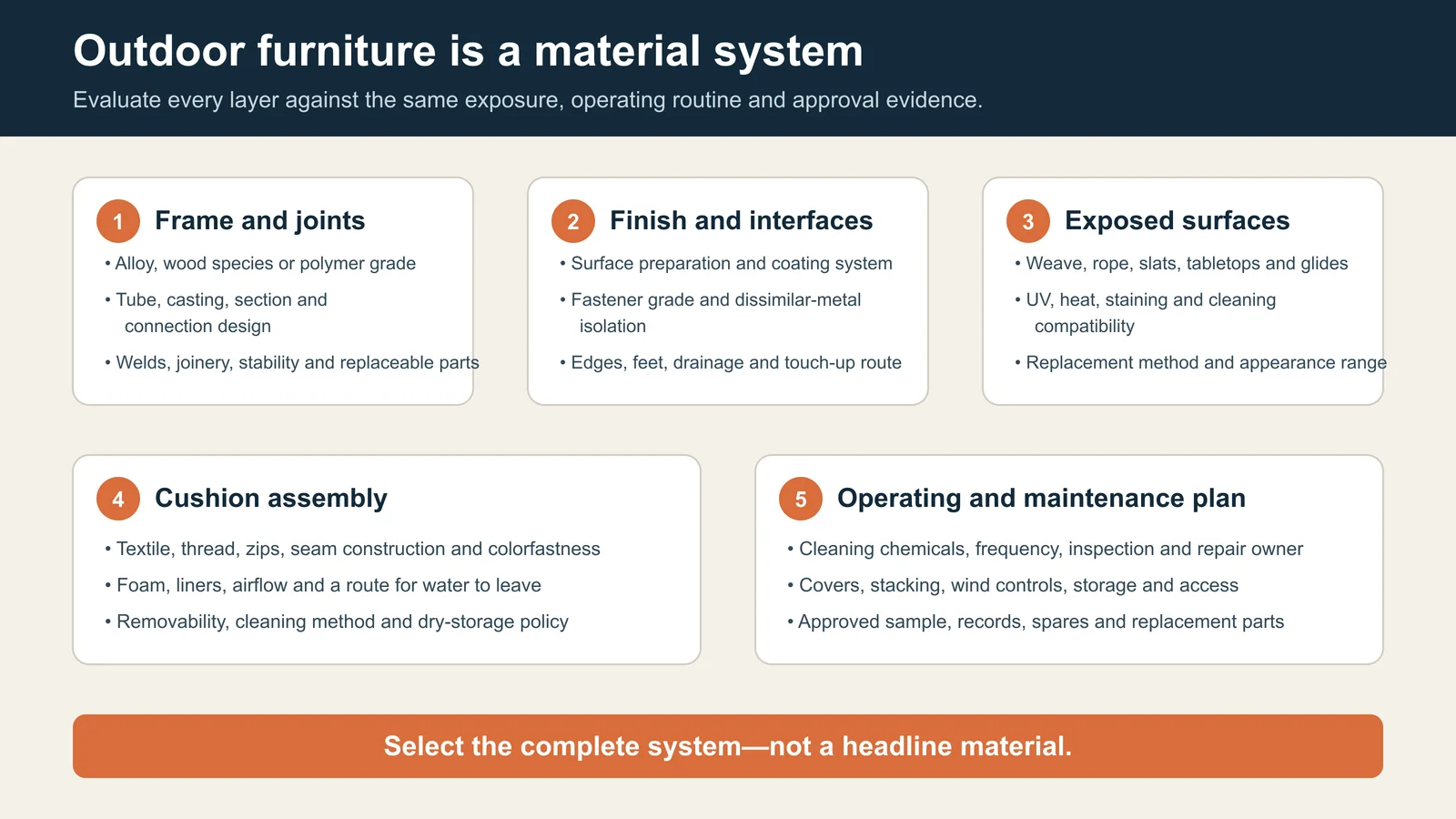
That changes the question. A procurement team is not choosing between the words “aluminum,” “teak,” “stainless steel,” “wicker” and “HDPE.” It is choosing among assemblies: frame sections and joints, surface preparation and finish, fasteners, glides, tabletops, weave or rope, textile, seams, foam, drainage, replaceable parts and an operating plan. Two products with the same headline material can behave very differently because those layers differ.
Start with exposure cells, not one climate label
“Coastal resort” or “hot climate” is too broad for a material approval. Divide the property into exposure cells: areas where furniture shares a meaningful combination of sun and shade, rain or irrigation, salt or pool splash, temperature, wind, soil, guest use, movement, cleaning and storage.
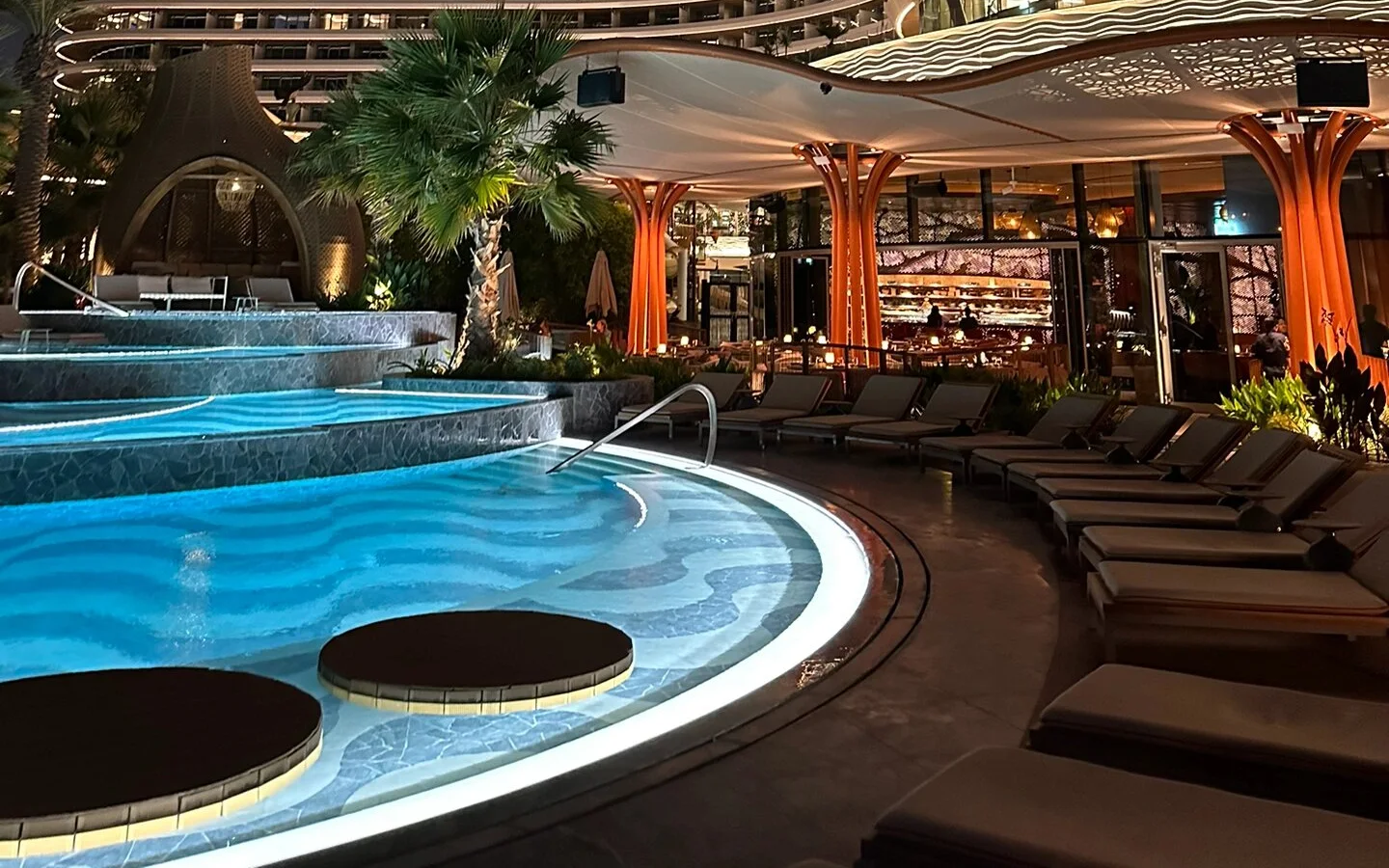
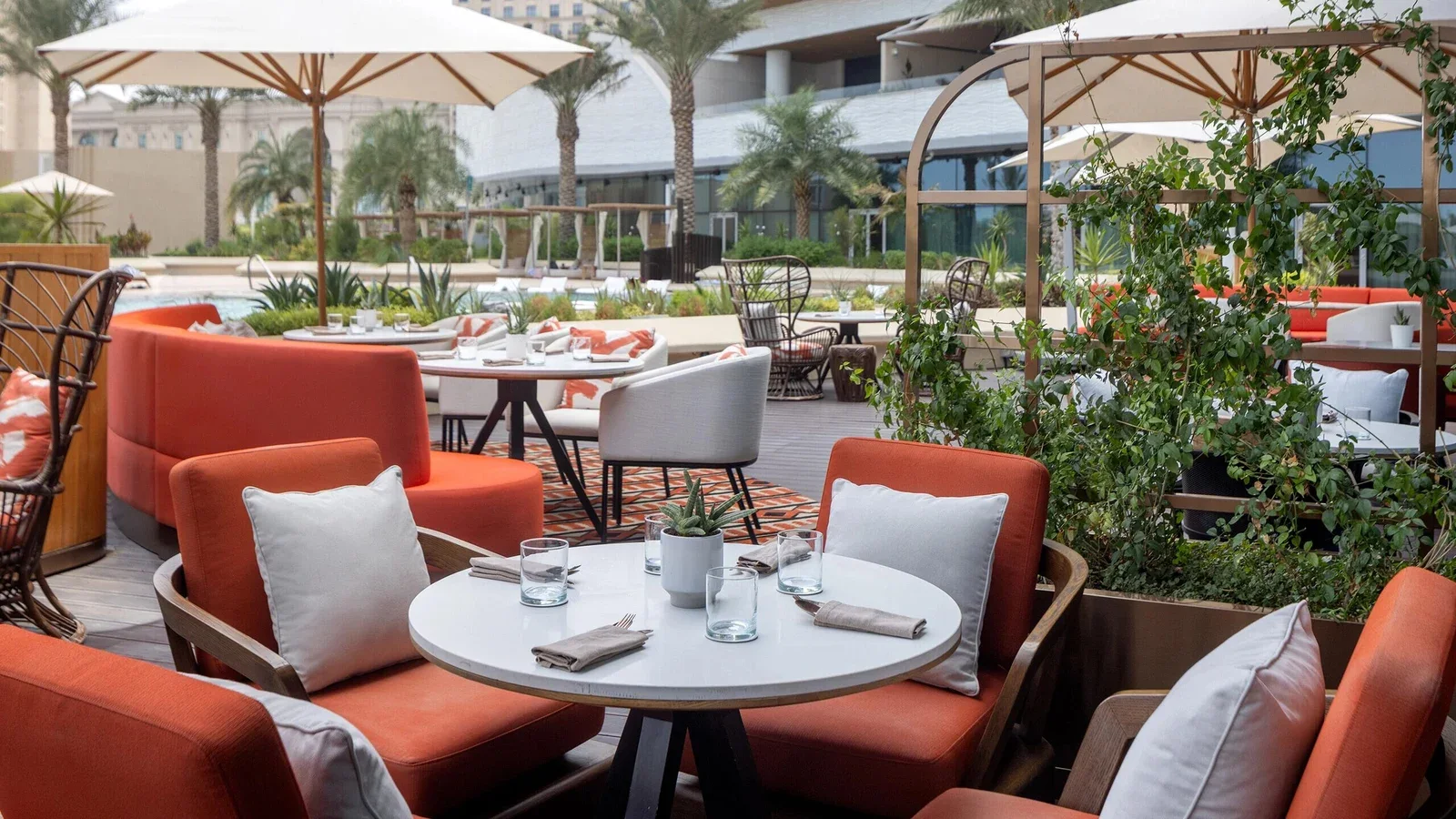
An open pool edge, a covered restaurant terrace and a rooftop lounge may be on the same property yet impose different demands. Furniture may also move between cells. Record that movement; otherwise a system approved for shelter may spend service hours in direct weather.
| Exposure-cell input | Record as a condition | Translate into a selection question |
|---|---|---|
| Water and moisture | Direct rain, irrigation, splash, condensation, standing-water risk, drying opportunity | Where can water enter, remain and leave the complete assembly? |
| Sun and temperature | Hours of direct sun, shade pattern, seasonal temperature range, guest-contact surfaces | What evidence covers color, finish, movement and usable surface condition? |
| Airborne and deposited agents | Salt, dust, sand, pollution, food, beverage and cleaning residues | Which interfaces collect deposits, and can staff reach and maintain them? |
| Wind and movement | Exposed direction, gust plan, stacking, trolley route, lifting and storage | Does the complete product fit the property’s stability and handling plan? |
| Operating demand | Dining or lounging use, occupancy, turnover, closures, staff and repair access | Can the property execute the required inspection, cleaning, drying and repair? |
Use climate data as a baseline, then inspect the site
For US projects, NOAA’s current Climate Normals provide station-based 30-year averages and other statistics for temperature, precipitation and related variables. Equivalent authoritative sources should be used in other markets. These records help establish a baseline, but they do not measure a specific terrace, predict every extreme event or approve a product.
Add the site evidence the baseline cannot supply: orientation, shadow studies, wind assessment, proximity to coast or pool, irrigation drift, drainage, heat reflected from paving or facades, storage conditions and the property’s emergency weather plan. State who supplied each input and its date. Unknowns remain open decisions; they are not silently converted into favorable assumptions.
Expand every candidate into an assembly bill
A supplier’s material label is a starting reference, not a comparable specification. Ask each candidate to provide an assembly bill at the same level of detail:
- frame material identity, form, section and wall or member information appropriate to the design;
- weld, joint, connector and fastener identities, including contact between different materials;
- surface preparation, coating or finish system, edges, penetrations and repair route;
- tabletops, slats, weave, rope, caps, glides and attachment methods;
- textile, thread, seams, closures, barriers, foam, ventilation and drainage;
- removable and replaceable components, tools, access and spare-part identity;
- care limits, storage conditions and the documents that will transfer to operations.
Keep “not stated” visible. A missing fastener grade, foam construction or finish-repair method should not inherit the reputation of the named frame material.
Map the route from exposure to an inspectable interface
Material decisions become useful when each environmental input is connected to a physical route and an observable consequence. For example: deposited salt plus retained moisture reaches a fastener-to-frame interface; rain enters a hollow section and lacks a verified drain path; sunlight reaches a dark guest-contact surface; water passes a cushion seam but has no documented exit or drying route.
The map is not a prediction that failure will occur. It is a way to identify where the design, product evidence, prototype or maintenance plan must answer a question. If the team cannot name the route, it is likely comparing marketing categories rather than actual furniture.
Eliminate red-gate failures before assigning scores
Weighted scorecards can conceal a serious mismatch: high marks for appearance and price may compensate mathematically for unresolved drainage or an unsupported exposure claim. Use non-compensating gates first. A candidate remains on hold or leaves the shortlist when any required gate is unresolved.
- Identity gate: the drawings, material schedule, finish, hardware and soft-goods identity do not describe the offered unit consistently.
- Exposure gate: the supplier’s evidence does not cover the relevant exposure cell or its limitations are unknown.
- Interface gate: water paths, different-material contacts, edges, joints, glides or cushion drainage are not resolved.
- Operations gate: required cleaning, inspection, movement, covering, storage or repair cannot be performed by the planned team and access.
- Evidence gate: a report, sample or claim cannot be tied to the proposed product, method, condition and acceptance criterion.
- Recovery gate: the project has no defined response for coating damage, lost glides, stained covers, failed inserts or other expected service exceptions.
Only the systems that clear all applicable gates enter comparative scoring. The team may then weight design intent, comfort, handling, appearance range, service effort, repairability, spares and commercial terms without letting them erase a critical technical unknown.
Compare five material systems conditionally
The following matrix supports a shortlist; it does not award a category winner. Each row assumes that the exact construction and evidence still need review.
| Candidate system | Useful when | Potential disqualifier or open question | Evidence to request |
|---|---|---|---|
| Finished aluminum assembly | Staff need movable furniture, flexible forms and a metal that does not form iron rust | Wind plan, section and joint design, coating system, damage repair, drainage or dissimilar-material contact is unresolved | Alloy and construction identity, finish system, hardware schedule, drawings, exposure-relevant reports, care and repair instructions |
| Stainless-steel assembly | Strength, slender detailing, weight or a specific metal appearance supports the design | Grade, finish, crevices, fabrication contamination, salt deposits or contact with other materials is not addressed | Grade and finish identity, fabrication and interface details, applicable exposure evidence, cleaning and inspection requirements |
| Protected carbon-steel assembly | Weight, stiffness or anchoring strategy is valuable and the coating can be inspected and repaired | Edges, welds, penetrations, water traps, coating damage or touch-up ownership remains open | Substrate and coating system, preparation, detail drawings, exposure evidence, damage-repair and inspection route |
| Timber system | Natural character, tactile quality and an accepted weathering or finish strategy are central to the brief | Species identity, moisture movement, end grain, joinery, drainage, finish renewal or accepted appearance range is unclear | Species and sourcing identity, construction, moisture and finish guidance, sample range, care, repair and replacement route |
| Polymer, composite, weave or rope system | Moisture tolerance, consistent appearance, integrated color or replaceable surface elements fit the use | Exact polymer, reinforcement, UV evidence, thermal movement, stiffness, heat, fastening, repair or recycling route is unknown | Composition and grade, construction, exposure-relevant data, color range, repair limits, care and replacement-part identity |
High sun and heat change the approval questions
In a high-sun cell, do not reduce the decision to “fade resistant.” Review every exposed layer: coating or timber finish, polymer or weave, textile and thread, adhesive, cap, glide and guest-contact surface. Record the color and sheen range the design can accept, how parts move with temperature and which observations or test results support the claim.
Shade, ventilation, covers and daily movement can change actual exposure. They belong in the operating brief, not as assumed protection. A material that depends on a cover is not equivalent to one approved for uncovered service unless the property can deploy, dry and store that cover as planned.
Rain, humidity and freeze conditions make drainage a system property
Rain suitability cannot be inferred from a water-resistant frame. Inspect horizontal ledges, hollow sections, joints, glides, tabletop-to-base interfaces, cushion seams, liners, foam and the drying route. In cold climates, the project team should define where retained water and temperature cycling matter and obtain qualified input appropriate to the construction.
For timber, the US Forest Service Wood Handbook separates moisture relations and dimensional change from biodeterioration, preservation and finishing. That is a useful warning against selecting wood by species reputation alone. The construction, finish, drainage, accepted weathering and care plan remain part of the material system.
Coastal and pool zones expose metal interfaces, not just frames
Salt and poolside deposits can reach fasteners, crevices, feet, weld transitions, coating damage and mixed-material contacts. An “aluminum frame” or “stainless hardware” label does not resolve those interfaces.
The Aluminum Association’s structural aluminum FAQ states that fastener selection depends on required strength, service conditions, removability and intended service life, and it addresses moist contact with other metals. This is not a furniture fastener prescription. It supports the narrower conclusion that interface design must be reviewed for the actual service condition rather than inferred from the frame name.
Textile evidence must match more than abrasion
An outdoor cushion is a layered drainage and appearance system: cover material, coating or treatment, pigment, thread, seam, closure, barrier, insert, airflow, attachment and storage. Ask what the named test measured, which exact textile was tested, under what method and condition, and what acceptance criterion the project uses.
The Association for Contract Textiles notes in its current performance guidance that abrasion is only one component of durability and does not by itself predict appearance retention or overall durability. Do not use one abrasion number to infer outdoor exposure, color, stain, chemical, seam, foam, fire or complete-cushion performance.
Grade evidence by its connection to the offered unit
Evidence is strongest when its identity and conditions match the proposed product. Use a simple ladder:
- E0 — assertion: terms such as “outdoor grade,” “marine grade” or “all weather” without a controlled identity and scope;
- E1 — declared identity: named material, finish, component and revision, but no supporting result for the exposure question;
- E2 — product-linked document: data or instruction tied to the proposed component, with stated scope and limitations;
- E3 — applicable result: report with product identity, method, conditions, measured property and criterion relevant to the project question;
- E4 — controlled project proof: approved sample or prototype, current drawing and comment record linked to the production reference.
The ladder is not a universal certification scheme. It tells the project team what is known and what remains open. Different questions may require different evidence; a color sample cannot approve hidden drainage, and a frame report cannot approve the cushion.
Work through two zones before choosing one family
Consider a hypothetical resort package with a movable dining chair required in two cells. Cell A is a covered restaurant terrace with wind-driven rain at the edge and frequent furniture rearrangement. Cell B is an open pool perimeter with direct sun, splash and a property wind procedure.
A lightweight finished-aluminum system may clear Cell A’s handling requirement but stay on hold in Cell B until the stability plan, coating, hardware, water paths and textile assembly are resolved. A heavier steel or timber system may help one stability or design objective but introduce a coating-inspection, movement, moisture or finish-renewal burden the operator cannot accept. A polymer or composite candidate may simplify some moisture concerns but remain unresolved on exact grade, heat, stiffness, fasteners or repair.
The correct output is not one winner for the resort. It may be one system for both cells after all gates clear, different systems by cell, or a redesigned product that closes the open interfaces. Record why. The hypothetical example supplies no product approval or service-life prediction.
Plan sample proof around the unresolved failure routes
Do not ask a sample to “confirm quality.” Give it a bounded proof plan. Review drawing and material identity first, then inspect the routes that kept the candidate open: water entry and exit, joint and fastener access, coating coverage at edges, stability and handling, glide behavior, cushion removal and drainage, appearance under project lighting, cleaning response under the named instruction, and replaceable-part fit.
For every check, state the method or observation, condition, acceptance criterion, reviewer and record location. Where a laboratory or qualified engineering test is required, identify the applicable method and responsible party rather than improvising a site test. A visually attractive sample is still incomplete when the decisive hidden interface or evidence question remains open.
Lock the decision in one material selection record
The final record should be short enough to govern drawings, samples and procurement:
| Record field | Required decision |
|---|---|
| Exposure cell | Zone, baseline data, local observations, movement between zones and controlling conditions |
| Candidate assembly | Frame, finish, fasteners, exposed surfaces, cushion, drainage, glides and replaceable parts by revision |
| Gate status | Pass, hold or reject for identity, exposure, interfaces, operations, evidence and recovery |
| Evidence map | Question, source or report, exact product identity, scope, limitation and evidence grade |
| Sample decision | Approved attributes, open comments, prohibited extrapolations and responsible reviewer |
| Operating consequence | Movement, inspection, care, storage, repair, spares and ownership accepted by the property |
| Release reference | Current drawing, material schedule, sample status and authorized approval record |
If a supplier proposes a substitution, return to the assembly bill and gates. A similar appearance or material family is not evidence of equivalence. The proposed revision needs its own identity, interfaces, evidence and approval status.
Transfer the selected system into care and replacement controls
Material selection is complete only when operations receive the exact component identities, care instructions, inspection points, acceptable appearance range, prohibited methods, storage needs, repair route and spare-part references. This handoff does not prescribe the cleaning method; it supplies the product identity and limits needed to create one safely.
Keep pre-purchase selection and in-service cleaning as separate decisions. Selection asks whether an assembly is supportable in a defined exposure cell. Cleaning asks how an identified, existing unit and observed condition can be handled, tested and released. Combining them encourages a material name to stand in for a current product instruction.
Build a shortlist Gainwell can review without guessing
Gainwell’s current outdoor furniture category covers project-specific seating, loungers, tables and specialty pieces, with materials, finishes, drainage, stability and sampling coordinated around project requirements. It is a starting scope, not a blanket statement that every material or construction fits every environment.
Use the project enquiry page to share the project country, venue and exposure cells, current drawings, quantities, preferred systems, operating constraints, required tests and open evidence questions. Gainwell can review technical-development and sample inputs for the proposed scope. Final suitability, engineering, testing, safety, compliance, warranty, programme and commercial responsibilities must be confirmed in the current project documents.