Hotel Furniture Budget: How to Build a Project Cost Baseline
A hotel furniture budget should be reproducible from room-family configurations, public-area asset groups, net purchase quantities and comparable rate evidence—not from hotel key count alone. Two properties with the same number of rooms can require very different furniture populations. One may have a single standard room, while another has king and twin variants, suites, connecting rooms, retained items and several unique public areas.
The practical sequence is: define the furniture-only boundary, assign each room to a controlled configuration, calculate net quantities, build public-area groups, attach a rate passport to each priced unit and keep unresolved variants visible. This guide does not provide a universal hotel furniture cost per room. A portable benchmark without the same scope, region, specification, quantity, price date, currency and delivery boundary is not a project baseline.
Fence the hotel furniture scope before calculating it
This page isolates manufactured furniture for guestrooms, suites and selected public areas. The project must decide which loose and fixed items belong inside that boundary. Current Gainwell product guidance organizes furniture across beds and headboards, casegoods and storage, seating and upholstery, tables and workspaces, outdoor, specialty items and architectural millwork. That directory is a scope prompt, not a universal bill of quantities.
Build a one-page scope fence with four columns:
| Scope state | Meaning | Example treatment | Control needed |
|---|---|---|---|
| Inside furniture baseline | Manufactured item or configuration calculated on this page | Guestroom headboard, bedside unit, desk, lounge chair or lobby seating group | Item/configuration ID and net quantity |
| Adjacent but elsewhere | Needed for completion but carried in another controlled budget | Artwork, decorative lighting, appliances or specialist connection | Destination account and owner |
| Retained or refurbished | Existing asset proposed to satisfy part of the requirement | Selected loose chairs or tables retained after condition review | Identity, quantity, location, condition decision and refurbishment scope |
| Open | Boundary or responsibility is not decided | Fixed vanity, feature mirror, stone top or installation scope | Decision owner and closure event; do not assume zero |
The broader FF&E budget may carry freight, receiving, tax, installation, consultants, contingency and other asset categories. Do not reproduce that entire framework here. Instead, state the exact commercial point at which this furniture baseline ends and link every exclusion to its controlled destination.
Freeze six minimum inputs for the baseline date
A baseline is a dated configuration, not a permanent truth. Record six inputs before calculating:
- Room population: room numbers or counts by current room family and revision.
- Area population: public-area zones included in the furniture scope and their current layout source.
- Furniture identities: stable item or configuration codes connected to drawings and schedules.
- Specification maturity: concept, scheduled, drawn, sampled, approved or another project-defined state.
- Purchase treatment: new, retained, refurbished, owner-supplied, spare or excluded.
- Commercial basis: currency, price date, delivery point and included services for the rates used.
Put the revision and status beside each input. If the room schedule is current but the item schedule predates a suite redesign, the calculation is not aligned merely because both files exist.
Create a configuration card before multiplying room counts
A room family is an operational label; a furniture configuration is a controlled set of manufactured items. They are sometimes the same, but not always. A king and twin room may share the same desk and storage while using different bed and bedside configurations. Conversely, two rooms called “standard king” may need handed or accessible variants.
Give each unique furniture set a configuration card containing:
- configuration ID and rooms that use it;
- item IDs and quantity per configuration;
- handed, dimension, upholstery, finish or hardware variants that affect manufacture or price;
- current drawing, schedule and sample status;
- items outside the manufacturer package;
- retained or owner-supplied elements; and
- the event that releases the configuration for pricing.
Do not create a new configuration for every room if the furniture set is genuinely identical. Equally, do not force visibly different sets into an “average room.” The card should be granular enough to explain quantity and cost, but stable enough to manage repetition.
Use a sparse crosswalk instead of one average room package
A sparse room-to-configuration crosswalk makes similarity and variation visible without creating hundreds of repeated rows.
| Room family | Room count | Bed-zone configuration | Work/storage configuration | Seating configuration |
|---|---|---|---|---|
| Standard king | Current schedule input | B-K1 | W-S1 | S-A1 |
| Standard twin | Current schedule input | B-T1 | W-S1 | S-A1 |
| Corner king | Current schedule input | B-K1 | W-C1 | S-C1 |
| Suite | Current schedule input | B-K2 | W-S2 | S-S2 |
The IDs above illustrate structure only. The project supplies the real configurations. This crosswalk prevents a common error: copying a full average package to every key even when only one furniture zone differs. It also shows where one decision affects several room families, which helps prioritize design closure.
Calculate the net purchase population
Calculate gross demand by configuration, then convert it into the quantity the project actually plans to purchase:
Gross configured demand = sum of (room-family count × configuration quantity per room family) + public-area group quantity.
Net purchase quantity = gross configured demand + approved spares − verified retained quantity − verified refurbished quantity − verified owner-supplied quantity.
Every subtraction needs evidence that the asset truly satisfies the same controlled requirement. A chair listed for refurbishment is not automatically available: identity, quantity, condition, dimensions, finish, location, programme and refurbishment responsibility may still be open. If the evidence is incomplete, keep the quantity in a variance queue rather than subtracting it silently.
Run two reconciliations:
- the sum of room-family counts must reproduce the current room population; and
- every net furniture quantity must reproduce from configuration demand and documented additions or subtractions.
Build public areas as asset graphs, not cost-per-key leftovers
Lobby, lounge, restaurant, club and meeting furniture rarely repeats like guestrooms. Budget each area as an asset graph: a named composition of related pieces connected to one layout, operational use and approval state.
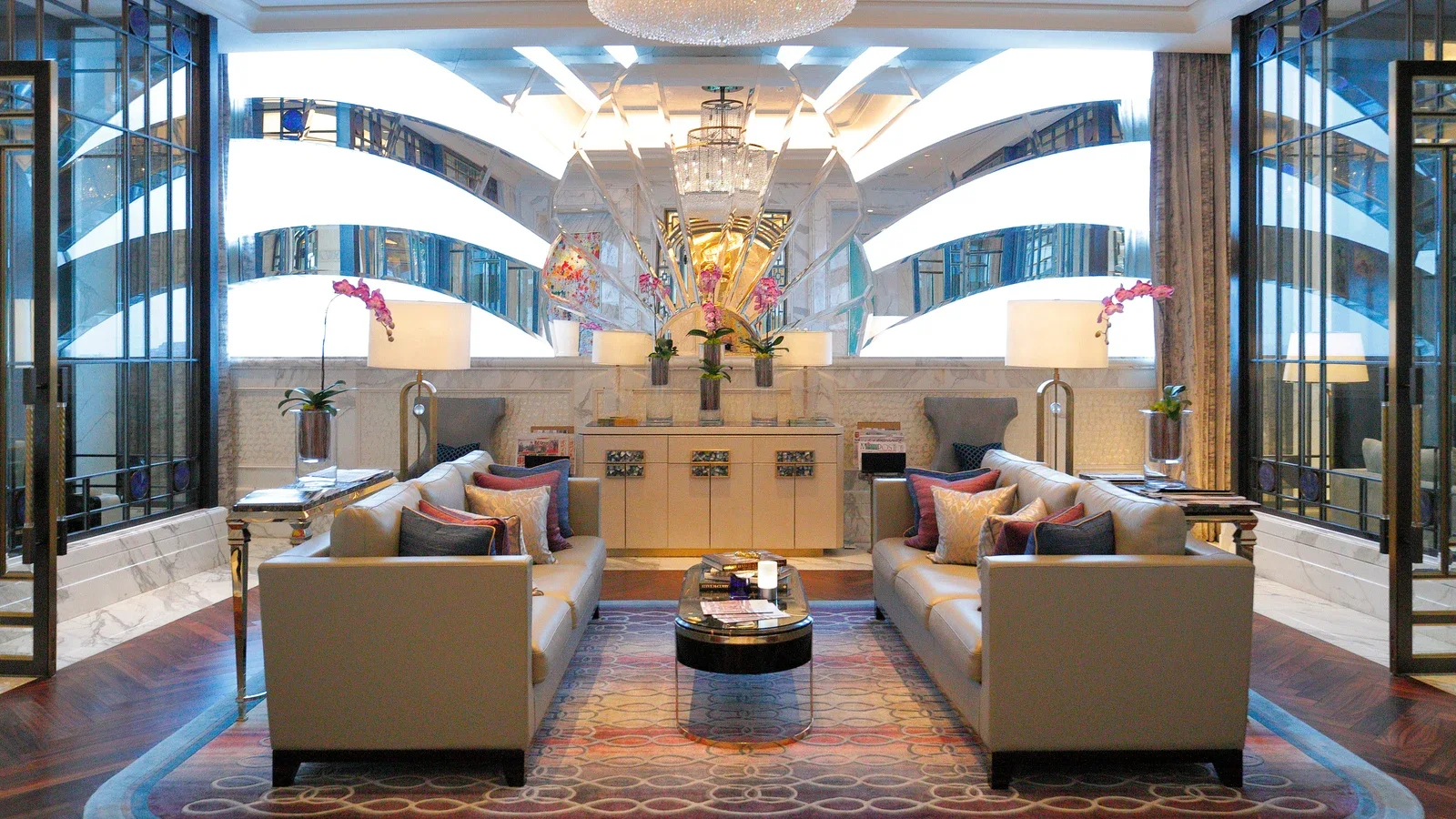
For a lounge group, for example, record the sofas, lounge chairs, central table, side tables and any furniture carried elsewhere. Add a group ID, zone, layout revision, quantity multiplier, specification maturity and decision owner. This exposes three things that a per-key allowance hides:
- a signature piece may be unique even when surrounding seating repeats;
- changing one layout can alter several linked quantities at once; and
- a zone can be released, deferred or redesigned without distorting the guestroom baseline.
Do not infer a public-area item list from a photograph. The current coordinated layout and furniture schedule govern the calculation.
Give every rate a six-field comparability passport
A rate can enter the project baseline only when its passport is compatible with the quantity it prices. Record:
- Priced identity: item or configuration ID and the exact drawing/specification basis.
- Quantity basis: the lot size, repetition and variant mix assumed by the rate.
- Maturity: whether the evidence is an analogous estimate, defined allowance, budget quote, current quotation or commitment under the project dictionary.
- Commercial boundary: what product, development, sample, packing, delivery or other services are included or excluded.
- Time and currency: price date, validity, currency and any project-approved conversion or timing treatment.
- Source and qualification: origin of the rate, important exceptions and the next evidence needed.
Two rates are not comparable merely because they share a currency and item name. A prototype-priced one-off, a production lot and a delivered-site quotation represent different quantity and service conditions. Normalize the passports first; update the baseline second.
The GAO Cost Estimating and Assessment Guide is not a hospitality pricing standard. Its general discipline is useful: define purpose and scope, establish a technical baseline and work breakdown, document data and assumptions, test sensitivity, present results and update the estimate as evidence changes.
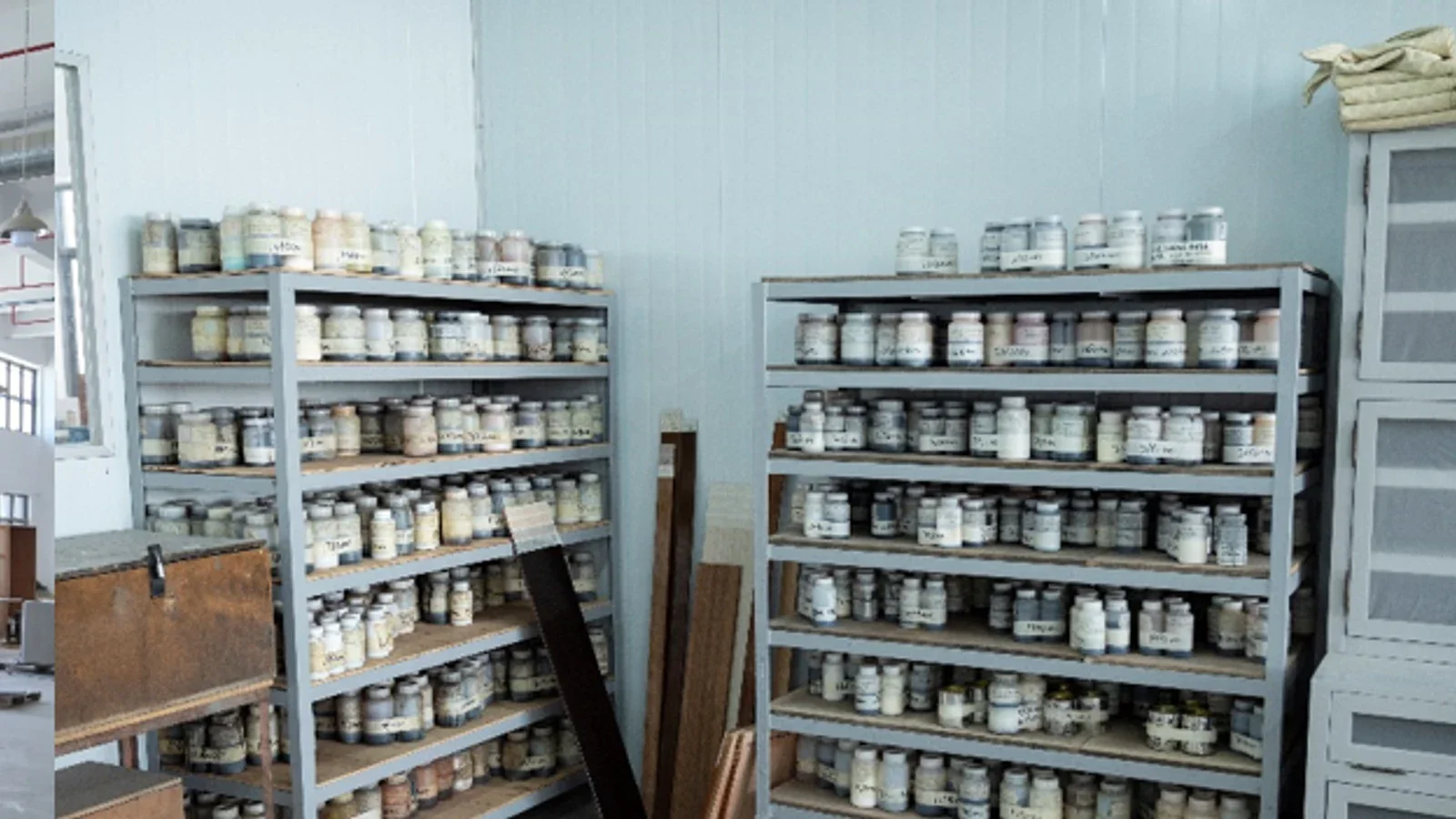
Place development costs where their driver is visible
Custom furniture may require drawings, finish samples, prototypes, mock-ups, special reviews or project-specific packaging decisions. Do not bury these costs inside an average room rate if their driver is a configuration, a unique item or the project as a whole.
Assign each development amount to one of three levels:
- Configuration level: work that applies to one repeated furniture set.
- Unique-item or zone level: work caused by a public-area piece or special condition.
- Programme level: work that supports the full furniture package and has an explicit allocation rule if management needs a per-room view.
This prevents the first room or first item from appearing artificially expensive while later repetitions look artificially cheap. It also lets the team see whether a design change affects one configuration or reopens a programme-level approval.
Worked example: build a baseline in planning units
The following example demonstrates the arithmetic using dimensionless planning units. It is not currency, a cost-per-room benchmark, a quotation, a forecast or a recommendation.
An illustrative 80-room project has 50 standard king rooms, 20 standard twin rooms and 10 suites. The controlled room configurations carry these furniture rates:
| Configuration | Quantity | Rate basis | Planning units |
|---|---|---|---|
| Standard king furniture set | 50 | 18 units per approved configuration | 900 |
| Standard twin furniture set | 20 | 20 units per approved configuration | 400 |
| Suite furniture set | 10 | 42 units per approved configuration | 420 |
| Guestroom configuration subtotal | 80 rooms | Sum of controlled configurations | 1,720 |
The public-area graph adds a lobby group at 160 units, a lounge group at 90 and a meeting-area group at 50. Programme-level drawing, sample and packaging inputs add 80 units. The gross known baseline is therefore:
1,720 + 160 + 90 + 50 + 80 = 2,100 planning units.
A verified retained-furniture decision removes 30 units from the purchase population, while approved spares add 20. The net known furniture baseline becomes:
2,100 − 30 + 20 = 2,090 planning units.
Suppose one suite finish decision and one destination-service boundary remain unresolved. Keep them in the variance queue; do not turn them into zero or silently apply a blanket percentage. If management asks for an average, 2,090 ÷ 80 = 26.125 planning units per key—but that reporting ratio is not a pricing method. It includes public areas and programme inputs, and it cannot be transferred to another hotel.
Test one driver at a time before creating scenarios
A useful sensitivity test changes a defined input while holding the other current inputs constant. Test drivers that map to the configuration model:
- a room moves from one controlled configuration to another;
- a retained quantity fails condition review and returns to new purchase;
- a public-area layout adds or removes an asset group;
- a finish or hardware decision moves a rate passport to a different basis;
- quantity consolidation changes the applicable rate evidence; or
- the commercial delivery point changes.
Record the old input, tested input, affected configuration IDs, mathematical effect and decision consequence. Do not label an unsupported plus-or-minus percentage as analysis. Where several drivers could move together, present clearly named scenarios and explain their assumptions rather than implying probability.
Keep unresolved furniture decisions in a variance queue
The variance queue sits between the known baseline and future change. Each entry needs:
- affected room families, zones, configuration or item IDs;
- current condition and why it prevents a responsible amount;
- quantity and rate passport currently used, if any;
- possible effect only where a documented basis exists, otherwise “range not established”;
- decision owner and required evidence;
- closure event and expected date; and
- the rule for transferring an approved result into the baseline.
Typical entries include an unreconciled suite count, an undecided retained-item condition, a feature chair without an approved design, or a quotation that excludes a requested service. The queue is not contingency and it is not permission to reserve the highest conceivable value. It is a visible statement of what the known baseline cannot yet claim.
Trace furniture changes through their originating coordinate
When the baseline moves, classify the change by the coordinate that changed:
| Change coordinate | Example | Evidence to retain |
|---|---|---|
| Population | Room count or public-area group changed | Previous and current area/room source |
| Configuration | Room set or item quantity per set changed | Old and new configuration card plus approval |
| Purchase treatment | Retained item becomes new purchase, or owner-supplied scope is confirmed | Condition, ownership and scope decision |
| Rate passport | Specification, quantity basis, date, currency or commercial boundary changed | Superseded and current rate evidence |
| Correction | Duplicate, mapping or formula error removed | Affected IDs and control correction |
Preserve the previous baseline and reconcile to the current one. This furniture-specific trail is deliberately narrower than a full FF&E management bridge: it explains configuration and purchase-population movement, while the wider owner budget governs tax, contingency, account transfers and project-wide reporting.
Release the baseline only when five signals are green
- Population signal: room families reproduce the current key count and public-area zones match the current included layout.
- Configuration signal: every room and zone maps to controlled furniture configurations or asset groups without unowned duplicates or gaps.
- Net-quantity signal: spares, retained, refurbished and owner-supplied quantities have documented authority and reconcile mathematically.
- Rate signal: every material amount has a compatible six-field passport; incompatible quotations remain qualified.
- Variance signal: every unresolved driver is visible with an owner, evidence request and transfer rule.
If population or configuration is red, return to the room and area schedules. If net quantity is red, isolate the disputed retained or supplied assets. If rate is red, request a comparable basis rather than choosing the lowest headline number. If variance is red, do not describe the baseline as complete.
Send manufacturers a controlled pricing packet
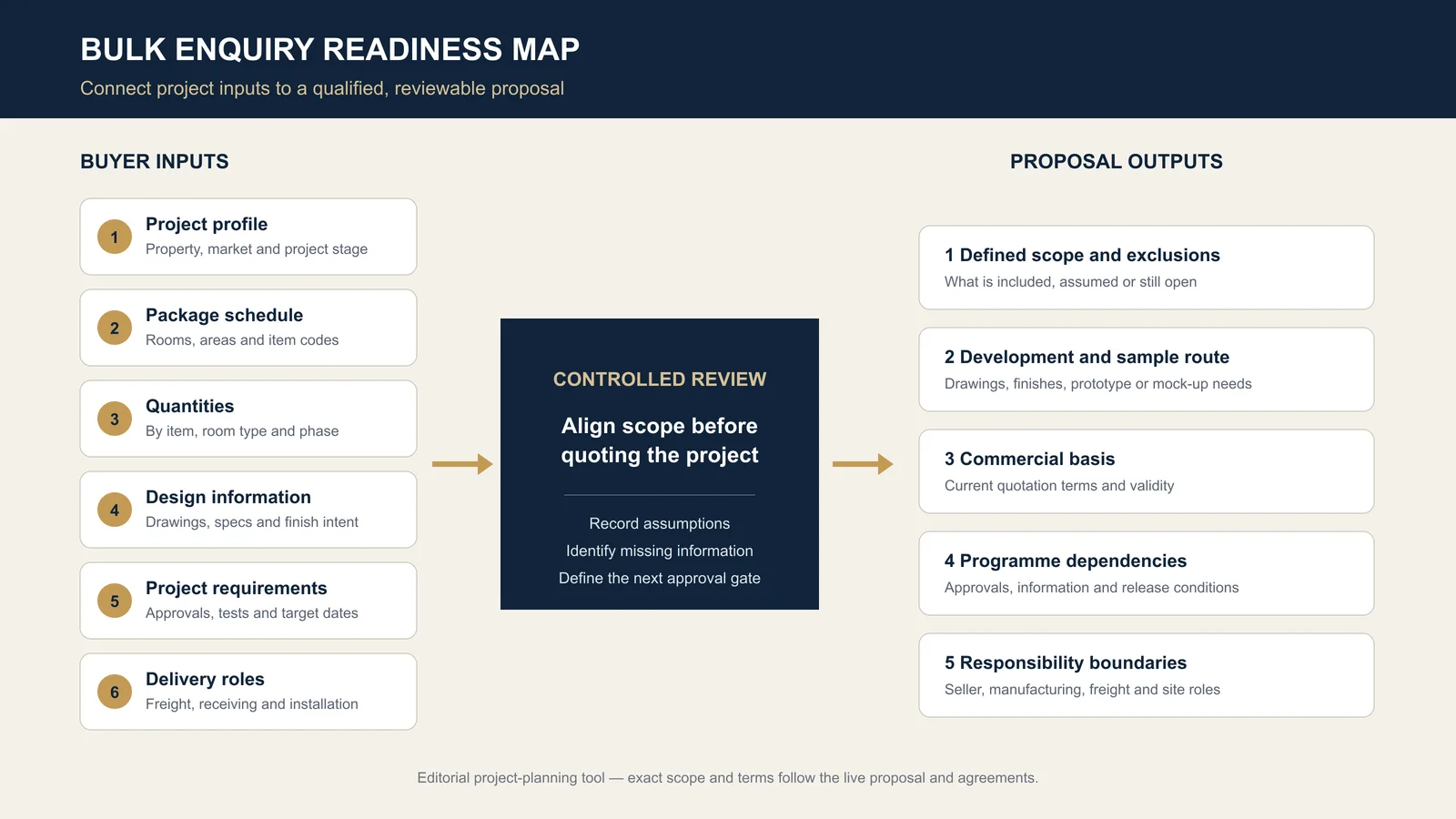
A manufacturer can provide better evidence when the pricing request follows the same configuration logic as the baseline. Send the relevant room/area schedule, furniture configurations, item quantities, drawings, materials and finishes, required project tests, sample or mock-up expectations, destination, approval route, programme and requested commercial boundary.
Gainwell’s current luxury hotel solution describes scope alignment across room types and public areas, followed by mock-up, production and sequenced-delivery controls. Its capabilities page describes technical development, value engineering, prototyping, manufacturing control, packaging and delivery support. Exact activities, locations, evidence and responsibilities must be confirmed for the live project.
Do not send confidential financing or the entire owner budget when only a furniture package review is needed. Share the controlled configuration population, specification status, destination, requested delivery point and unresolved furniture assumptions. Use the Gainwell project enquiry page to request a project-specific review; no live price, programme or scope is created by this article.