FF&E Specifications: What to Include Before RFQ and Production
An FF&E package can be detailed enough to price and still be unsafe to manufacture. For RFQ, manufacturers need a common basis that makes inclusions, exclusions and uncertainty comparable. For production, they need every critical attribute tied to an authorized value or bounded reference, a verification method and a current release.
That distinction is the purpose of an FF&E specification. It converts design intent for one furniture, fixture or equipment item into controlled requirements. A good specification does not remove every unknown at the first issue; it shows which decisions are fixed, which are intentionally bounded and which remain open—and it prevents an open decision from being mistaken for a production instruction.

What is an FF&E specification?
An FF&E specification is the controlled statement of what an item must be, what variation is allowed, how important attributes will be verified and which current references authorize the requirement. In a custom hospitality furniture project, the specification may point to drawings, material or finish references, hardware information, interface data, approved samples and project-specific evidence.
It is not interchangeable with every adjacent document:
| Record | Primary job | What it should not be asked to do alone |
|---|---|---|
| FF&E schedule | Identify items, locations, quantities, ownership and project state | Carry all product geometry, construction and verification detail |
| Specification | State required, permitted and unresolved item attributes | Replace every drawing, sample, contract or professional review |
| Drawing | Communicate geometry, sections, interfaces and selected construction details | Prove every material, finish, performance or approval condition |
| Sample or prototype | Provide evidence for the attributes explicitly reviewed | Approve attributes that were not inspected or recorded |
| Quotation | State the bidder’s commercial response to the issued basis | Silently complete missing design decisions |
| Release record | Authorize a named revision and its conditions for the next action | Make an obsolete or unresolved reference current |
One current FF&E design/purchasing system offers a useful illustration of this separation: its documentation assigns each distinct specification a unique ID, connects the specification to objects and rooms, and records dimensions, materials or finishes, approvals, submittals and revisions in different fields. That is one software model—not an industry standard—but it demonstrates why identity, use, requirement and status should not be collapsed into one paragraph. See the FF&EZ specification documentation.
Test readiness on three axes
Do not judge a specification by page count or the number of filled cells. Test each decision-critical attribute on three axes:
- Coverage: has the project addressed the attribute needed for pricing or production?
- Certainty: is the attribute fixed, intentionally bounded or still open?
- Traceability: can a reviewer find the controlling value, reference, revision, decision owner and verification route?
The weakest relevant axis controls the issue decision. A fully described finish with no identifiable control sample has a traceability gap. A drawing with precise geometry but an unresolved site interface has a certainty gap. A long specification that omits an important service access requirement has a coverage gap.
This three-axis test is an editorial planning model, not a certification or numerical quality score. Use the project’s own approval terminology and contractual requirements.
Ask eight questions about each item
The depth varies by product, but the following question map exposes most missing decisions without forcing every item into the same template:
| Question line | What the specification must clarify |
|---|---|
| Identity and application | Which item or family is this, where is it used and which variants are genuinely equivalent? |
| Form and fit | Which dimensions, orientation, clearances, geometry and coordinated interfaces matter at this issue? |
| Visible intent | Which profile, proportion, pattern direction, color, sheen, texture and transition must be preserved? |
| Material or system | Which exposed and concealed selections must be named, and where may a proposed alternative be evaluated? |
| Use and function | What operation, access, maintenance, cleaning or guest-use condition must the item support? |
| External interfaces | Which building, service, adjacent-finish, installer or other supplier information controls fit and responsibility? |
| Verification | What drawing, declaration, sample, prototype, inspection or project-required evidence will answer each material claim? |
| Commercial and release boundary | What is included, excluded or assumed, and who may approve a deviation or release the next stage? |
Not all lines belong in one cell or document. The specification can point to controlled sources. What matters is that the reader can follow the reference without guessing which file or revision governs.
Write requirements that can be answered
For every important attribute, write a requirement that contains enough structure to receive a clear response:
Item or component + observable attribute + required value or bounded reference + verification route + exception route.
For example, “premium walnut finish” is not answerable because “premium” has no shared decision rule. A project-ready direction might instead identify the visible components concerned, the authorized finish reference, which attributes the reference controls, how comparison will occur and where a proposed deviation must be recorded. The project team—not a generic template—must supply the actual reference and acceptance conditions.
Use five writing checks:
- Can the manufacturer respond with comply, proposed alternative or open query?
- Can the reviewer observe or verify the stated attribute?
- Does the sentence point to one current source rather than “latest drawings”?
- Are project-specific standards, editions, tests or certificates named only by the responsible party?
- Does the wording distinguish a requirement from a preferred direction?
Mark every important attribute fixed, bounded or open
Uncertainty is manageable when it is visible. Give each decision-critical attribute one of three states:
- Fixed: one authorized requirement or reference controls. A change needs the defined approval route.
- Bounded: the project permits a named range, option set or alternate process. The quotation must expose which option it uses.
- Open: no authorized answer exists yet. Record the owner, decision needed, impact, common pricing assumption if appropriate and closure point.
An open field is not automatically a failure at RFQ. It becomes a failure when bidders would have to invent materially different bases and the project has not supplied a common assumption or comparison method. A production-critical open field is a hold: manufacture should not start on the affected scope until the project-authorized route closes it.
Use different thresholds for RFQ and production
| Decision line | RFQ-ready condition | Production-ready condition |
|---|---|---|
| Item and population | Item/family, application and comparable quantity basis are stated | Released item codes, variants and authorized quantities point to current records |
| Geometry and interface | Pricing envelope, design references and unresolved interfaces are visible | Production geometry and critical interfaces point to authorized drawings and field information |
| Materials and finish | Required direction, inclusion basis, alternate rules and sample-development scope are stated | Authorized material and finish references cover the required attributes and current production scope |
| Function and project requirements | Use conditions and responsible-party requirements are identified sufficiently for a comparable response | Applicable requirements, evidence route and accepted exceptions are closed for the released scope |
| Evidence | Required submittals, samples, prototypes or declarations and their commercial treatment are stated | Required evidence has the recorded status needed by the project’s release procedure |
| Commercial boundary | Inclusions, exclusions, assumptions and alternates can be normalized | The awarded and approved scope matches the released technical baseline |
| Revision and authority | Issued RFQ set and query route are identifiable | Authorized release, revision set, conditions and deviation register are identifiable |
“RFQ-ready” does not mean “final,” and “approved sample” does not necessarily mean “production-ready.” Apply the project’s contracts and release procedure; these thresholds are a planning aid.

Issue a quote-basis card with the RFQ
A short quote-basis card makes uncertainty comparable without copying the full specification. For each bid item or package, record:
- issued item, drawing and specification references;
- quantity and destination basis used for pricing;
- fixed requirements and permitted alternates;
- open decisions with the common assumption or allowance to be used;
- included components, samples, prototypes, tests, packaging and other defined services;
- excluded work and interfaces requiring another party;
- required deviations, clarifications and evidence in the bidder response.
This card does not replace bid normalization. It gives that process a controlled technical basis and makes a “no exception” response meaningful.
Worked example: pressure-test a hotel bedside unit
Assume the project is developing a custom bedside unit coded NT-204. The following example contains placeholders rather than product instructions. Replace every bracketed reference, value and authority with the project’s approved information.
| Decision line | Possible RFQ issue | What must mature for production |
|---|---|---|
| Identity and use | NT-204; applicable room family; left/right variant basis; pricing population from [issued schedule] | Released variants and quantities reconciled to the authorized room/item records |
| Envelope and room fit | Concept geometry and bounding envelope from [drawing/revision]; site interface listed as an open query | Authorized shop drawing identifies critical dimensions, orientation and coordinated interface information |
| Visible finish | Design direction, exposed component list and allowance for finish-sample development | Control reference [sample ID/status] names the attributes reviewed and any permitted variation |
| Hardware or access | Required function, included component basis and alternate-response rule | Authorized hardware or construction reference, location, operation and required verification are linked |
| Service interface | Scope boundary identifies the responsible designer/consultant and a common assumption for pricing | Approved coordinated interface, supply boundary and required specialist review are recorded before affected work |
| Packing and identification | Pricing basis states assembled/knock-down assumption, destination logic and included protection | Released pack method, component relationship, label data and destination code point to the current item |
Now apply the three-axis test. If the finish has a reference but no defined coverage—color only, for example—the attribute lacks coverage for sheen, texture or other project-required visible decisions. If the service interface has a concept location but no responsible authority, it lacks certainty. If the geometry says “per approved drawing” but the drawing number and revision cannot be found, it lacks traceability.
The issue decision follows the weakest relevant line. The item may remain suitable for a qualified RFQ if all bidders use the same stated service-interface assumption. It is not ready for production on that interface until the authorized information closes.
Treat every sample as a scoped answer
A sample answers only the questions the review record assigns to it. A finish panel may answer selected questions about visible color, sheen, texture or transitions. It does not automatically approve dimensions, hidden construction, hardware, service interfaces, packaging, performance or every later production unit.
For each sample or prototype used as specification evidence, identify:
- sample or prototype ID and the item/component it covers;
- drawing and specification revision reviewed with it;
- attributes included and explicitly not included in the review;
- result, comments, permitted range and required correction;
- reviewer or approval authority and current status;
- retention, reproduction and replacement method for the controlling reference.
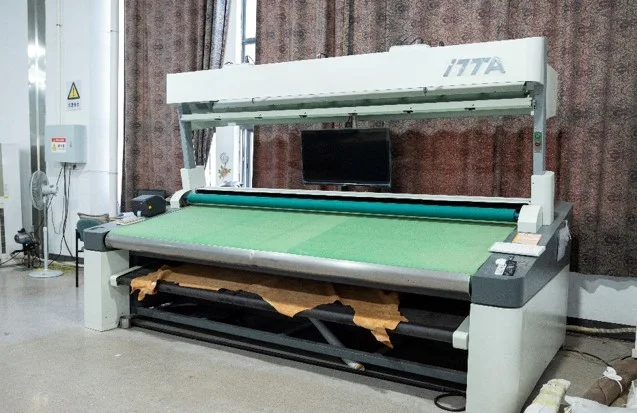
The image above shows fabric on inspection equipment. It does not prove a test result, material identity or project approval. Its useful lesson is procedural: a fabric requirement needs an observable check, a controlling reference, a stage and an exception record.
Resolve conflicts through a query, not a silent hierarchy
Schedules, specifications, drawings, samples, quotations and comments can disagree. Do not invent a universal precedence rule; the contract and responsible project team must establish the applicable authority.
When a conflict appears, create one query that records the affected item and attribute, conflicting references and revisions, pricing or production impact, temporary hold or common assumption, decision authority, answer and all records that need reissue. A manufacturer should not choose the most convenient source and call the conflict resolved.
Run a six-line production release checksum
Before releasing an item or affected component, verify six connected lines:
- Population: item code, variants, destinations and released quantity basis.
- Requirement set: current specification, drawings and applicable project instructions.
- Physical references: samples or prototypes and the attributes each one controls.
- Evidence state: required submittals, reviews, inspections or specialist confirmations at the status required for release.
- Exceptions: approved deviations, conditional comments, open items outside the release and their boundaries.
- Authority: named release, date, revision and party permitted to authorize the next stage.
If one line points to an obsolete or unidentified record, the checksum fails for the affected scope. Hold that scope or issue a deliberately limited release; do not describe the entire item as production-ready.
Reopen only the attributes affected by a change
A later change does not always invalidate the whole item. Compare the proposed change with the six-line checksum, identify affected attributes and reopen only the connected drawings, references, evidence, commercial basis, quantities or interfaces. Preserve the earlier decision record so the team can see what changed and which work may already have relied on it.
For example, a new finish selection may reopen the visible-finish requirement, control sample, quotation impact and inspection reference while leaving an already coordinated overall envelope unchanged. If the finish process changes dimensions, substrate preparation, interface or performance requirements, the affected boundary is wider. The responsible project parties decide that scope.
What should you send Gainwell for a specification review?
Gainwell’s current hospitality product directory covers loose, upholstered and fixed furniture categories, while its capability workflow describes technical development, shop drawings, prototypes, material coordination, manufacturing controls, packaging and project coding. Its casegoods and storage page includes the type of bedside units, wardrobes, minibars and cabinetry that may require item-specific definition. These are first-party capability statements, not a promise of the live project’s scope, evidence, programme or compliance.
For a useful review, send the item register, current concept and technical drawings, room/area and quantity basis, material and finish directions, sample status, use conditions, interface information, project-specific requirements, RFQ or production target, open-decision list, approval route and required response format. Share the controlled FF&E specification package with Gainwell so the team can confirm applicable development inputs, assumptions, services and responsibility boundaries.